Department of Nursing, Chang Gung University of Science and Technology, Taoyuan, Taiwan; Department of Nephrology, Chang Gung Memorial Hospital at Linkou, Taoyuan, Taiwan.
Department of Nursing, Central Taiwan University of Science and Technology, Taichung, Taiwan.
Biomed J. 2022 Jun;45(3):533-541. doi: 10.1016/j.bj.2021.05.005. Epub 2021 May 21.
Restless legs syndrome (RLS), a neurological disorder, often affects sleep quality in hemodialysis patients. This study aimed to evaluate acupressure's effect on the severity of RLS symptoms and sleep quality in hemodialysis patients with RLS.
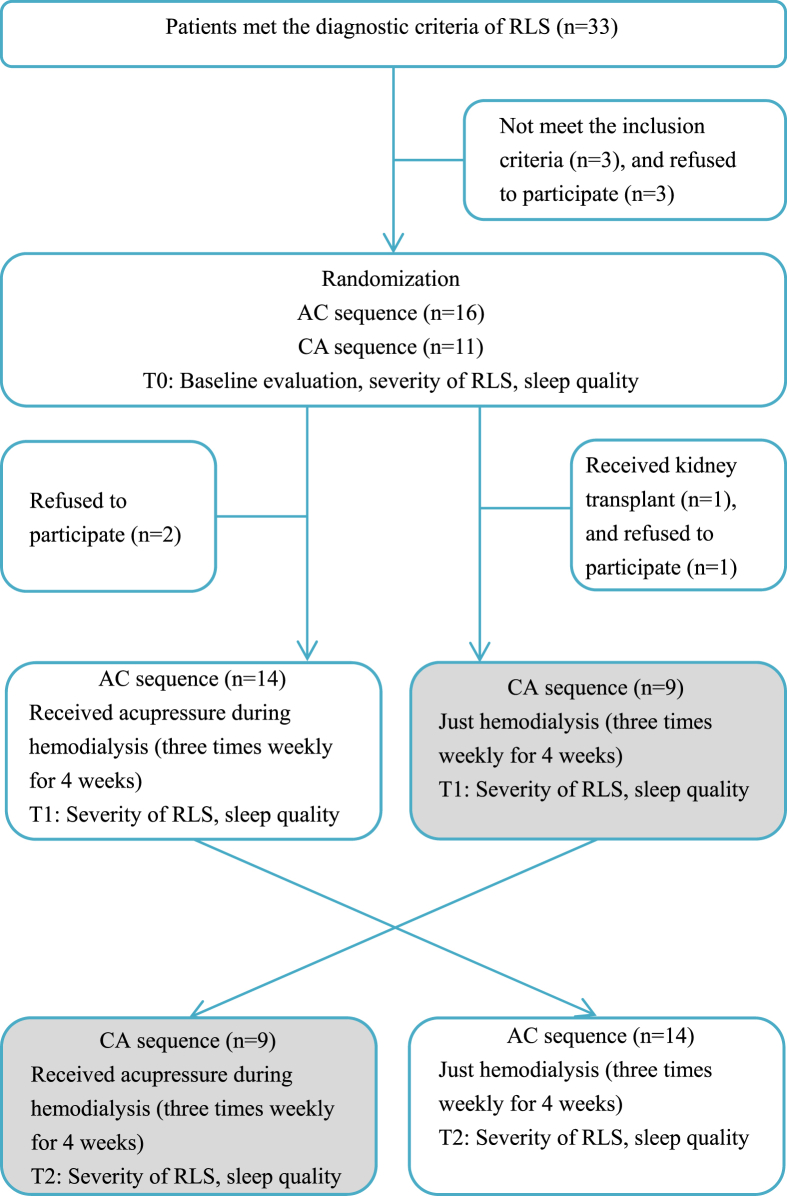
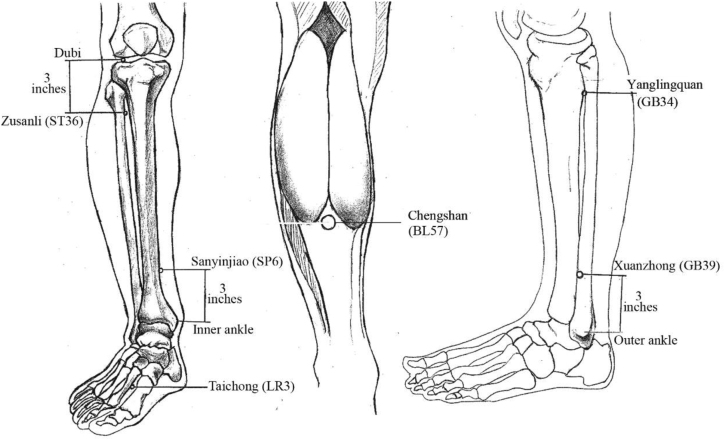
This study is a cluster-randomized crossover pilot study. Patients were randomized to two sequences: acupressure for one month and observation for another month (AC); and observation for one month and acupressure for another month (CA). For the four-week acupressure intervention, patients received 36 min of acupressure three times weekly during their hemodialysis sessions. The acupoints were on the bilateral lower limbs, including Zusanli (ST36), Yanglingquan (GB34), Sanyinjiao (SP6), Xuanzhong (GB39), Chengshan (BL57), and Taichong (LR3). RLS severity and sleep quality (measured with the Pittsburgh sleep quality index, PSQI) were measured at baseline, month 1, and month 2.
AC sequence (n = 14) was similar to the CA sequence (n = 9) in terms of gender, age, education, employment, marital status, comorbid disease, BMI, duration of dialysis, medication for RLS and insomnia, RLS severity, and PSQI. The general linear mixed model revealed no significant carryover effect on RLS severity, PSQI, and the seven subscales of PSQI. A significant treatment effect (acupressure) was only observed in RLS severity (p = 0.0013) but not in PSQI and the seven subscales. The significant period effect was observed in RLS severity (p = 0.0250) and the subscale of sleep disturbance (p = 0.0021).
In hemodialysis patients with RLS, acupressure can alleviate the severity of RLS but cannot improve sleep quality.
不宁腿综合征(RLS)是一种神经系统疾病,常影响血液透析患者的睡眠质量。本研究旨在评估穴位按压对 RLS 血液透析患者 RLS 症状严重程度和睡眠质量的影响。
本研究为集群随机交叉试验研究。患者随机分为两组:穴位按压组(AC)为期一个月,观察组(CA)为期一个月;然后两组交换干预措施,AC 组改为观察组,CA 组改为穴位按压组,各为期一个月。在为期四周的穴位按压干预期间,患者在每次血液透析治疗期间接受 36 分钟的穴位按压,每周三次。穴位位于双下肢,包括足三里(ST36)、阳陵泉(GB34)、三阴交(SP6)、悬钟(GB39)、承山(BL57)和太冲(LR3)。在基线、第 1 个月和第 2 个月时测量 RLS 严重程度和睡眠质量(用匹兹堡睡眠质量指数 PSQI 测量)。
AC 组(n=14)和 CA 组(n=9)在性别、年龄、教育、就业、婚姻状况、合并症、BMI、透析时间、RLS 和失眠药物、RLS 严重程度和 PSQI 方面相似。一般线性混合模型显示 RLS 严重程度、PSQI 和 PSQI 的七个子量表均无明显的交叉效应。仅在 RLS 严重程度(p=0.0013)而非 PSQI 和七个子量表上观察到治疗效果(穴位按压)的显著差异。RLS 严重程度(p=0.0250)和睡眠障碍子量表(p=0.0021)观察到显著的时间效应。
在 RLS 血液透析患者中,穴位按压可以减轻 RLS 的严重程度,但不能改善睡眠质量。