Department of Pulmonary and Critical Care Medicine, The Affiliated People's Hospital of Shanxi Medical University, Shanxi Provincial People's Hospital, Taiyuan, 030012, People's Republic of China.
Department of Nephrology, The Affiliated People's Hospital of Shanxi Medical University, Shanxi Provincial People's Hospital, Taiyuan, 030012, People's Republic of China.
Sci Rep. 2022 Jul 14;12(1):11996. doi: 10.1038/s41598-022-16372-3.
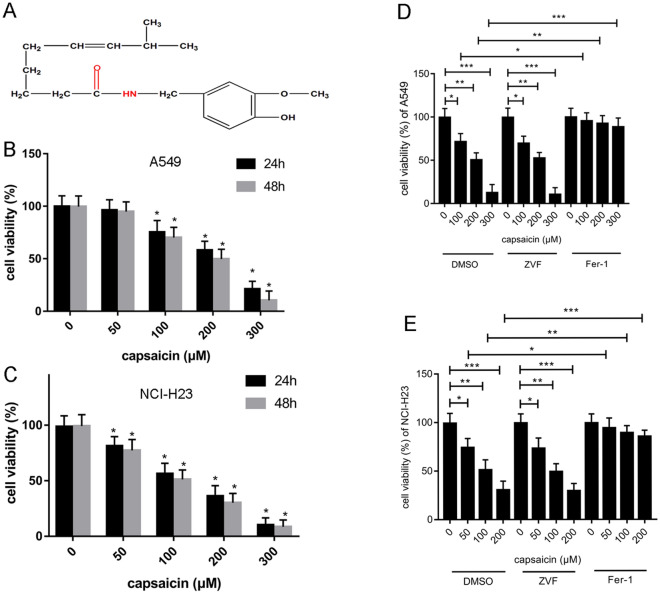
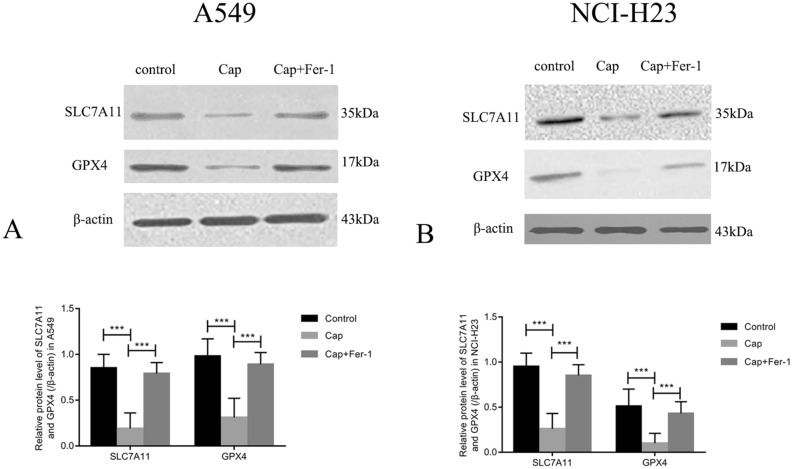
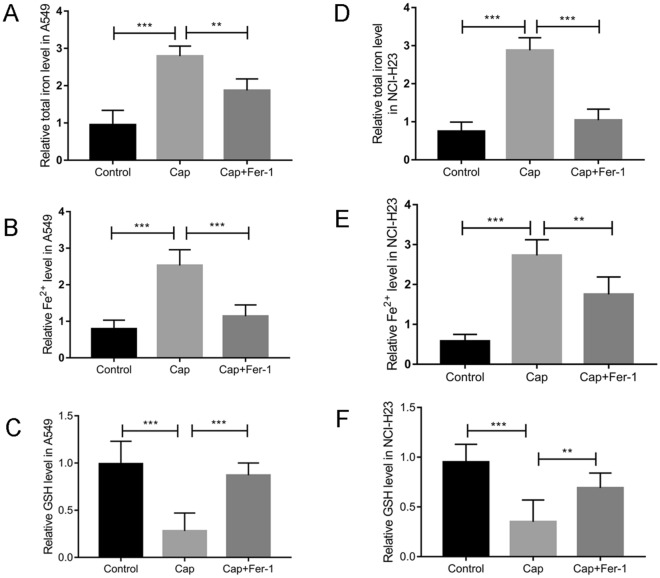
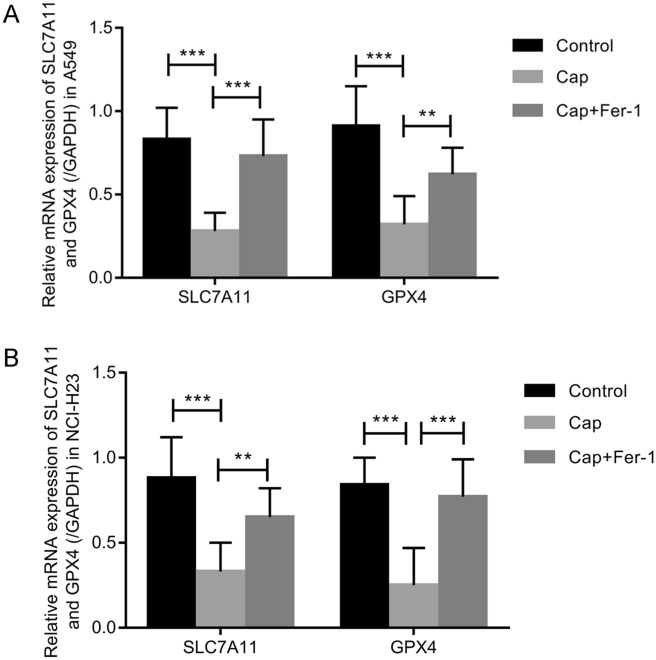
NSCLC is the first cause of cancer-related deaths in China and threatens life expectancy of the people. Novel drugs and treatment strategies are urgently required. Capsaicin is noticed as a potential new drug for lots of tumors due to its anti-proliferative effect on cancer cells. Our study evaluated the roles of capsaicin in NSCLC cells (A549 and NCI-H23) and further explored its underlying mechanisms. Effect of capsaicin treatment on cell viability was determined by MTT assay and IC50 values for A549 and NCI-H23 cells were ascertained. The iron kit detected the total iron levels and the ferric divalent ions levels in A549 and NCI-H23 cells. GSH kit was used to detect the expression of GSH in A549 and NCI-H23 cells. Additionally, mRNA and protein levels of SLC7A11 and GPX4 were analyzed by real-time PCR and western blot analysis. Through MTT assay, we found that 200 μM capsaicin in cultured A549 cells for 48 h could reach the IC50 value, and the condition was 100 μM and 48 h for NCI-H23 cells. Capsaicin increased total iron levels and ferrous ion levels in A549 and NCI-H23 cells in contrast with the control group, whereas the levels of GSH was reduced in contrast with the control group. Besides, mRNA and protein levels of SLC7A11 and GPX4 were decreased significantly in A549 and NCI-H23 cells treated with capsaicin in contrast with the control group. Our study indicated that capsaicin inhibited the proliferation of A549 and NCI-H23 cells and induced ferroptosis by inactivating SLC7A11/GPX4 signaling. Capsaicin could be used as a potential anticancer agent in the treatment of NSCLC.
非小细胞肺癌(NSCLC)是中国癌症相关死亡的首要原因,威胁着人民的预期寿命。因此,急需新型药物和治疗策略。由于其对癌细胞的抗增殖作用,辣椒素已被注意为许多肿瘤的潜在新药。我们的研究评估了辣椒素在非小细胞肺癌细胞(A549 和 NCI-H23)中的作用,并进一步探讨了其潜在机制。MTT 测定法测定了辣椒素处理对细胞活力的影响,并确定了 A549 和 NCI-H23 细胞的 IC50 值。铁试剂盒检测 A549 和 NCI-H23 细胞中的总铁水平和二价铁离子水平。GSH 试剂盒用于检测 A549 和 NCI-H23 细胞中 GSH 的表达。此外,通过实时 PCR 和 Western blot 分析分析 SLC7A11 和 GPX4 的 mRNA 和蛋白水平。通过 MTT 测定法,我们发现 200μM 辣椒素在培养的 A549 细胞中作用 48 小时可达到 IC50 值,而 NCI-H23 细胞的条件是 100μM 和 48 小时。与对照组相比,辣椒素增加了 A549 和 NCI-H23 细胞中的总铁水平和亚铁离子水平,而与对照组相比,GSH 水平降低。此外,与对照组相比,辣椒素处理的 A549 和 NCI-H23 细胞中 SLC7A11 和 GPX4 的 mRNA 和蛋白水平显著降低。我们的研究表明,辣椒素通过抑制 SLC7A11/GPX4 信号通路抑制 A549 和 NCI-H23 细胞的增殖并诱导铁死亡。辣椒素可用作治疗非小细胞肺癌的潜在抗癌药物。