Li Jiachen, Pan Jianmin, Liu Yang, Luo Xiaohui, Yang Cheng, Xiao Wangfa, Li Qishang, Yang Lihui, Zhang Xiaodong
Department of Gastrointestinal and Gland Surgery, The First Affiliated Hospital of Guangxi Medical University, Nanning, Guangxi Zhuang Autonomous Region 530021, P.R. China.
Department of Nursing, Guangxi Medical University, Nanning, Guangxi Zhuang Autonomous Region 530021, P.R. China.
Exp Ther Med. 2022 Jun 16;24(2):520. doi: 10.3892/etm.2022.11447. eCollection 2022 Aug.
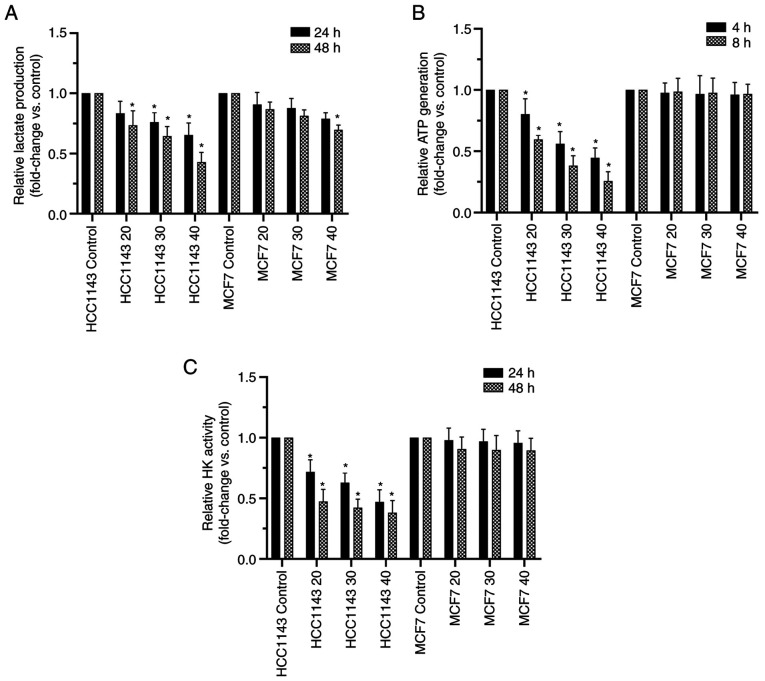
Aerobic glycolysis is commonly observed in tumor cells, including triple-negative breast cancer (TNBC) cells, and the rate of aerobic glycolysis is higher in TNBC cells than in non-TNBC cells. Hexokinase 2 (HK2) is a key enzyme in the glycolytic pathway and a target of the transcription factor c-Myc, which is highly expressed in TNBC and promotes aerobic glycolysis by enhancing HK2 expression. As an inhibitor of HK2, 3-bromopyruvic acid (3-BrPA) exhibits good therapeutic efficacy in intrahepatic and extrahepatic tumors and inhibits the proliferation of human tumor cells with high expression levels of c-Myc and . In addition, 3-BrPA combines with photodynamic therapy to inhibit TNBC cell migration. Thioredoxin-interacting protein (TXNIP) competes with c-Myc to reduce glucose consumption in tumor cells to restrain cell proliferation. A comparative analysis was performed in the present study in TNBC (HCC1143) and non-TNBC (MCF-7) cell lines to explore the effect of 3-BrPA on energy metabolism in TNBC cells and to investigate the possible mechanism of action. Cell viability and apoptosis were detected through Cell Counting Kit-8 and flow cytometry assays, respectively. Expression levels of HK2, glucose transporter 1, TXNIP, c-Myc and mitochondria-regulated apoptosis pathway proteins were measured through western blotting. 3-BrPA inhibited cell proliferation, downregulated c-Myc and HK2 expression, and upregulated TXNIP expression in TNBC cells, but it doesn't have the same effect on non-TNBC cells. Furthermore, 3-BrPA induced the typical manifestations of mitochondrial-mediated apoptosis such as decreasing Bcl-2 expression and increasing Bax, Cyt-C and Caspase-3 expression. The present results suggested that 3-BrPA promoted TXNIP protein expression and reduced HK2 expression in TNBC cells by downregulating c-Myc expression, inhibiting glycolysis including suppressing lactate generation, intracellular ATP generation and HK activity, inducing mitochondrial-mediated apoptosis and eventually suppressing TNBC cell proliferation. These findings may reveal a novel therapeutic target for the clinical treatment of TNBC.
有氧糖酵解在肿瘤细胞中普遍存在,包括三阴性乳腺癌(TNBC)细胞,且TNBC细胞中的有氧糖酵解速率高于非TNBC细胞。己糖激酶2(HK2)是糖酵解途径中的关键酶,也是转录因子c-Myc的靶点,c-Myc在TNBC中高表达,并通过增强HK2表达促进有氧糖酵解。作为HK2的抑制剂,3-溴丙酮酸(3-BrPA)在肝内和肝外肿瘤中显示出良好的治疗效果,并抑制c-Myc高表达的人类肿瘤细胞的增殖。此外,3-BrPA与光动力疗法联合使用可抑制TNBC细胞迁移。硫氧还蛋白相互作用蛋白(TXNIP)与c-Myc竞争,以减少肿瘤细胞中的葡萄糖消耗,从而抑制细胞增殖。本研究在TNBC(HCC1143)和非TNBC(MCF-7)细胞系中进行了比较分析,以探讨3-BrPA对TNBC细胞能量代谢的影响,并研究其可能的作用机制。分别通过细胞计数试剂盒-8和流式细胞术检测细胞活力和凋亡情况。通过蛋白质免疫印迹法检测HK2、葡萄糖转运蛋白1、TXNIP、c-Myc和线粒体调节的凋亡途径蛋白的表达水平。3-BrPA抑制TNBC细胞的增殖,下调c-Myc和HK2的表达,并上调TXNIP的表达,但对非TNBC细胞没有相同的作用。此外,3-BrPA诱导线粒体介导的凋亡的典型表现,如降低Bcl-2表达并增加Bax、细胞色素C和半胱天冬酶-3的表达。目前的结果表明,3-BrPA通过下调c-Myc表达促进TNBC细胞中TXNIP蛋白表达并降低HK2表达,抑制糖酵解,包括抑制乳酸生成、细胞内ATP生成和HK活性,诱导线粒体介导的凋亡并最终抑制TNBC细胞增殖。这些发现可能为TNBC的临床治疗揭示一个新的治疗靶点。