Tavakoli Niki, Fong Emma J, Coleman Abigail, Huang Yu-Kai, Bigger Mathias, Doche Michael E, Kim Seungil, Lenz Heinz-Josef, Graham Nicholas A, Macklin Paul, Finley Stacey D, Mumenthaler Shannon M
bioRxiv. 2024 Dec 5:2024.05.24.595756. doi: 10.1101/2024.05.24.595756.
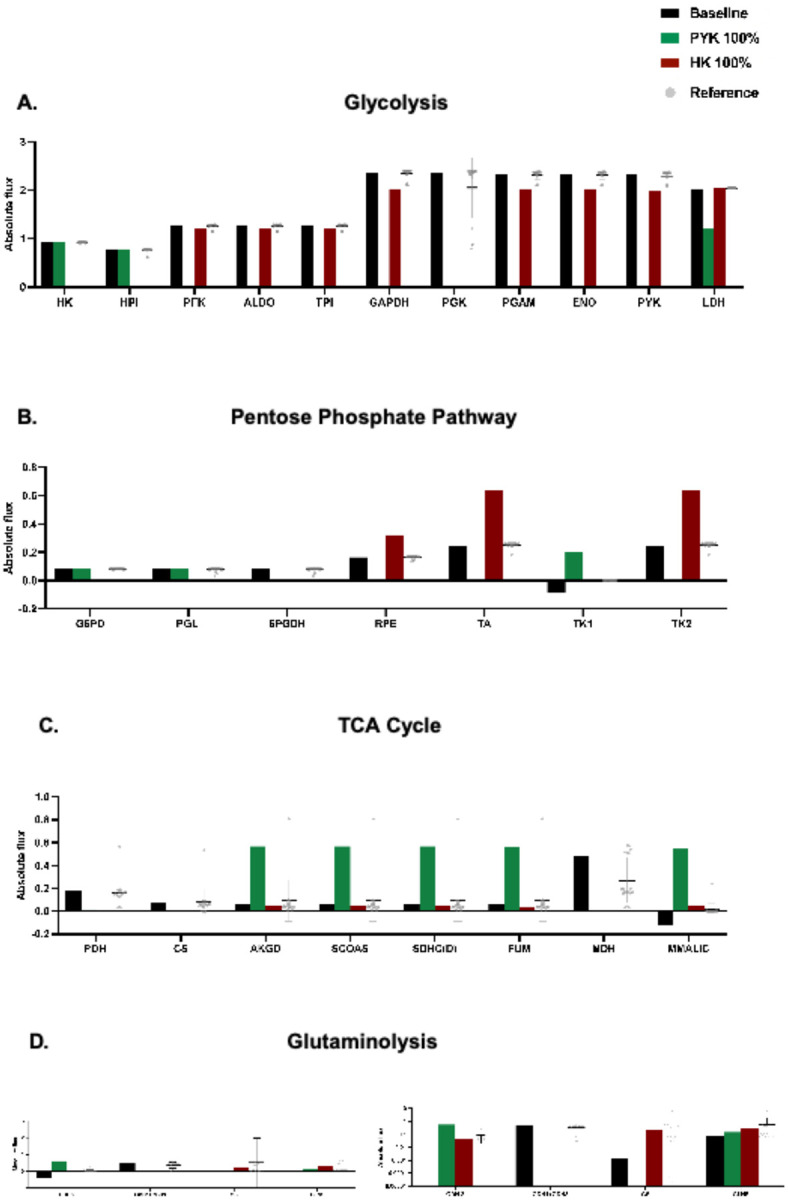
Cancer-associated fibroblasts (CAFs) play a key role in metabolic reprogramming and are well-established contributors to drug resistance in colorectal cancer (CRC). To exploit this metabolic crosstalk, we integrated a systems biology approach that identified key metabolic targets in a data-driven method and validated them experimentally. This process involved a novel machine learning-based method to computationally screen, in a high-throughput manner, the effects of enzyme perturbations predicted by a computational model of CRC metabolism. This approach reveals the network-wide effects of metabolic perturbations. Our results highlighted hexokinase (HK) as a crucial target, which subsequently became our focus for experimental validation using patient-derived tumor organoids (PDTOs). Through metabolic imaging and viability assays, we found that PDTOs cultured in CAF-conditioned media exhibited increased sensitivity to HK inhibition, confirming the model predictions. Our approach emphasizes the critical role of integrating computational and experimental techniques in exploring and exploiting CRC-CAF crosstalk.
癌症相关成纤维细胞(CAFs)在代谢重编程中起关键作用,并且是结直肠癌(CRC)耐药性的公认促成因素。为了利用这种代谢串扰,我们整合了一种系统生物学方法,该方法以数据驱动的方式识别关键代谢靶点并通过实验进行验证。这个过程涉及一种基于机器学习的新方法,以高通量方式计算筛选由CRC代谢计算模型预测的酶扰动的影响。这种方法揭示了代谢扰动在全网络范围内的影响。我们的结果突出了己糖激酶(HK)作为一个关键靶点,随后它成为我们使用患者来源的肿瘤类器官(PDTOs)进行实验验证的重点。通过代谢成像和活力测定,我们发现培养在CAF条件培养基中的PDTOs对HK抑制表现出更高的敏感性,证实了模型预测。我们的方法强调了整合计算和实验技术在探索和利用CRC-CAF串扰中的关键作用。