Department of Pediatrics, The First Affiliated Hospital of Zhengzhou University, Zhengzhou, China.
Front Cell Infect Microbiol. 2022 Jun 28;12:899028. doi: 10.3389/fcimb.2022.899028. eCollection 2022.
Pulmonary infection is a leading cause of mortality in pediatric patients with hematologic malignancy (HM). In clinical settings, pulmonary pathogens are frequently undetectable, and empiric therapies may be costly, ineffective and lead to poor outcomes in this vulnerable population. Metagenomic next-generation sequencing (mNGS) enhances pathogen detection, but data on its application in pediatric patients with HM and pulmonary infections are scarce.
We retrospectively reviewed 55 pediatric patients with HM and pulmonary infection who were performed mNGS on bronchoalveolar lavage fluid from January 2020 to October 2021. The performances of mNGS methods and conventional microbiological methods in pathogenic diagnosis and subsequently antibiotic adjustment were investigated.
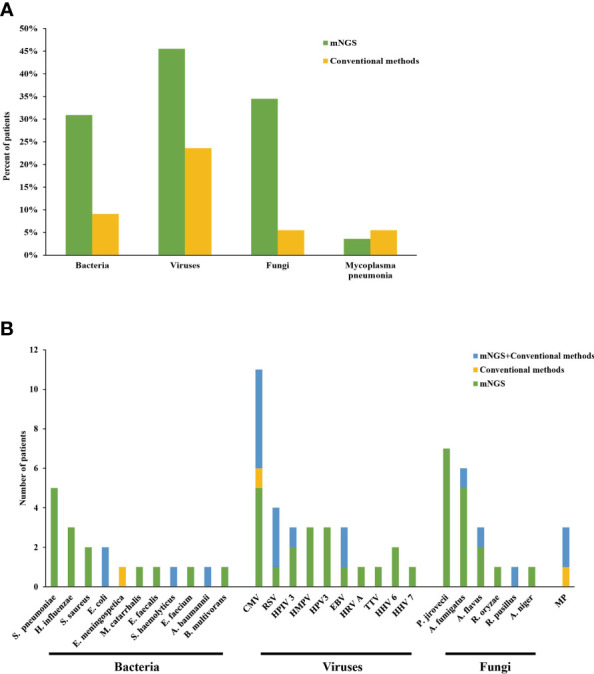
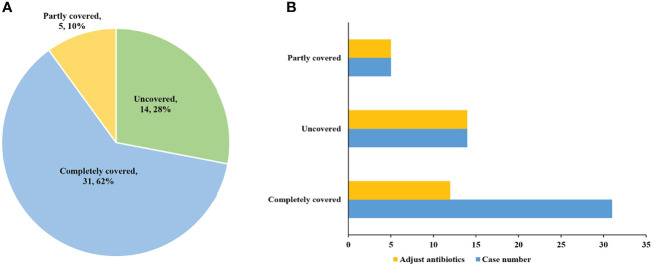
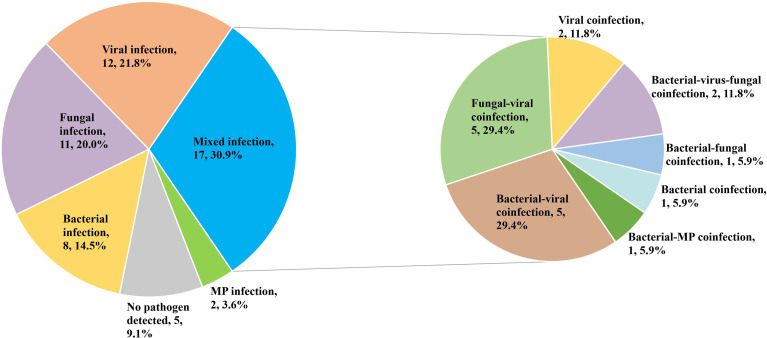
A definite or probable microbial etiology of pulmonary infection was established for 50 of the 55 patients (90.9%) when mNGS was combined with conventional microbiological tests. The positive rate was 87.3% (48 of 55 patients) for mNGS versus 34.5% (19 of 55 patients) with conventional microbiological methods ( < 0.001). Bacteria, viruses and fungi were detected in 17/55 (30.9%), 25/55 (45.5%) and 19/55 (34.5%) cases using mNGS, respectively. Furthermore, 17 patients (30.9%) were identified as pulmonary mixed infections. Among the 50 pathogen-positive cases, 38% (19/50) were not completely pathogen-covered by empirical antibiotics and all of them were accordingly made an antibiotic adjustment. In the present study, the 30-day mortality rate was 7.3%.
mNGS is a valuable diagnostic tool to determine the etiology and appropriate treatment in pediatric patients with HM and pulmonary infection. In these vulnerable children with HM, pulmonary infections are life-threatening, so we recommend that mNGS should be considered as a front-line diagnostic test.
肺部感染是血液恶性肿瘤(HM)儿科患者死亡的主要原因。在临床环境中,肺部病原体经常无法检测到,经验性治疗可能既昂贵又无效,并导致这一脆弱人群的不良结局。宏基因组下一代测序(mNGS)增强了病原体的检测,但关于其在 HM 合并肺部感染的儿科患者中的应用的数据很少。
我们回顾性分析了 2020 年 1 月至 2021 年 10 月间 55 例 HM 合并肺部感染的儿科患者支气管肺泡灌洗液的 mNGS 检测结果。研究了 mNGS 方法与传统微生物学方法在病原诊断和随后抗生素调整中的性能。
当 mNGS 与传统微生物学检测相结合时,55 例患者中有 50 例(90.9%)确定或可能存在肺部感染的微生物病因。mNGS 的阳性率为 87.3%(55 例患者中有 48 例),而传统微生物学方法的阳性率为 34.5%(55 例患者中有 19 例)(<0.001)。mNGS 分别检测到 17/55(30.9%)例细菌、25/55(45.5%)例病毒和 19/55(34.5%)例真菌。此外,17 例(30.9%)患者为肺部混合感染。在 50 例病原体阳性病例中,38%(19/50)的患者经验性抗生素治疗不完全覆盖病原体,所有患者均进行了抗生素调整。本研究中 30 天死亡率为 7.3%。
mNGS 是确定 HM 合并肺部感染病因和适当治疗的有价值的诊断工具。在这些 HM 脆弱儿童中,肺部感染是危及生命的,因此我们建议 mNGS 应作为一线诊断测试。