J Clin Invest. 2022 Jul 15;132(14). doi: 10.1172/JCI161572.
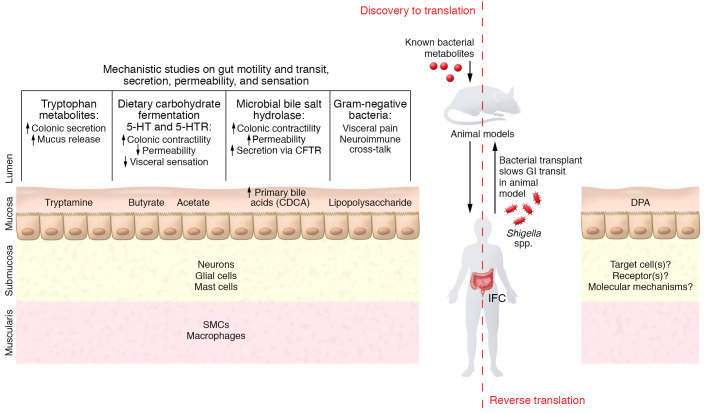
Gastrointestinal (GI) motility requires coordination among several cell types in the intestinal epithelium and the neuromuscular apparatus. A disruption in GI motility was primarily attributed to disruption of this coordinated effort among different host cells, but recent studies have begun to uncover how the products of gut microbiota can alter GI motility by modulating the function of different host cells and the interactions among them. In this issue of the JCI, Chen, Qiu, et al. used a reverse translation approach, isolating a Shigella sp. - peristaltic contraction-inhibiting bacterium (PIB) - from a cohort of patients with intractable constipation. They identified an ω-3 polyunsaturated fatty acid (PUFA), docosapentaenoic acid (DPA), produced by this Shigella variant, as an important driver of constipation using a series of microbiologic, biochemical, and genetic manipulations combined with in vitro and in vivo studies. This finding advances the field, given that production of DPA is rare in the human gut and appears to have a distinct effect on GI physiology.
胃肠道(GI)运动需要肠道上皮和神经肌肉装置中的几种细胞类型之间的协调。GI 运动的紊乱主要归因于不同宿主细胞之间这种协调努力的中断,但最近的研究开始揭示肠道微生物组的产物如何通过调节不同宿主细胞的功能及其相互作用来改变 GI 运动。在本期 JCI 中,Chen、Qiu 等人使用反向翻译方法,从一组难治性便秘患者中分离出一种志贺氏菌属 - 蠕动收缩抑制菌(PIB)。他们通过一系列微生物学、生物化学和遗传操作以及体外和体内研究,确定了这种志贺氏菌变体产生的一种 ω-3 多不饱和脂肪酸(PUFA)二十二碳五烯酸(DPA)是导致便秘的重要驱动因素。这一发现具有重要意义,因为 DPA 在人类肠道中的产生很少见,并且似乎对 GI 生理学有明显的影响。