Department of Neonatology, All India Institute of Medical Sciences, Rishikesh, Uttarakhand, India.
Department of Neonatology, St. Johns Medical College Hospital, Bangalore, Karnataka, India.
J Glob Health. 2022 Jul 16;12:12001. doi: 10.7189/jogh.12.12001.
Though recommended by numerous guidelines, adherence to supine sleep position during the first year of life is variable across the globe.
This systematic review of randomized trials and observational studies assessed the effect of the supine compared to non-supine (prone or side) sleep position on healthy newborns. Key outcomes were neonatal mortality, sudden infant death syndrome (SIDS), sudden unexpected death in infancy (SUDI), acute life-threatening event (ALTE), neurodevelopment, and positional plagiocephaly. We searched MEDLINE via PubMed, Cochrane CENTRAL, EMBASE, and CINAHL (updated till November 2021). Two authors separately evaluated the risk of bias, extracted data, and synthesised effect estimates using relative risk (RR) or odds ratio (OR). The GRADE approach was used to assess the certainty of evidence.
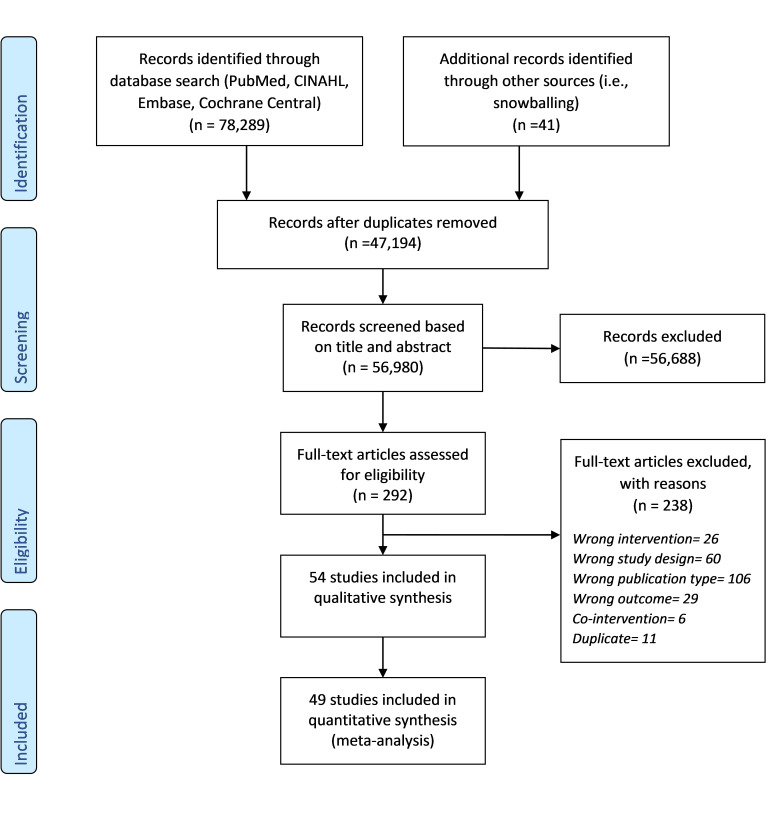
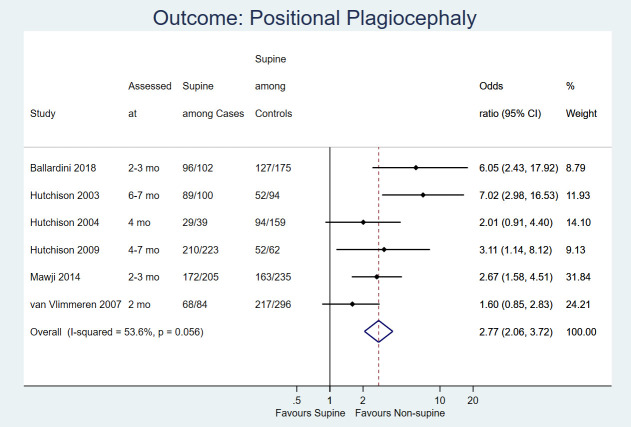
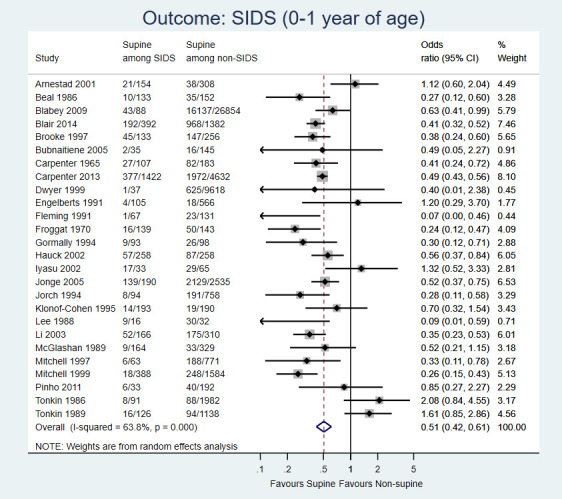
We included 54 studies (43 observational studies and 11 intervention trials) involving 474 672 participants. A single study meeting the inclusion criteria suggested that the supine sleep position might reduce the risk of SUDI (0-1 year; OR = 0.39, 95% confidence interval (CI) = 0.23-0.65; 384 infants), compared to non-supine position. Supine sleep position might reduce the risk of SIDS (0-1 year; OR = 0.51, 95% CI = 0.42-0.61; 26 studies, 59332 infants) and unexplained SIDS/severe ALTE (neonatal period; OR = 0.16, 95% CI = 0.03-0.82; 1 study, 119 newborns), but the evidence was very uncertain. Supine sleep position probably increased the odds of being 0.5 standard deviation (SD) below mean on Gross Motor Scale at 6 months (OR = 1.67, 95% CI = 1.22-2.27; 1 study, 2097 participants), but might have little to no effect at 18 months of age (OR = 1.16, 95% CI = 0.96, 1.43; 1 study, 1919 participants). An increase in positional plagiocephaly at 2-7 months of age with supine sleep position is possible (OR = 2.77, 95% CI = 2.06-3.72; 6 studies, 1774 participants).
Low- to very low-certainty evidence suggests that supine sleep position may reduce the risk of SUDI (0-1 year) and SIDS (0-1 year). Limited evidence suggests that supine sleeping probably delays short-term 'gross motor' development at 6 months, but the effect on long-term neurodevelopment at 18 months may be negligible.
尽管许多指南都推荐,但在全球范围内,婴儿在一岁前采用仰卧睡眠姿势的情况各不相同。
本系统综述对随机试验和观察性研究进行了评估,比较了仰卧位与非仰卧位(俯卧位或侧卧位)对健康新生儿的影响。主要结局是新生儿死亡率、婴儿猝死综合征(SIDS)、婴儿意外猝死(SUDI)、急性危及生命事件(ALTE)、神经发育和位置性扁头畸形。我们通过 PubMed 检索了 MEDLINE、Cochrane 中心数据库、EMBASE 和 CINAHL(更新至 2021 年 11 月)。两位作者分别评估了偏倚风险、提取数据,并使用相对风险(RR)或比值比(OR)综合效应估计值。采用 GRADE 方法评估证据确定性。
我们纳入了 54 项研究(43 项观察性研究和 11 项干预试验),涉及 474672 名参与者。一项符合纳入标准的研究表明,与非仰卧位相比,仰卧位可能降低 SUDI(0-1 岁)的风险(OR=0.39,95%置信区间[CI]0.23-0.65;384 名婴儿)。仰卧位可能降低 SIDS(0-1 岁)(OR=0.51,95%CI0.42-0.61;26 项研究,59332 名婴儿)和不明原因 SIDS/严重 ALTE(新生儿期)(OR=0.16,95%CI0.03-0.82;1 项研究,119 名新生儿)的风险,但证据非常不确定。仰卧位可能增加 6 个月时 gross motor 量表评分低于平均水平 0.5 个标准差的几率(OR=1.67,95%CI1.22-2.27;1 项研究,2097 名参与者),但在 18 个月时可能几乎没有影响(OR=1.16,95%CI0.96-1.43;1 项研究,1919 名参与者)。仰卧位可能增加 2-7 个月时位置性扁头畸形的几率(OR=2.77,95%CI2.06-3.72;6 项研究,1774 名参与者)。
低到非常低确定性证据表明,仰卧位可能降低 SUDI(0-1 岁)和 SIDS(0-1 岁)的风险。有限的证据表明,仰卧睡眠可能会延迟 6 个月时的短期“大运动”发育,但对 18 个月时的长期神经发育的影响可能微不足道。