Department of Psychology and Centre for Vision Research, York University, Toronto, Ontario, Canada.
School of Optometry and Vision Science, University of Waterloo, Waterloo, Ontario, Canada.
J Vis. 2022 Jul 11;22(8):6. doi: 10.1167/jov.22.8.6.
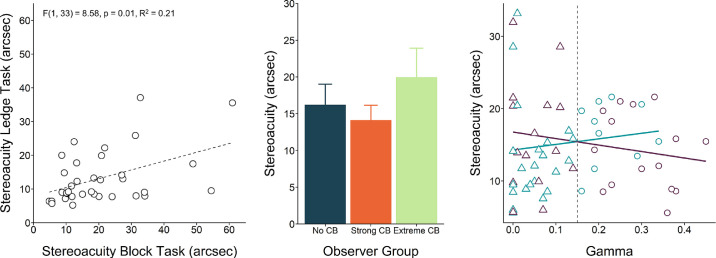
Determining the relief of upcoming terrain is critical to locomotion over rough or uneven ground. Given the significant contribution of stereopsis to perceived surface shape, it should play a crucial role in determining the shape of ground surfaces. The aim of this series of experiments was to evaluate the relative contribution of monocular and binocular depth cues to judgments of ground relief. To accomplish this goal, we simulated a depth discrimination task using naturalistic imagery. Stimuli consisted of a stereoscopically rendered grassy terrain with a central mound or a dip with varying height. We measured thresholds for discrimination of the direction of the depth offset. To determine the relationship between relief discrimination and measures of stereopsis, we used two stereoacuity tasks performed under the same viewing conditions. To assess the impact of ambiguous two-dimensional shading cues on depth judgments in our terrain task, we manipulated the intensity of the shading (low and high). Our results show that observers reliably discriminated ground reliefs as small as 20 cm at a viewing distance of 9.1 m. As the shading was intensified, a large proportion of observers (30%) exhibited a strong convexity bias, even when stereopsis indicated a concave depression. This finding suggests that there are significant individual differences in the reliance on assumptions of surface curvature that must be considered in experimental conditions. In impoverished viewing environments with limiting depth cues, these convexity biases could persist in judgments of ground relief, especially when shading cues are highly salient.
确定即将出现的地形的缓解情况对于在崎岖或不平坦的地面上移动至关重要。鉴于立体视觉对感知表面形状的重要贡献,它应该在确定地面形状方面发挥关键作用。本系列实验的目的是评估单眼和双眼深度线索对地面起伏判断的相对贡献。为了实现这一目标,我们使用自然图像模拟了深度辨别任务。刺激物由中央丘或凹陷的具有不同高度的立体渲染草地地形组成。我们测量了辨别深度偏移方向的阈值。为了确定地形任务中的深度辨别与立体视敏度测量之间的关系,我们使用了在相同观察条件下进行的两个立体视敏度任务。为了评估我们的地形任务中二维阴影线索的歧义对深度判断的影响,我们操纵了阴影的强度(低和高)。我们的结果表明,观察者可以可靠地辨别出距离 9.1 米的地面起伏,小至 20 厘米。随着阴影的增强,很大一部分观察者(30%)表现出强烈的凸面偏差,即使立体视觉显示出凹面凹陷。这一发现表明,在实验条件下,必须考虑对表面曲率假设的依赖程度存在显著的个体差异。在深度线索有限的贫困观察环境中,这些凸面偏差可能会在地面起伏的判断中持续存在,尤其是当阴影线索高度明显时。