University of Massachusetts Chan Medical School, Program in Molecular Medicine, Worcester, MA, USA.
University of Massachusetts Chan Medical School, Department of Molecular, Cellular and Cancer Biology, Worcester, MA, USA.
Nat Commun. 2022 Jul 15;13(1):4109. doi: 10.1038/s41467-022-31899-9.
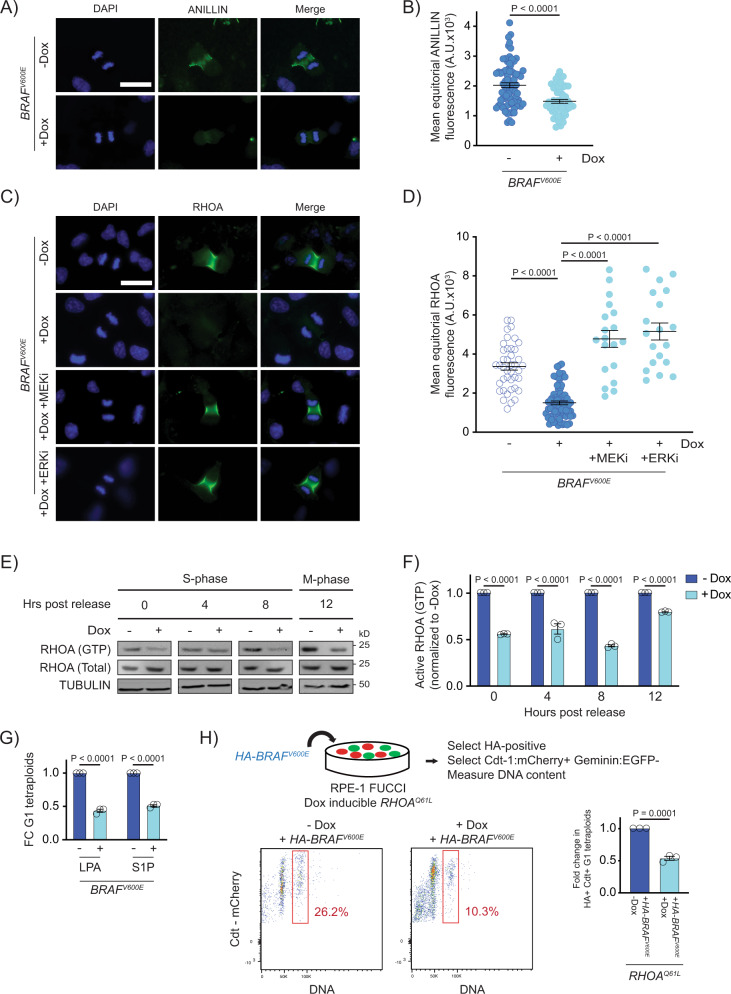
Melanomas and other solid tumors commonly have increased ploidy, with near-tetraploid karyotypes being most frequently observed. Such karyotypes have been shown to arise through whole-genome doubling events that occur during early stages of tumor progression. The generation of tetraploid cells via whole-genome doubling is proposed to allow nascent tumor cells the ability to sample various pro-tumorigenic genomic configurations while avoiding the negative consequences that chromosomal gains or losses have in diploid cells. Whereas a high prevalence of whole-genome doubling events has been established, the means by which whole-genome doubling arises is unclear. Here, we find that BRAF, the most common mutation in melanomas, can induce whole-genome doubling via cytokinesis failure in vitro and in a zebrafish melanoma model. Mechanistically, BRAF causes decreased activation and localization of RhoA, a critical cytokinesis regulator. BRAF activity during G1/S phases of the cell cycle is required to suppress cytokinesis. During G1/S, BRAF activity causes inappropriate centriole amplification, which is linked in part to inhibition of RhoA and suppression of cytokinesis. Together these data suggest that common abnormalities of melanomas linked to tumorigenesis - amplified centrosomes and whole-genome doubling events - can be induced by oncogenic BRAF and other mutations that increase RAS/MAPK pathway activity.
黑色素瘤和其他实体瘤通常具有较高的倍性,最常观察到的是近四倍体核型。这种核型已被证明是通过全基因组加倍事件产生的,这些事件发生在肿瘤进展的早期阶段。全基因组加倍产生的四倍体细胞被认为使新生肿瘤细胞能够在避免染色体增益或丢失在二倍体细胞中产生的负面影响的同时,对各种促肿瘤发生的基因组构象进行采样。虽然已经确定了全基因组加倍事件的高发生率,但全基因组加倍产生的方式尚不清楚。在这里,我们发现黑色素瘤中最常见的突变 BRAF 可以通过细胞分裂失败在体外和斑马鱼黑色素瘤模型中诱导全基因组加倍。在机制上,BRAF 导致关键细胞分裂调节剂 RhoA 的活性降低和定位减少。细胞周期 G1/S 期的 BRAF 活性对于抑制细胞分裂是必需的。在 G1/S 期,BRAF 活性导致中心体扩增不当,这部分与 RhoA 的抑制和细胞分裂的抑制有关。这些数据表明,与肿瘤发生相关的黑色素瘤的常见异常——扩增的中心体和全基因组加倍事件——可以由致癌 BRAF 和其他增加 RAS/MAPK 途径活性的突变诱导。