Kirsch-Volders Micheline, Mišík Miroslav, Fenech Michael
Laboratory for Cell Genetics, Department Biology, Faculty of Sciences and Bio-Engineering Sciences, Vrije Universiteit Brussel, Pleinlaan 2, 1050, Brussels, Belgium.
Center for Cancer Research, Medical University of Vienna, Borschkegasse 8a, 1090, Vienna, Austria.
Chromosoma. 2025 Mar 21;134(1):3. doi: 10.1007/s00412-025-00829-1.
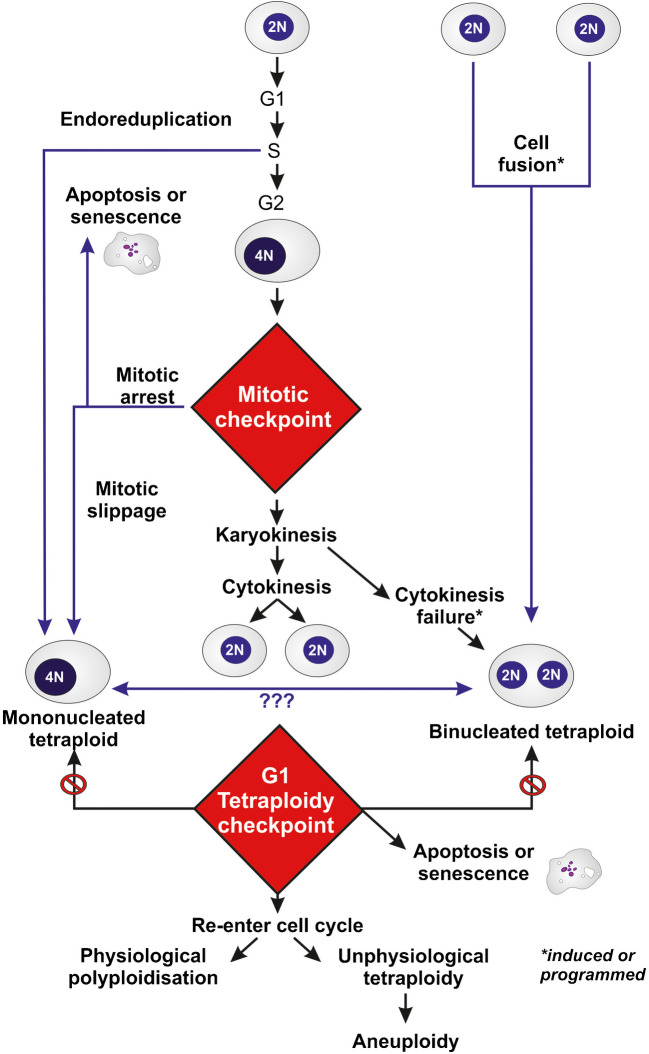
Tetraploidisation plays a crucial role in evolution, development, stress adaptation, and disease, but its beneficial or pathological effects in different tissues remain unclear. This study aims to compare physiological and unphysiological tetraploidy in eight steps: 1) mechanisms of diploidy-to-tetraploidy transition, 2) induction and elimination of unphysiological tetraploidy, 3) tetraploid cell characteristics, 4) stress-induced unphysiological tetraploidy, 5) comparison of physiological vs. unphysiological tetraploidy, 6) consequences of unphysiological stress-induced tetraploidy, 7) nutritional or pharmacological prevention strategies of tetraploidisation, and 8) knowledge gaps and future perspectives. Unphysiological tetraploidy is an adaptive stress response at a given threshold, often involving mitotic slippage. If tetraploid cells evade elimination through apoptosis or immune surveillance, they may re-enter the cell cycle, causing genetic instability, micronuclei formation, aneuploidy, modification of the epigenome and the development of diseases. The potential contributions of unphysiological tetraploidy to neurodegenerative, cardiovascular and diabetes related diseases are summarized in schematic figures and contrasted with its role in cancer development. The mechanisms responsible for the transition from physiological to unphysiological tetraploidy and the tolerance to tetraploidisation in unphysiological tetraploidy are not fully understood. Understanding these mechanisms is of critical importance to allow the development of targeted nutritional and pharmacological prevention strategies and therapies.
四倍体化在进化、发育、应激适应和疾病中起着关键作用,但其在不同组织中的有益或病理作用仍不清楚。本研究旨在从八个方面比较生理性和非生理性四倍体:1)二倍体向四倍体转变的机制,2)非生理性四倍体的诱导和消除,3)四倍体细胞特征,4)应激诱导的非生理性四倍体,5)生理性与非生理性四倍体的比较,6)非生理性应激诱导四倍体的后果,7)四倍体化的营养或药物预防策略,8)知识空白和未来展望。非生理性四倍体是在给定阈值下的一种适应性应激反应,通常涉及有丝分裂滑脱。如果四倍体细胞通过凋亡或免疫监视逃避消除,它们可能重新进入细胞周期,导致遗传不稳定、微核形成、非整倍体、表观基因组修饰和疾病发展。非生理性四倍体对神经退行性疾病、心血管疾病和糖尿病相关疾病的潜在贡献在示意图中进行了总结,并与其在癌症发展中的作用进行了对比。从生理性四倍体向非生理性四倍体转变的机制以及非生理性四倍体中对四倍体化的耐受性尚未完全了解。了解这些机制对于开发有针对性的营养和药物预防策略及治疗方法至关重要。