Department of Otorhinolaryngology, Affiliated Hospital of Inner Mongolia University for the Nationalities, Tongliao, China.
Department of Otorhinolaryngology, The First Hospital of China Medical University, 155 Nanjing Street, Heping District, Shenyang, 110001, Liaoning, China.
Sci Rep. 2022 Jul 15;12(1):12132. doi: 10.1038/s41598-022-16541-4.
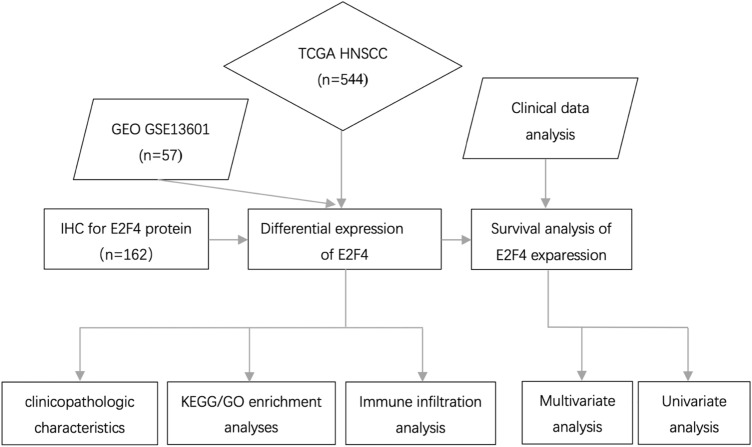
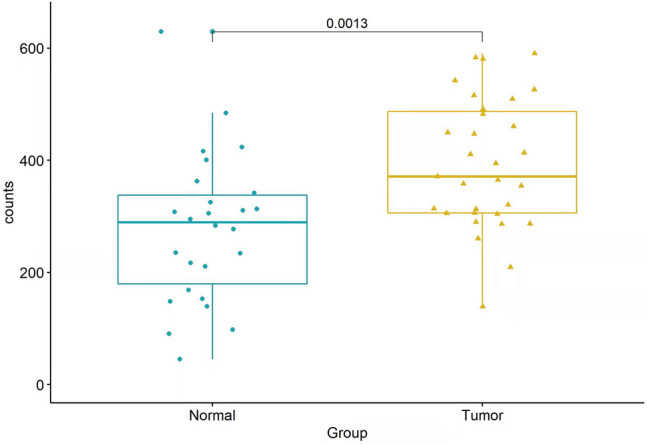
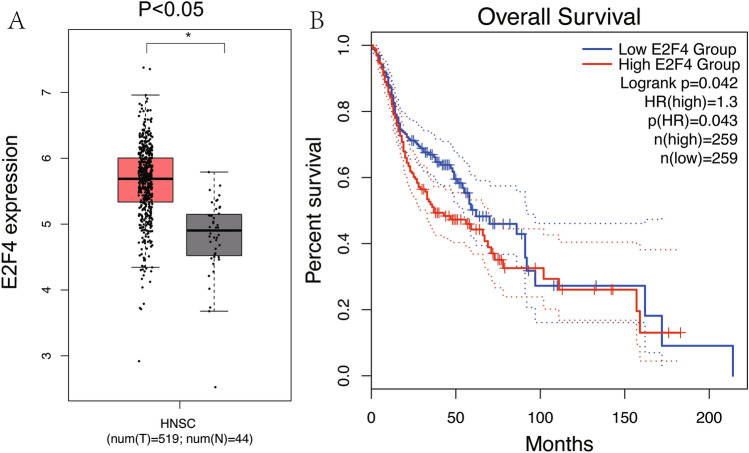
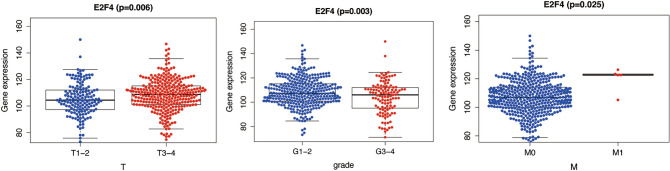
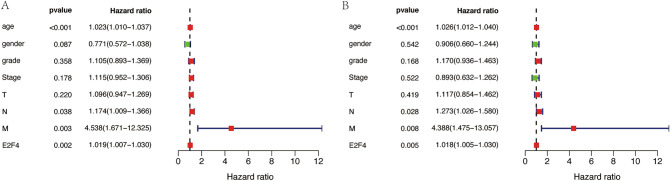
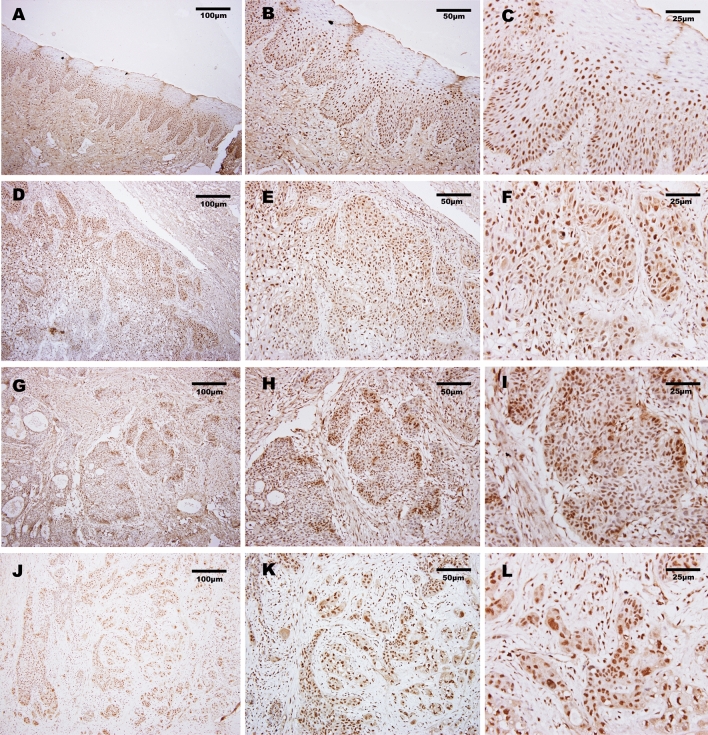
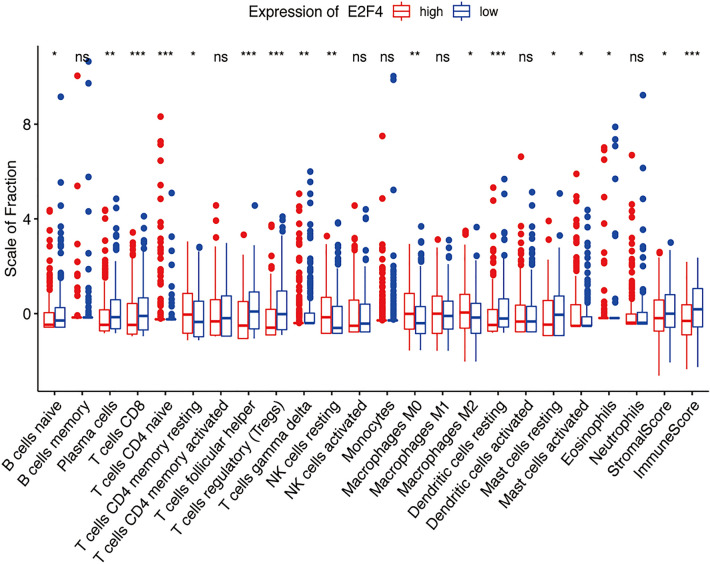
To investigate the relationship between the transcription factor, E2F4, and head and neck squamous cell carcinoma (HNSCC), and to preliminarily explore the signaling pathways and immunological role of E2F4. The mRNA expression of E2F4 in HNSCC was evaluated by searching Gene Expression Omnibus (GEO) and The Cancer Genome Atlas (TCGA) datasets. E2F4 protein expression was analyzed by immunohistochemistry using the CMU1h-ENT database. The association between E2F4 expression and tumor infiltration of immune cells was analyzed. Intracellular signaling by E2F4 was explored using KEGG and GO analysis. The correlation of E2F4 expression with clinical characteristics and its prognostic role were validated and analyzed in TCGA database. From the analysis of GEO and TCGA data, E2F4 expression was found to be up-regulated in HNSCC tumor tissues, and its level was associated with T, Grade, and M staging. Kaplan-Meier curve and Cox analyses indicated that the high expression of E2F4 was related to a poor prognosis. Thus, E2F4 was considered a potential prognostic factor for HNSCC. Immunohistochemical staining showed that E2F4 was mainly localized in the cell nucleus; it was highly expressed in HNSCC tissues, with a significant difference noted from that in pericancerous mucosa tissues. A correlation was observed between the differential expression of E2F4 and the immune infiltration of HNSCC. As revealed by KEGG and GO analysis, differential enrichment was found in the cell cycle, spliceosome, meiosis, microbial polysaccharide synthesis, and WNT signaling pathway, as well as in cyclic adenosine monophosphate, ERBB2, VEGF, GCNP and MYC pathways. E2F4 plays an important role in tumor progression and may be a critical biological prognostic factor for HNSCC. In addition, it functions in the nucleus as a transcription factor, regulates immune cells, and could be a promising molecular target for the diagnosis and treatment of HNSCC.
为了研究转录因子 E2F4 与头颈部鳞状细胞癌(HNSCC)之间的关系,并初步探讨 E2F4 的信号通路和免疫学作用。通过搜索基因表达综合数据库(GEO)和癌症基因组图谱(TCGA)数据集来评估 E2F4 在 HNSCC 中的 mRNA 表达。使用 CMU1h-ENT 数据库通过免疫组织化学分析 E2F4 蛋白表达。分析 E2F4 表达与肿瘤浸润免疫细胞的相关性。通过 KEGG 和 GO 分析探讨 E2F4 的细胞内信号传导。在 TCGA 数据库中验证和分析 E2F4 表达与临床特征的相关性及其预后作用。从 GEO 和 TCGA 数据分析中发现,E2F4 在 HNSCC 肿瘤组织中表达上调,其水平与 T、分级和 M 分期相关。Kaplan-Meier 曲线和 Cox 分析表明,E2F4 高表达与预后不良相关。因此,E2F4 被认为是 HNSCC 的潜在预后因素。免疫组织化学染色显示,E2F4 主要定位于细胞核内;在 HNSCC 组织中高表达,与癌旁粘膜组织有显著差异。E2F4 的差异表达与 HNSCC 的免疫浸润之间存在相关性。KEGG 和 GO 分析显示,在细胞周期、剪接体、减数分裂、微生物多糖合成和 WNT 信号通路以及环磷酸腺苷、ERBB2、VEGF、GCNP 和 MYC 通路中发现差异富集。E2F4 在肿瘤进展中起重要作用,可能是 HNSCC 的关键生物学预后因素。此外,它作为转录因子在核内发挥作用,调节免疫细胞,可能是 HNSCC 诊断和治疗的有前途的分子靶标。