Department of Social Welfare, Jeonbuk National University, 567 Baekje-daero, Deokjin-gu, Jeonju-si, Jeollabuk-do, 54896, Republic of Korea.
Subst Abuse Treat Prev Policy. 2022 Jul 15;17(1):52. doi: 10.1186/s13011-022-00481-3.
In recent years, female drinking has been on the rise worldwide, and this trend can be observed in Korea as well. Accordingly, this study aimed to examine the heterogeneous longitudinal changes in drinking patterns among Korean women, while also exploring the determinants of these changes. In particular, the study identified the gender perspective-related determinants of the classified patterns of problem drinking.
Data on 4615 adult women who participated in the Korea Welfare Panel Study (KOWEPS) for 3 years (2018-2020) were analyzed longitudinally using SPSS Statistics 22.0 and M-plus 7.0. The changes in female drinking patterns were analyzed using latent class growth analysis. Subsequently, multinomial logistic regression analysis was performed to identify the predictive factors affecting the changes in drinking patterns.
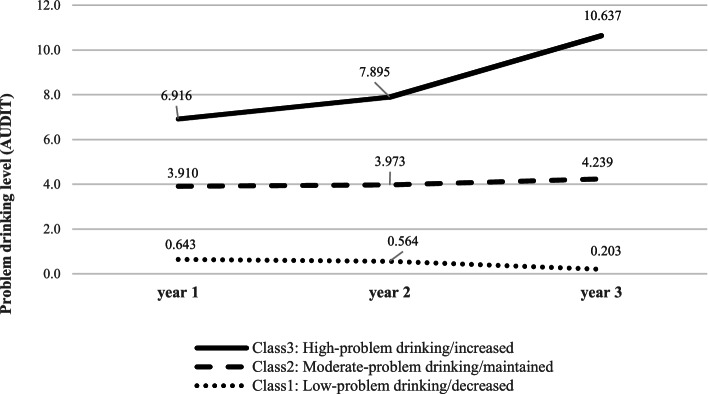
Latent class analysis yielded three classes: "low problem drinking/decreased," "moderate problem drinking/maintained," and "high problem drinking/increased." Of the participants, 80.4% were in the first class, 14.5% in the second, and 5.1% in the third. After controlling for sociodemographic and psychosocial factors, we found: i) domestic violence, work-family balance stress, and gender role perception were not statistically significant for the "moderate problem drinking/maintained" class; lower levels of depression (odds ratio; OR = .750, p < .05) and higher levels of satisfaction with social relationships (OR = 1.257, p < .05) increased the probability of belonging to the "moderate problem drinking/maintained" group compared to the low problem drinking/decreased class; ii) in the "high problem drinking/increased" class, relative to the low problem drinking/decreased class, experience of domestic violence (OR = 1.857, p < .05), work-family balance stress (OR = 1.309, p < .05), and gender role perception (OR = .705, p < .05) were significant predictors of drinking behavior.
Problem drinking in Korean women demonstrated heterogeneous patterns of change, with gender-specific factors being the main predictors of this change. Therefore, this study developed a strategy for reducing the harmful effects of female drinking, which considers the characteristics of the changes in women's drinking patterns as well as factors from the gender perspective.
近年来,全球范围内女性饮酒呈上升趋势,韩国也不例外。因此,本研究旨在考察韩国女性饮酒模式的异质纵向变化,并探讨这些变化的决定因素。特别是,本研究确定了与性别视角相关的决定因素,这些因素影响了问题饮酒的分类模式。
使用 SPSS Statistics 22.0 和 M-plus 7.0 对参加韩国福利面板研究(KOWEPS)三年(2018-2020 年)的 4615 名成年女性进行了纵向数据分析。使用潜在类别增长分析来分析女性饮酒模式的变化。随后,进行了多项逻辑回归分析,以确定影响饮酒模式变化的预测因素。
潜在类别分析产生了三个类别:“低问题饮酒/减少”、“中等问题饮酒/维持”和“高问题饮酒/增加”。参与者中,80.4%属于第一类,14.5%属于第二类,5.1%属于第三类。在控制了社会人口学和心理社会因素后,我们发现:i)家庭暴力、工作-家庭平衡压力和性别角色认知对“中等问题饮酒/维持”类没有统计学意义;较低的抑郁水平(比值比;OR=0.750,p<0.05)和较高的社会关系满意度(OR=1.257,p<0.05)与属于“中等问题饮酒/维持”组相比,与低问题饮酒/减少组相比,可能性更高;ii)在“高问题饮酒/增加”类中,与低问题饮酒/减少类相比,家庭暴力经历(OR=1.857,p<0.05)、工作-家庭平衡压力(OR=1.309,p<0.05)和性别角色认知(OR=0.705,p<0.05)是饮酒行为的显著预测因素。
韩国女性的问题饮酒表现出异质的变化模式,性别特定因素是这种变化的主要预测因素。因此,本研究制定了一项减少女性饮酒危害的策略,该策略考虑了女性饮酒模式变化的特征以及性别视角的因素。