Department of Clinical Psychology and Psychotherapy, Saarland University, Germany; Leibniz Institute for Resilience Research, Germany.
Department of Clinical Psychology and Psychotherapy, Saarland University, Germany.
J Psychiatr Res. 2022 Sep;153:236-244. doi: 10.1016/j.jpsychires.2022.07.004. Epub 2022 Jul 6.
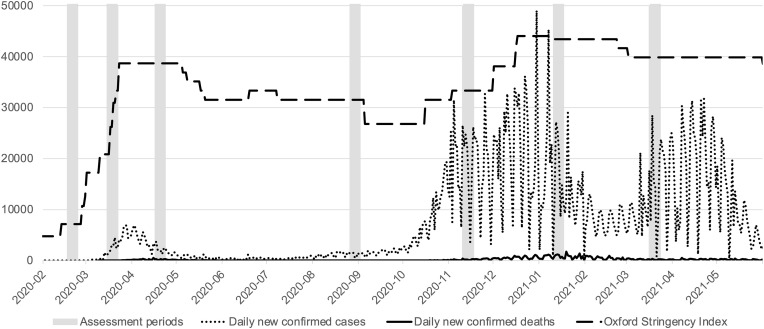
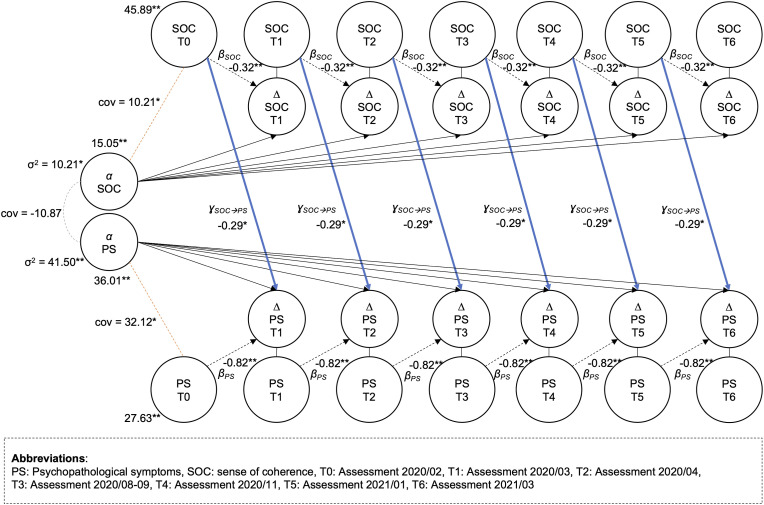
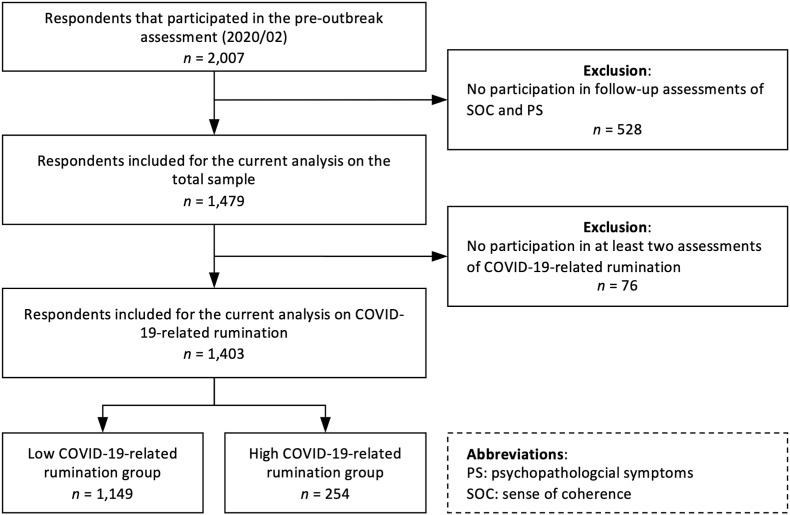
The COVID-19 pandemic is a major chronic stressor affecting all societies and almost all individuals. Consequently, research demonstrated a negative impact of COVID-19 on mental health in parts of the general population. However, not all people are affected equally thus making the identification of resilience factors modulating the pandemic's impact on mental health an important research agenda. One of these factors is sense of coherence (SOC), the key component of the salutogenesis framework. The current study aimed at investigating the long-term relationship between SOC and psychopathological symptoms, and the impact of COVID-19-related rumination as its moderator. The prospective observational study assessed psychopathological symptoms and SOC before the COVID-19 outbreak in Germany (February 2020) and at six critical time points during the pandemic in an online panel (n = 1,479). Bivariate latent change score models and latent growth mixture modeling were used to analyze changes in psychopathological symptoms and SOC along with their interaction and to differentiate trajectories of COVID-19-related rumination. A model allowing for unidirectional coupling from SOC to psychopathological symptoms demonstrated best fit. In the total sample, psychopathological symptoms increased significantly over time. Previous SOC predicted later changes in psychopathological symptoms, whereby a stronger SOC was associated with a decrease in symptoms over time. The same pattern of results was evident in the high-rumination (17.2%) but not in the low-rumination group (82.8%). Our findings demonstrate that SOC is an important predictor and modulator of psychopathological symptoms during the COVID-19 pandemic, particularly in those respondents that ruminate about the pandemic.
COVID-19 大流行是一个主要的慢性压力源,影响着所有社会和几乎所有个体。因此,研究表明 COVID-19 对部分普通人群的心理健康产生了负面影响。然而,并非所有人都受到同等程度的影响,因此确定调节大流行对心理健康影响的弹性因素是一个重要的研究议程。这些因素之一是意义感(SOC),这是健康促进框架的关键组成部分。本研究旨在调查 SOC 与精神病理症状之间的长期关系,以及 COVID-19 相关的反刍作为其调节因素的影响。这项前瞻性观察研究在德国 COVID-19 爆发之前(2020 年 2 月)以及大流行期间的六个关键时间点(n=1479)在在线小组中评估了精神病理症状和 SOC。使用双变量潜在变化分数模型和潜在增长混合模型来分析精神病理症状和 SOC 的变化及其相互作用,并区分 COVID-19 相关反刍的轨迹。允许从 SOC 到精神病理症状的单向耦合的模型表现出最佳拟合。在总样本中,精神病理症状随时间显著增加。先前的 SOC 预测了以后的精神病理症状变化,即 SOC 越强,症状随时间的下降幅度越大。在高反刍(17.2%)组中,但不在低反刍(82.8%)组中,出现了相同的结果模式。我们的研究结果表明,SOC 是 COVID-19 大流行期间精神病理症状的重要预测因子和调节剂,特别是在那些对大流行进行反刍的应答者中。