El-Mehy Amira A, El-Gendy Hala M, Aioub Ahmed A A, Mahmoud Samy F, Abdel-Gawad Shebl, Elesawy Ahmed E, Elnahal Ahmed S M
Crop Intensification Res. Dep., Field Crops Res. Inst., Agricultural Research Center, Egypt.
plant Pathology Research Institute, Agricultural Research Center, Egypt.
Saudi J Biol Sci. 2022 May;29(5):3482-3493. doi: 10.1016/j.sjbs.2022.02.032. Epub 2022 Feb 25.
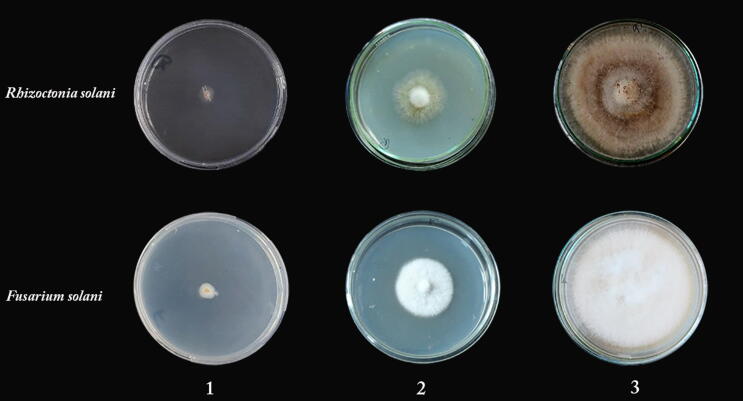
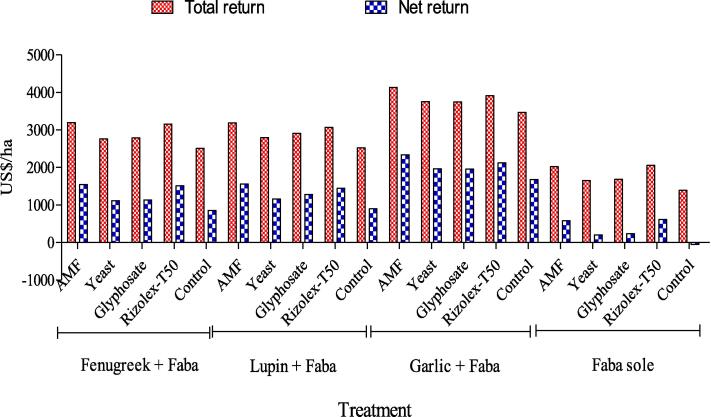
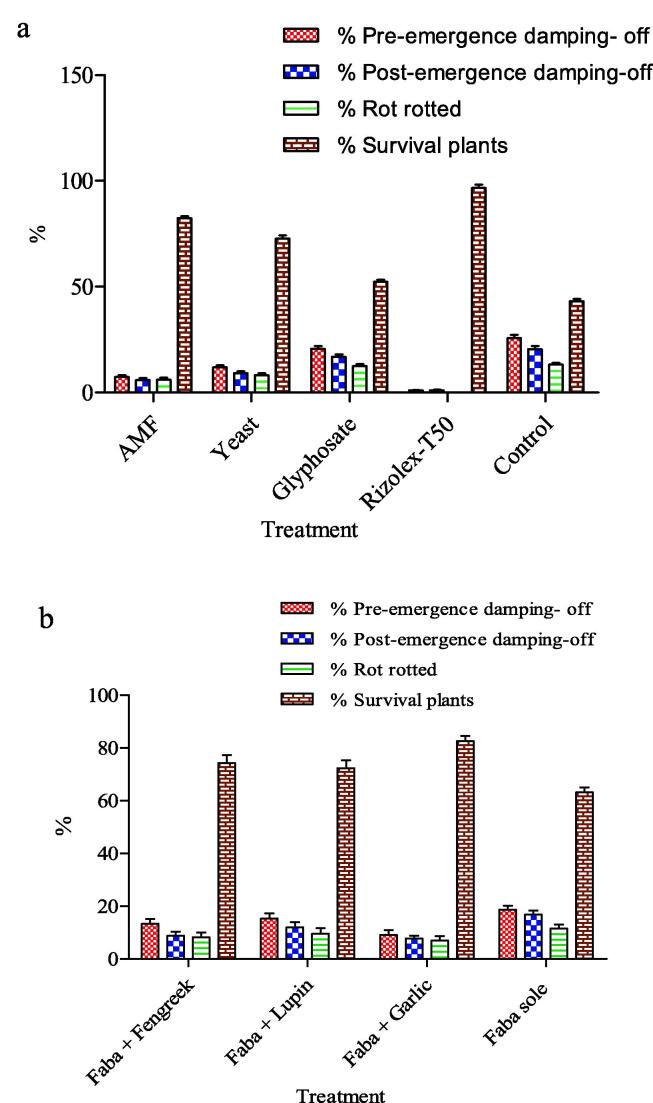
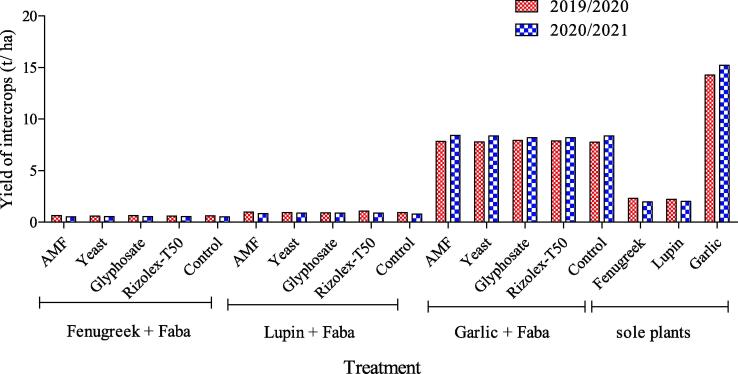
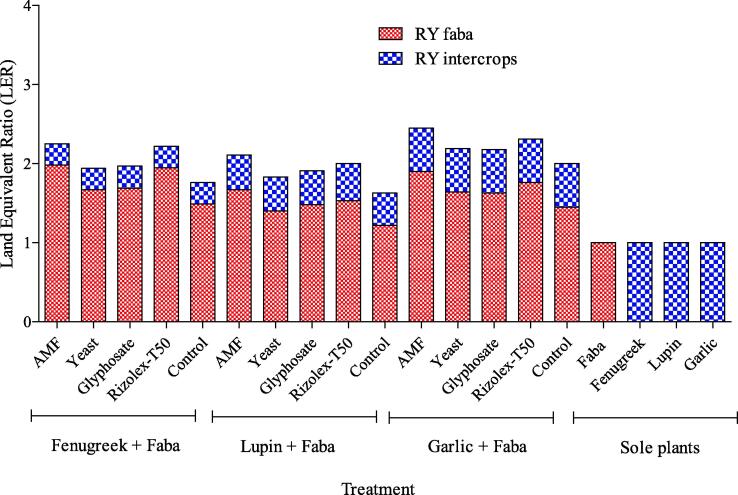
Multispecies cropping systems contribute to sustainable agriculture with multiple ecosystem services. Effects of intercropping of various crops with faba beans on growth and yield parameters and disease severity of root rot, damping off and broomrape were investigated. This study was implemented in the laboratory, greenhouse and field to investigate the effect of the intercropping systems (fenugreek + faba bean, lupine + faba bean, garlic + faba bean and sole faba bean). The intercropping systems were combined with the application of arbuscular mycorrhiza fungi (AMF) and yeast as bio-control agents, compared to chemical application of herbicides (Glyphosate) and fungicides (Rizolex-T50), to control rot root diseases and broomrape weeds, spp., of faba bean plants and under the naturally infested field. yeast and Rizolex-T50 significantly inhibited mycelial growth of root pathogenic fungi. Intercropping with garlic and/or application of Rizolex-T, significantly decreased the incidence and disease index of root rot and damping-off diseases, meanwhile increased percentage of survival plants. , intercropping with fenugreek and/or application of Glyphosate, significantly reduced the number/weight of spikes/plot of broomrapes. Intercropping with fenugreek combined with AMF application promoted crop growth and significantly increased yield components. The AMF enhanced seed yield/ha when applied to the intercropping of faba bean + fenugreek and faba bean + garlic, showing the highest seed yield/ha with 3.722 and 3.568 ton/ha, respectively. Intercropping of faba bean with garlic integrated with AMF revealed the highest values of LER, 2.45, and net return, 2341 US$/ha. Our results suggested that using faba bean-garlic intercrop along with AMF inoculation can reduce root rot disease, damping off and broomrapes, as well as enhance the profitability of Egyptian farmer and sustainable production.
多物种种植系统通过多种生态系统服务促进可持续农业发展。研究了各种作物与蚕豆间作对生长和产量参数以及根腐病、猝倒病和列当属病害严重程度的影响。本研究在实验室、温室和田间开展,以调查间作系统(胡芦巴+蚕豆、羽扇豆+蚕豆、大蒜+蚕豆和单作蚕豆)的效果。将间作系统与丛枝菌根真菌(AMF)和酵母作为生物防治剂的应用相结合,与化学除草剂(草甘膦)和杀菌剂(立枯净-T50)的应用进行比较,以控制蚕豆植株的根腐病和列当属杂草,并在自然侵染的田间条件下进行。酵母和立枯净-T50显著抑制了根部致病真菌的菌丝生长。与大蒜间作和/或施用立枯净-T显著降低了根腐病和猝倒病的发病率和病情指数,同时提高了存活植株的百分比。与胡芦巴间作和/或施用草甘膦显著减少了列当属的穗数/小区数量/重量。与胡芦巴间作并施用AMF促进了作物生长,并显著增加了产量构成因素。当AMF应用于蚕豆+胡芦巴和蚕豆+大蒜的间作时,提高了每公顷种子产量,分别以3.722吨/公顷和3.568吨/公顷的产量显示出最高的每公顷种子产量。蚕豆与大蒜间作并结合AMF显示出最高的土地当量比(LER)值,为2.45,以及最高的净收益,为2341美元/公顷。我们的结果表明,使用蚕豆-大蒜间作并接种AMF可以减少根腐病、猝倒病和列当属病害,同时提高埃及农民的盈利能力和可持续产量。