Rebouh Nazih Y, Aliat Toufik, Polityko Petr M, Kherchouche Dalila, Boulelouah Nadia, Temirbekova Sulukhan K, Afanasyeva Yuliya V, Kucher Dmitry E, Plushikov Vadim G, Parakhina Elena A, Latati Mourad, Gadzhikurbanov Anvar S
Department of Environmental Management, Peoples' Friendship University of Russia (RUDN University), 117198 Moscow, Russia.
Forest Management Department, Higher National School of Forests, Khenchela 40000, Algeria.
Plants (Basel). 2022 Jun 14;11(12):1566. doi: 10.3390/plants11121566.
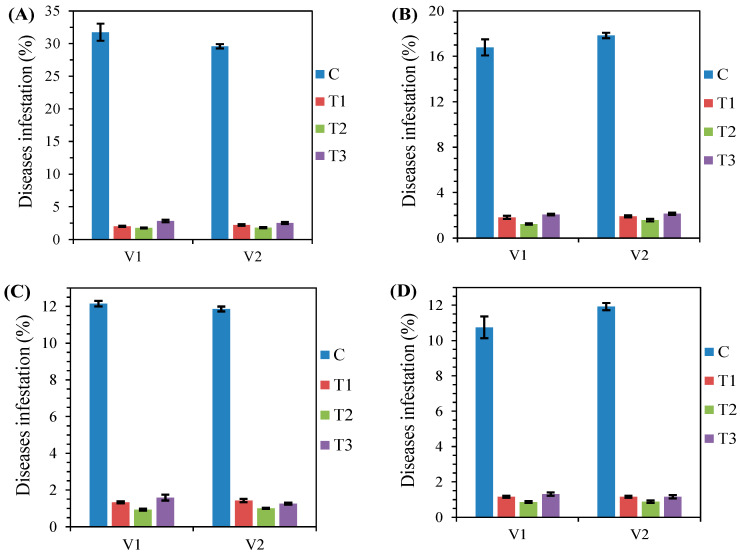
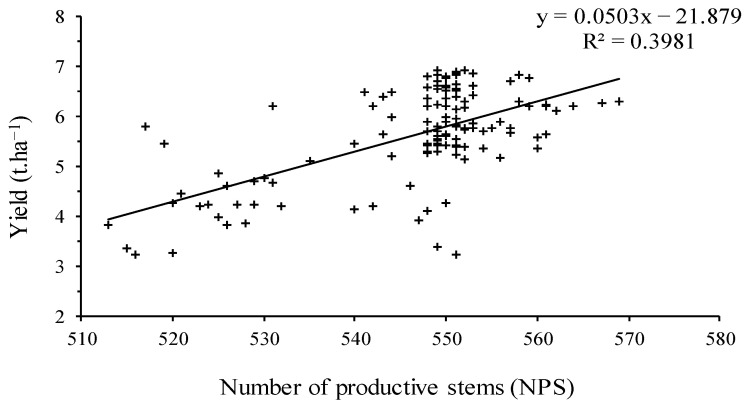
The control of wheat diseases using bioagents is not well studied under field conditions. The present study was aimed at investigating, during four consecutive growing seasons (2017-2020), the efficacy of two integrated crop protection (ICP) systems to control the common wheat diseases for enhancing the productivity and profitability of winter wheat crops and ensuring nutritional and food security. Two environmental-friendly treatments were tested, biological (T1), which contained bioagents and fertilizers, and combined (T2), which included fertilizers and bioagents coupled with lower doses of fungicides. The chemical treatment (T3) was used for comparison with (T1) and (T2). Furthermore, two Russian winter wheat varieties (Nemchinovskaya 17 (V1) and Moscovskaya 40 (V2)) were studied. A randomized complete block design was used with four replicates. Diseases infestation rates for snow mold (SM), root rot (RR), powdery mildew (PM), and (Fus), yield performances, and grain quality (measured through protein content) were determined according to the tested treatments, and the economic efficiency was calculated for each treatment. The combined treatment (T2) was the most effective against fungal diseases with 1.8% (SM), 1.2% (RR), 0.9% (PM), and 0.9% (Fus). The highest grain yield (6.8 t·ha), protein content (15.2%), and 1000-grain weight (43.7%) were observed for winter wheat variety Moscovskaya 40 with the combined treatment (T2). The highest number of productive stems (N.P.S) (556 stems/m) was attained for combined treatment (T2), followed by biological treatment (T1) (552 stems/m) with the variety Nemchinovskaya 17. The profitability (cost-benefit ratio) of the combined treatment (T2) was 2.38 with the Moscovskaya 40 variety (V2), while 2.03 was recorded for the biological treatment. Applying environmentally friendly combined and biological treatments resulted in high wheat yield and net income, as well as healthy products.
在田间条件下,利用生物制剂防治小麦病害的研究尚不充分。本研究旨在连续四个生长季节(2017 - 2020年)调查两种综合作物保护(ICP)系统对防治普通小麦病害的效果,以提高冬小麦作物的生产力和盈利能力,并确保营养和粮食安全。测试了两种环境友好型处理方法,生物处理(T1),包含生物制剂和肥料;组合处理(T2),包括肥料、生物制剂以及较低剂量的杀菌剂。化学处理(T3)用于与(T1)和(T2)进行比较。此外,还研究了两个俄罗斯冬小麦品种(涅姆钦诺夫斯卡娅17(V1)和莫斯科斯卡娅40(V2))。采用随机完全区组设计,重复四次。根据测试处理确定雪腐病(SM)、根腐病(RR)、白粉病(PM)和赤霉病(Fus)的病害侵染率、产量表现以及谷物品质(通过蛋白质含量衡量),并计算各处理的经济效益。组合处理(T2)对真菌病害最有效,雪腐病(SM)为1.8%、根腐病(RR)为1.2%、白粉病(PM)为0.9%、赤霉病(Fus)为0.9%。采用组合处理(T2)时,冬小麦品种莫斯科斯卡娅40的谷物产量最高(6.8吨·公顷)、蛋白质含量最高(15.2%)、千粒重最高(43.7%)。组合处理(T2)的有效茎数(N.P.S)最多(556个茎/米),其次是生物处理(T1)(552个茎/米),品种为涅姆钦诺夫斯卡娅17。组合处理(T2)与莫斯科斯卡娅40品种(V2)的盈利能力(成本效益比)为2.38,而生物处理的记录为2.03。应用环境友好型的组合处理和生物处理可实现小麦高产、净收入高,且产品健康。