Department of Pharmacy, People's Hospital of Guilin, Guilin, China.
Department of Rheumatology and Immunology, Affiliated Hospital of Guilin Medical University, Guilin, China.
Front Immunol. 2022 Jun 30;13:913667. doi: 10.3389/fimmu.2022.913667. eCollection 2022.
Antineutrophil cytoplasmic antibody (ANCA)-associated vasculitis (AAV) is a multisystem autoimmune disease with small-vessel involvement. In AAV, microscopic polyangiitis (MPA) and granulomatosis with polyangiitis (GPA) are major clinicopathologic variants. In addition, myeloperoxidase (MPO) and proteinase 3 (PR3) are major target antigens. The objective of the study was to explore the predictive factors for long-term survival in AAV patients.
A multicenter retrospective study was carried out on 407 patients between 2005 and 2020. Clinical parameters were obtained from laboratory tests including the ANCA types, antinuclear antibody (ANA), extractable nuclear antigen (ENA), anti-streptolysin O (ASO), glomerular filtration rate (GFR), and the laboratory examinations for the blood routine, liver function, renal function, and immunity, etc. The data for clinical parameters were collected from electronic medical records (EMRs), and the data for patient survival were acquired through regular follow-up. The association of clinical parameters with overall survival (OS) along with 3-year and 5-year survival rates was analyzed, and the nomogram as a predictive model was established according to the analysis results.
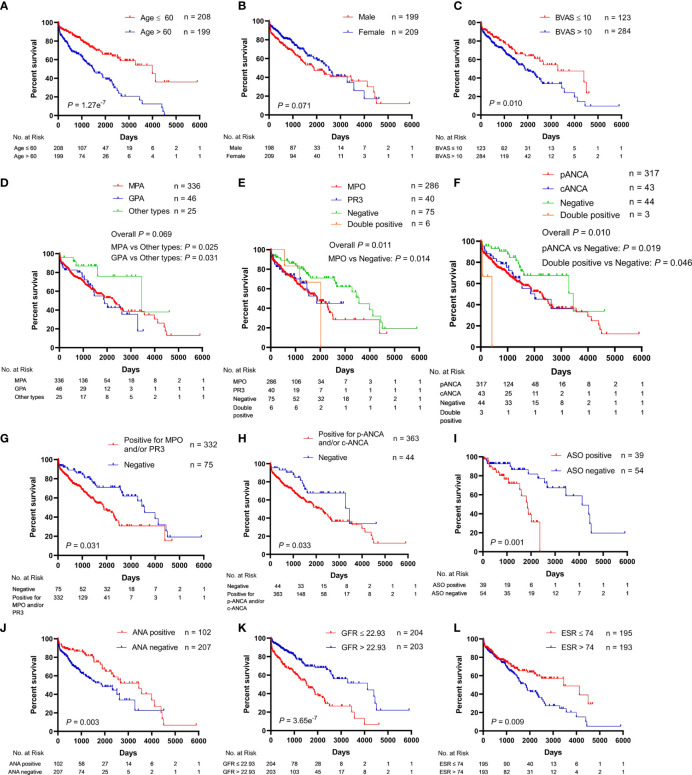
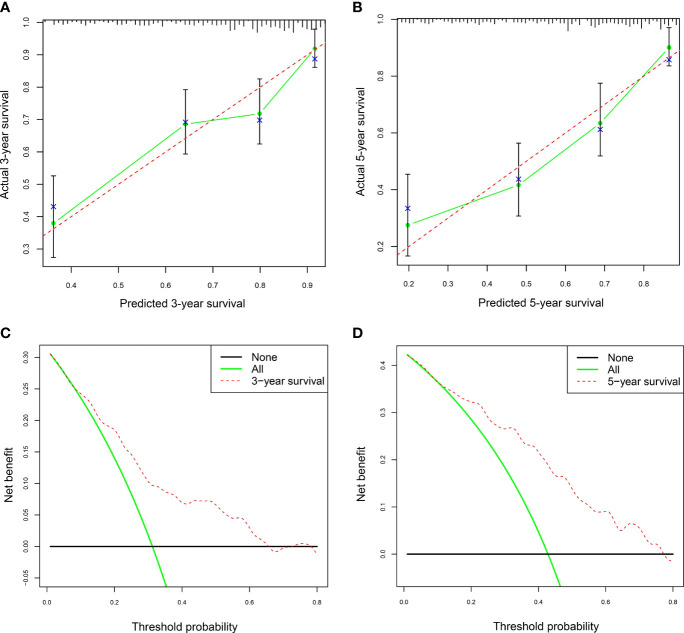
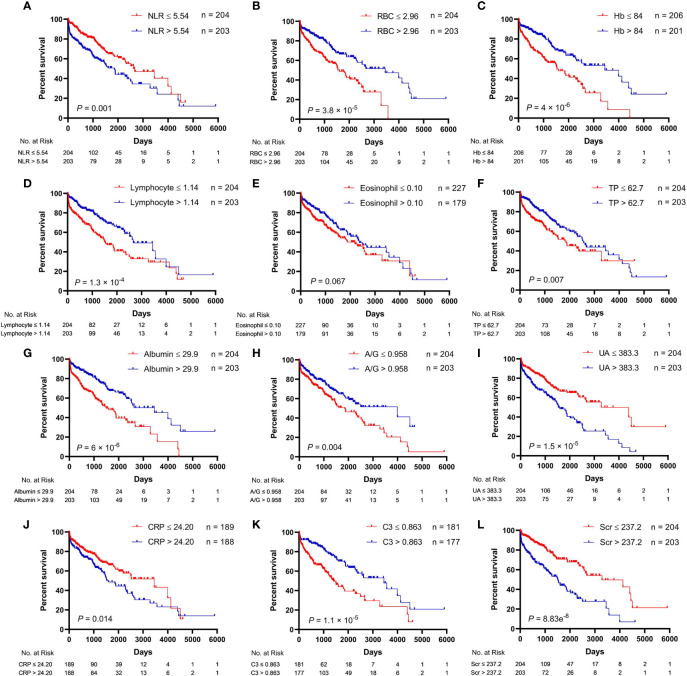
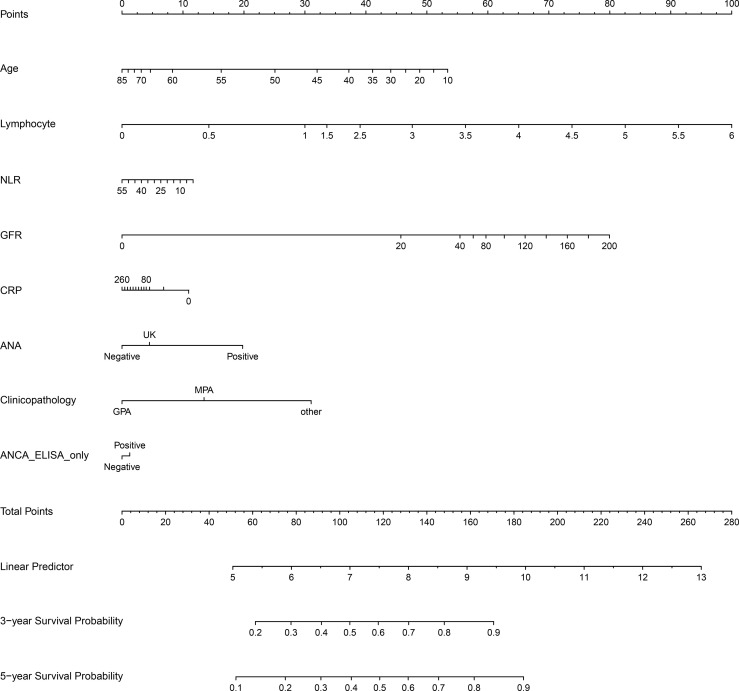
In the present study, 336 (82.6%) patients and 46 (11.3%) patients were diagnosed with MPA and GPA, respectively. The mean and median OS for all the patients were 2,285 and 2,290 days, respectively. The 1-year, 3-year, 5-year, and 10-year cumulative survival rates for all the patients were 84.2%, 76.3%, 57.2%, and 32.4%, respectively. Univariate and multivariate survival analyses indicated that the independent prognostic factors included age, pathological categories (MPA, GPA, and other types), serum ANCA types (negative or positive for MPO and/or PR3), ANA, ASO, GFR, lymphocyte, neutrophil-to-lymphocyte ratio (NLR), and C-reactive protein (CRP), and these clinical parameters except for ASO were used to construct a nomogram. The nomogram for 3-year and 5-year survival rates had a C-index of 0.721 (95% CI 0.676-0.766). The calibration curves showed that the predicted values of the nomogram for 3-year and 5-year survival rates were generally consistent with practical observed values, and decision curve analysis (DCA) further demonstrated the practicability and accuracy of the predictive model.
Laboratory tests at diagnosis have great significance in the prediction of long-term survival in AAV patients.
抗中性粒细胞胞质抗体(ANCA)相关性血管炎(AAV)是一种与小血管受累相关的多系统自身免疫性疾病。在 AAV 中,显微镜下多血管炎(MPA)和肉芽肿性多血管炎(GPA)是主要的临床病理变异型。此外,髓过氧化物酶(MPO)和蛋白酶 3(PR3)是主要的靶抗原。本研究旨在探讨 AAV 患者长期生存的预测因素。
对 2005 年至 2020 年间的 407 例患者进行了多中心回顾性研究。临床参数从实验室检查中获得,包括 ANCA 类型、抗核抗体(ANA)、可提取核抗原(ENA)、抗链球菌溶血素 O(ASO)、肾小球滤过率(GFR)以及血常规、肝功能、肾功能和免疫等实验室检查。临床参数的数据来自电子病历(EMR),患者生存数据通过定期随访获得。分析了临床参数与总生存率(OS)以及 3 年和 5 年生存率的关系,并根据分析结果建立了预测模型的列线图。
本研究中,336 例(82.6%)患者和 46 例(11.3%)患者分别被诊断为 MPA 和 GPA。所有患者的平均和中位 OS 分别为 2285 和 2290 天。所有患者的 1 年、3 年、5 年和 10 年累积生存率分别为 84.2%、76.3%、57.2%和 32.4%。单因素和多因素生存分析表明,独立预后因素包括年龄、病理类型(MPA、GPA 和其他类型)、血清 ANCA 类型(MPO 和/或 PR3 阴性或阳性)、ANA、ASO、GFR、淋巴细胞、中性粒细胞与淋巴细胞比值(NLR)和 C 反应蛋白(CRP),除 ASO 外,这些临床参数被用于构建列线图。3 年和 5 年生存率的列线图的 C 指数为 0.721(95%CI 0.676-0.766)。校准曲线表明,列线图预测的 3 年和 5 年生存率值与实际观察值基本一致,决策曲线分析(DCA)进一步证明了预测模型的实用性和准确性。
诊断时的实验室检查对预测 AAV 患者的长期生存具有重要意义。