Meurs Joris, Sakkoula Evangelia, Cristescu Simona M
Exhaled Biomarkers and Exposure Group, Department of Analytical Chemistry & Chemometrics, Institute for Molecules and Materials, Radboud University, Nijmegen, Netherlands.
Front Chem. 2022 Apr 26;10:853541. doi: 10.3389/fchem.2022.853541. eCollection 2022.
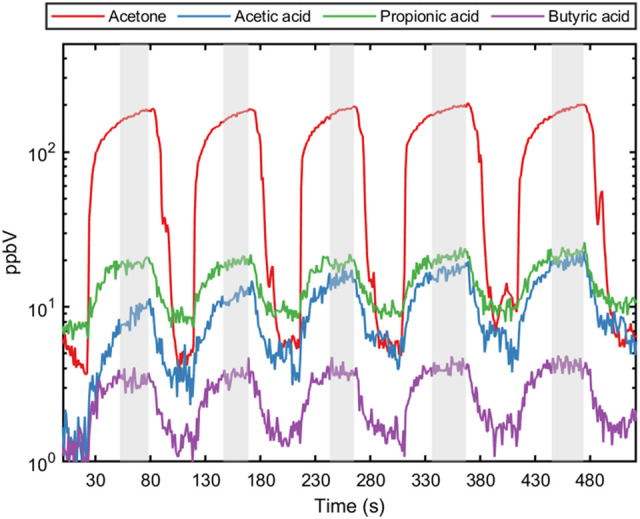
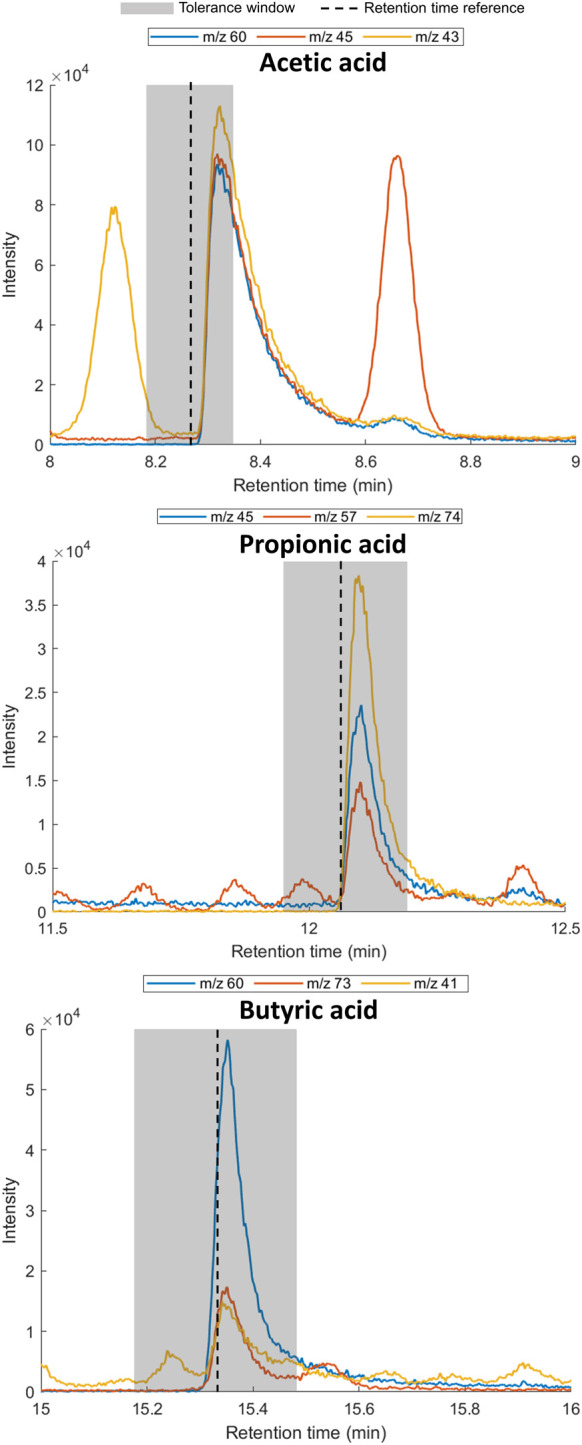
Short-chain fatty acids (SCFAs) are important metabolites produced by the gut microbiome as a result of the fermentation of non-digestible polysaccharides. The most abundant SCFAs are acetic acid, propionic acid, and butyric acid which make up 95% of this group of metabolites in the gut. Whilst conventional analysis SCFAs is done using either blood or fecal samples, SCFAs can also be detected in exhaled breath using proton transfer reaction-time-of-flight- mass spectrometry (PTR-ToF-MS) using HO for ionization. However, no investigation has been performed to characterize the reactions of SCFAs with HO and with other reagent ions, such as O and NO. Gas-phase samples of acetic acid, propionic acid, and butyric acid were analyzed with SRI/PTR-ToF-MS under dry and humid conditions. The ions generated and their distribution was determined for each reagent ion. It was found the humidity did not influence the product ion distribution for each SCFA. Using HO as a reagent ion, SRI/PTR-ToF-MS analysis of an exhaled breath sample was performed in real-time to demonstrate the methodology. The presence of SCFAs in exhaled breath was confirmed by thermal desorption-gas chromatography-mass spectrometry (TD-GC-MS). Breath sampling repeatability was within acceptable limits (<15%) for an analytical methodology for each investigated SCFA. Nutritional intervention studies could potentially benefit from real-time monitoring of exhaled SCFAs as an alternative to measuring SCFAs invasively in blood or fecal samples since it is non-invasive, and requires minimal time investment from participants.
短链脂肪酸(SCFAs)是肠道微生物群对不可消化多糖进行发酵产生的重要代谢产物。最丰富的短链脂肪酸是乙酸、丙酸和丁酸,它们在肠道中占这组代谢产物的95%。虽然传统上对短链脂肪酸的分析是使用血液或粪便样本进行的,但也可以使用质子转移反应飞行时间质谱(PTR-ToF-MS)以H₂O进行电离,在呼出气体中检测到短链脂肪酸。然而,尚未进行任何研究来表征短链脂肪酸与H₂O以及与其他试剂离子(如O₂⁺和NO⁺)的反应。在干燥和潮湿条件下,使用SRI/PTR-ToF-MS对乙酸、丙酸和丁酸的气相样本进行了分析。确定了每种试剂离子产生的离子及其分布。发现湿度不会影响每种短链脂肪酸的产物离子分布。使用H₂O作为试剂离子,对呼出气体样本进行了SRI/PTR-ToF-MS实时分析,以证明该方法。通过热解吸-气相色谱-质谱(TD-GC-MS)确认了呼出气体中短链脂肪酸的存在。对于每种研究的短链脂肪酸,呼气采样重复性在分析方法的可接受范围内(<15%)。营养干预研究可能会受益于对呼出短链脂肪酸的实时监测,作为一种替代在血液或粪便样本中进行侵入性测量短链脂肪酸的方法,因为它是非侵入性的,并且参与者所需的时间投入最少。