Wu Jie, Long Tairen, Wang Haiyan, Liang Jin-Xia, Zhu Chun
School of Chemistry and Chemical Engineering, Guizhou University, Guiyang, China.
Front Chem. 2022 Jun 29;10:896944. doi: 10.3389/fchem.2022.896944. eCollection 2022.
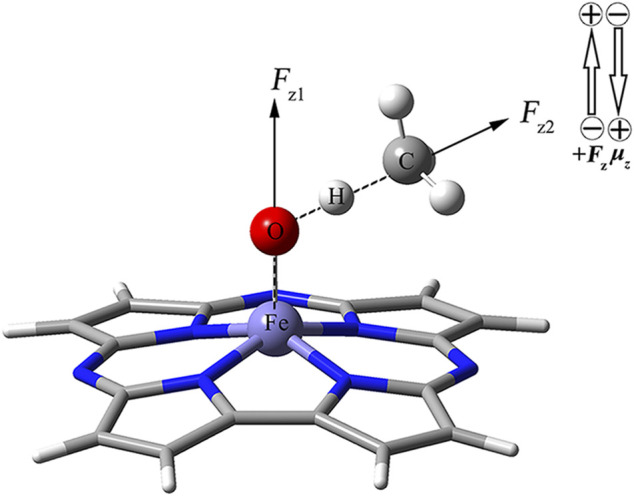
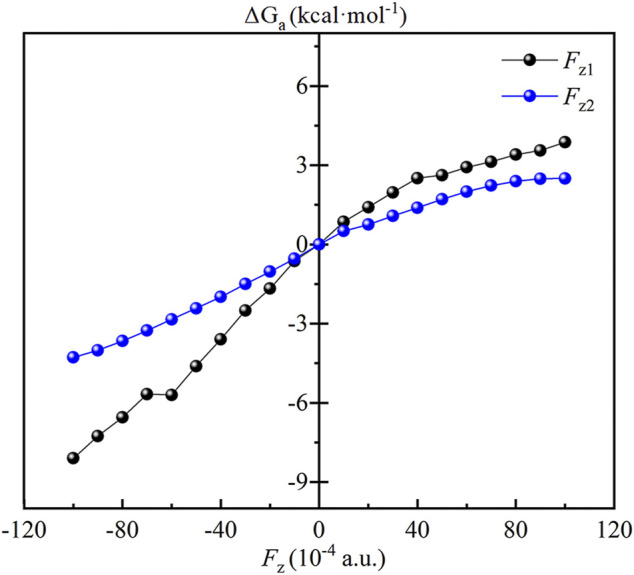
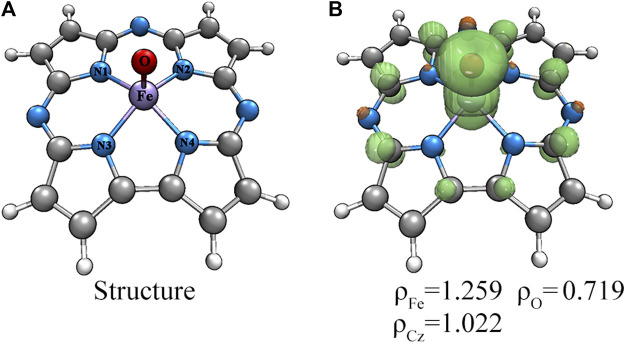
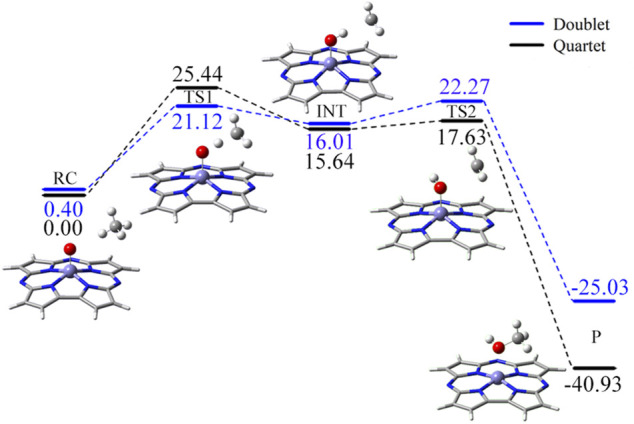
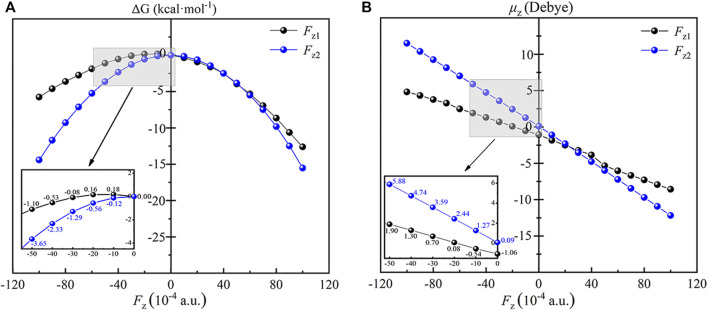
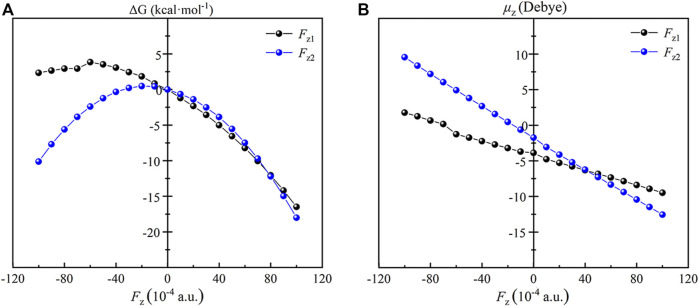
Methane is the simplest alkane and can be used as an alternative energy source for oil and coal, but the greenhouse effect caused by its leakage into the air is not negligible, and its conversion into liquid methanol not only facilitates transportation, but also contributes to carbon neutrality. In order to find an efficient method for converting methane to methanol, CH oxidation catalyzed by Fe(IV)-Oxo-corrolazine (Fe(IV)-Oxo-Cz) and its reaction mechanism regulation by oriented external electric fields (OEEFs) are systematically studied by density functional calculations. The calculations show that Fe(IV)-Oxo-Cz can abstract one H atom from CH to form the intermediate with OH group connecting on the corrolazine ring, with the energy barrier of 25.44 kcal mol. And then the product methanol is formed through the following rebound reaction. Moreover, the energy barrier can be reduced to 20.72 kcal mol through a two-state reaction pathway. Furthermore, the effect of OEEFs on the reaction is investigated. We found that OEEFs can effectively regulate the reaction by adjusting the stability of the reactant and the transition state through the interaction of electric field-molecular dipole moment. When the electric field is negative, the energy barrier of the reaction decreases with the increase of electric intensity. Moreover, the OEEF aligned along the intrinsic FeO reaction axis can effectively regulate the ability of forming the OH on the corrolazine ring by adjusting the charges of O and H atoms. When the electric field intensity is -0.010 a.u., the OH can be directly rebounded to the CH· before it is connecting on the corrolazine ring, thus forming the product directly from the transition state without passing through the intermediate with only an energy barrier of 17.34 kcal mol, which greatly improves the selectivity of the reaction.
甲烷是最简单的烷烃,可作为石油和煤炭的替代能源,但它泄漏到空气中所造成的温室效应不可忽视,将其转化为液态甲醇不仅便于运输,还有助于实现碳中和。为了找到一种将甲烷转化为甲醇的有效方法,通过密度泛函计算系统地研究了由Fe(IV)-氧代-咕啉(Fe(IV)-Oxo-Cz)催化的CH氧化反应及其通过定向外部电场(OEEFs)的反应机理调控。计算结果表明,Fe(IV)-Oxo-Cz可以从CH中夺取一个H原子,形成在咕啉环上连接有OH基团的中间体,能垒为25.44千卡/摩尔。然后通过后续的反弹反应生成产物甲醇。此外,通过双态反应途径,能垒可降低至20.72千卡/摩尔。进一步研究了OEEFs对该反应的影响。我们发现,OEEFs可以通过电场 - 分子偶极矩的相互作用来调节反应物和过渡态的稳定性,从而有效地调控反应。当电场为负时,反应的能垒随着电场强度的增加而降低。而且,沿固有FeO反应轴排列的OEEF可以通过调节O和H原子的电荷,有效地调控在咕啉环上形成OH的能力。当电场强度为 -0.010 a.u.时,OH在连接到咕啉环之前就可以直接反弹到CH·上,从而直接从过渡态形成产物,而无需经过中间体,此时能垒仅为17.34千卡/摩尔,大大提高了反应的选择性。