Rodrigues Gabriel D, Vicenzi Marco, Bellocchi Chiara, Beretta Lorenzo, Carandina Angelica, Tobaldini Eleonora, Carugo Stefano, Montano Nicola
Department of Clinical Sciences and Community Health, University of Milan, Milan, Italy.
Post Graduation Program in Cardiovascular Sciences, Federal Fluminense University, Niterói, Brazil.
Front Cardiovasc Med. 2022 Jul 1;9:899290. doi: 10.3389/fcvm.2022.899290. eCollection 2022.
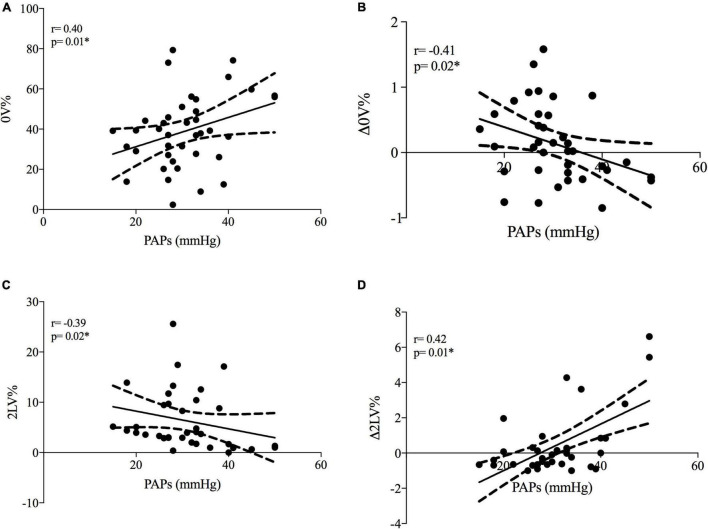
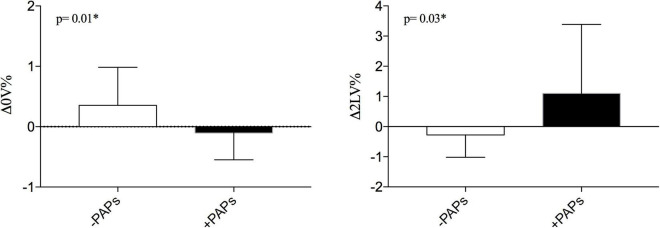
The current study was undertaken to test the hypothesis that systemic sclerosis (SSc) patients with higher systolic pulmonary arterial pressures (PAPs) present a blunted cardiac autonomic modulation and a pro-inflammatory profile. Thirty-nine SSc patients were enrolled (mean age 57 ± 11 years). ECG and respiration were recorded in the supine (SUP) position and during the active standing (ORT). Heart rate variability (HRV) analysis was performed on samples of 300 beats. The symbolic analysis identified three patterns, 0V%, (sympathetic) and 2UV% and 2LV%, (vagal). The %ΔORT was calculated from the differences between HRV in ORT and SUP, normalized (%) by the HRV values at rest. The PAPs was obtained non-invasively through echocardiography. For the inter-group analysis, participants were allocated in groups with higher (+PAPs ≥ median) and lower PAPs (-PAPs < median) values. At rest, the cardiac sympathetic modulation (represented by 0V%) was positively correlated with PAPs, while parasympathetic modulation (represented by 2LV%) was negatively correlated with PAPs. The dynamic response to ORT (represented by Δ0V% and Δ2LV%), sympathetic and parasympathetic were negatively and positively correlated with PAPs, respectively. The +PAPs group presented a higher inflammatory status and a blunted cardiac autonomic response to ORT (↓Δ0V% and ↑Δ2LV%) compared to the -PAPs group. These findings suggest an interplay among cardiac autonomic control, inflammatory status, and cardiopulmonary mechanics that should be considered for the assessment, monitoring, and treatment of SSc patients.
收缩期肺动脉压(PAPs)较高的系统性硬化症(SSc)患者存在心脏自主神经调节功能减弱和促炎状态。纳入了39例SSc患者(平均年龄57±11岁)。在仰卧位(SUP)和主动站立位(ORT)记录心电图和呼吸。对300次心跳的样本进行心率变异性(HRV)分析。符号分析确定了三种模式,0V%(交感神经)、2UV%和2LV%(迷走神经)。%ΔORT根据ORT和SUP时HRV的差异计算得出,并通过静息时的HRV值进行标准化(%)。通过超声心动图无创获取PAPs。对于组间分析,参与者被分为PAPs较高(+PAPs≥中位数)和较低(-PAPs<中位数)两组。静息时,心脏交感神经调节(以0V%表示)与PAPs呈正相关,而副交感神经调节(以2LV%表示)与PAPs呈负相关。对ORT的动态反应(以Δ0V%和Δ2LV%表示)中,交感神经和副交感神经分别与PAPs呈负相关和正相关。与-PAPs组相比,+PAPs组呈现出更高的炎症状态和对ORT的心脏自主神经反应减弱(↓Δ0V%和↑Δ2LV%)。这些发现提示在评估、监测和治疗SSc患者时,应考虑心脏自主神经控制、炎症状态和心肺力学之间的相互作用。