Kankilic Berna, Bayramli Erdal, Korkusuz Petek, Eroglu Hakan, Sener Burcin, Mutlu Pelin, Korkusuz Feza
Graduate School of Natural and Applied Sciences, Middle East Technical University, Ankara, Turkey.
Department of Chemistry, Faculty of Arts and Sciences, Middle East Technical University, Ankara, Turkey.
Front Surg. 2022 Jul 1;9:885241. doi: 10.3389/fsurg.2022.885241. eCollection 2022.
Chronic osteomyelitis, including implant-related prosthetic joint infection, is extremely difficult to cure. We develop vancomycin containing release systems from poly(d,l-lactide) (PDLLA) and poly(d,l-lactide-co-glycolide) (PLGA) composites with beta-tricalcium phosphate (β-TCP) to treat methicillin-resistant osteomyelitis. We ask whether vancomycin containing PDLLA/β-TCP and PLGA/β-TCP composites will prevent early biofilm formation, allow cell proliferation and osteogenic differentiation, and stimulate osteogenic signaling molecules in the absence of an osteogenic medium.
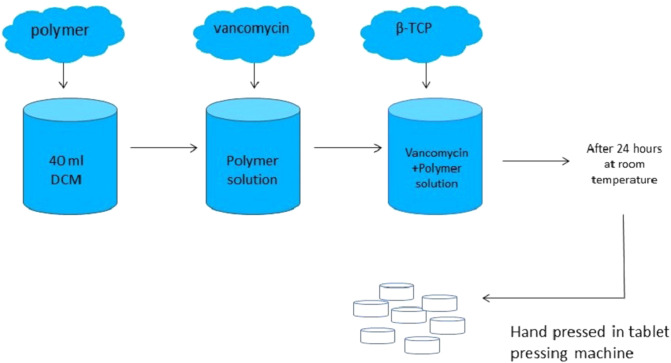
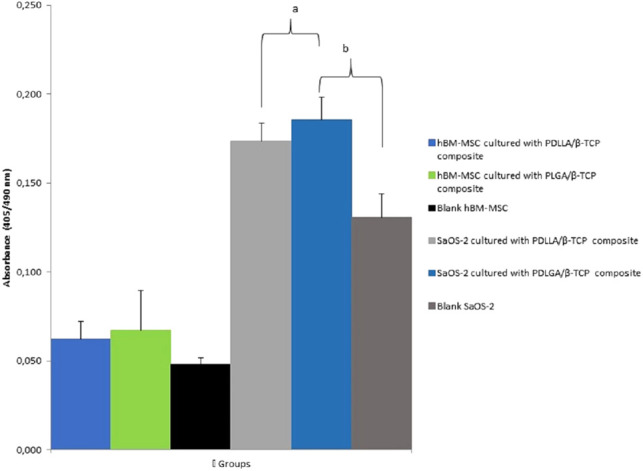
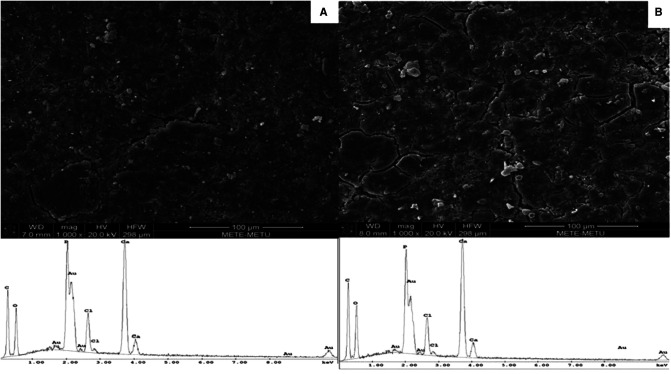
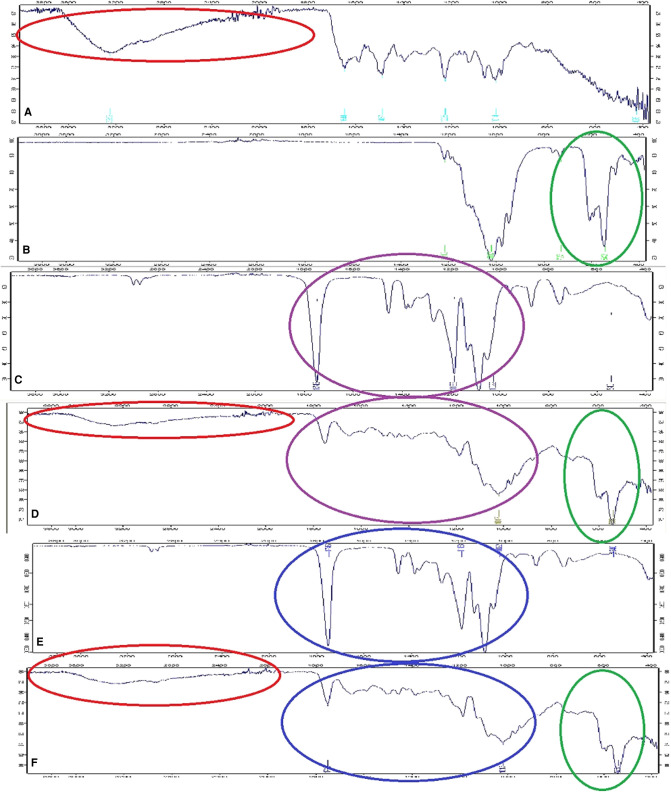
Composites were produced and characterized with scanning electron microscopy. vancomycin release was assessed for 6 weeks. Biofilm prevention was calculated by crystal violet staining. Human bone marrow-derived mesenchymal stem cells (hBM-MSCs) and osteosarcoma cell (SaOS-2) proliferation and differentiation were assessed with water soluble tetrazolium salt and alkaline phosphatase (ALP) staining. Real-time quantitative polymerase chain reaction defined osteogenic signaling molecules for hBM-MSCs.
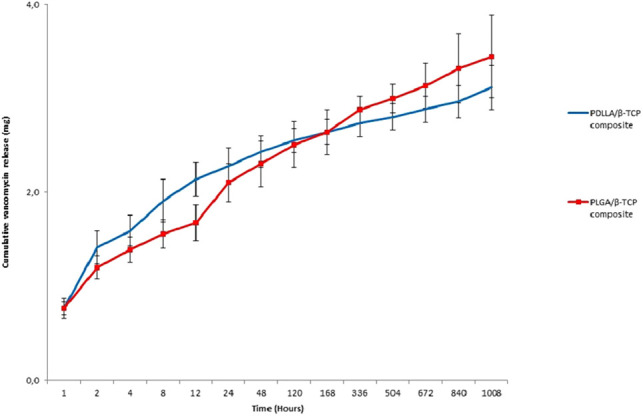
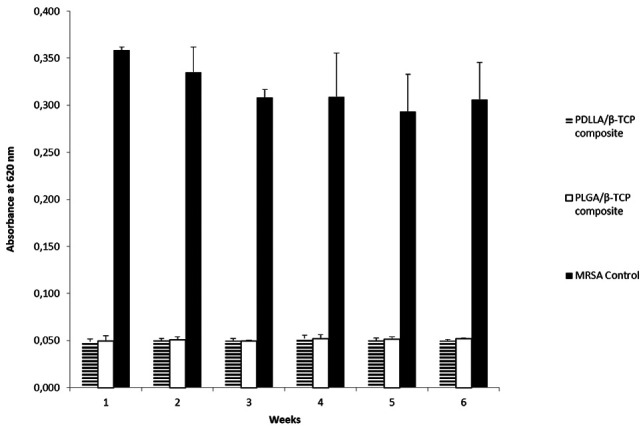
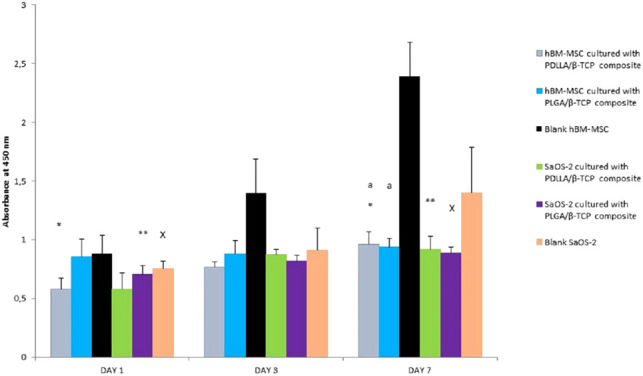
Totally, 3.1 ± 0.2 mg and 3.4 ± 0.4 mg vancomycin released from PDLLA/β-TCP and the PLGA/β-TCP composites, respectively, and inhibited early biofilm formation. hBM-MSCs and SaOS-2 cells proliferated on the composites and stimulated ALP activity of cells. Runt-related transcription factor 2 (RUNX2) and SRY-Box transcription Factor 9 (SOX9) expressions were, however, lower with composites when compared with control.
Vancomycin containing PDLLA/β-TCP and PLGA/β-TCP composites inhibited early biofilm formation and proliferated and differentiated hBM-MSCs and SaOS-2 cells, but osteogenesis-related RUNX2 and SOX9 transcription factors were not strongly expressed in the absence of an osteogenic medium for 14 days.
慢性骨髓炎,包括与植入物相关的人工关节感染,极难治愈。我们研发了由聚(d,l-丙交酯)(PDLLA)和聚(d,l-丙交酯-共-乙交酯)(PLGA)复合材料与β-磷酸三钙(β-TCP)组成的含万古霉素缓释系统,用于治疗耐甲氧西林骨髓炎。我们探究含万古霉素的PDLLA/β-TCP和PLGA/β-TCP复合材料是否能预防早期生物膜形成、促进细胞增殖和成骨分化,并在无成骨培养基的情况下刺激成骨信号分子。
制备复合材料并用扫描电子显微镜进行表征。评估万古霉素6周的释放情况。通过结晶紫染色计算生物膜预防效果。用水溶性四氮唑盐和碱性磷酸酶(ALP)染色评估人骨髓间充质干细胞(hBM-MSCs)和骨肉瘤细胞(SaOS-2)的增殖与分化。实时定量聚合酶链反应确定hBM-MSCs的成骨信号分子。
PDLLA/β-TCP和PLGA/β-TCP复合材料分别释放了3.1±0.2mg和3.4±0.4mg万古霉素,并抑制了早期生物膜形成。hBM-MSCs和SaOS-2细胞在复合材料上增殖,并刺激了细胞的ALP活性。然而,与对照组相比,复合材料组的 runt相关转录因子2(RUNX2)和SRY盒转录因子9(SOX9)表达较低。
含万古霉素的PDLLA/β-TCP和PLGA/β-TCP复合材料抑制了早期生物膜形成,并使hBM-MSCs和SaOS-2细胞增殖和分化,但在无成骨培养基的情况下培养14天时,与成骨相关的RUNX2和SOX9转录因子表达不强烈。