Codo Toafode Nonvignon Murielle, Marquardt Peter, Ahyi Virgile, Fester Karin, Spiegler Verena, Vissiennon Cica
Inter-Regional University of Industrial Engineering Biotechnologies and Applied Sciences, IRGIB Africa University, Cotonou, Benin.
Institute of Medical Physics and Biophysics, Leipzig University, Leipzig, Germany.
Front Pharmacol. 2022 Jun 30;13:931240. doi: 10.3389/fphar.2022.931240. eCollection 2022.
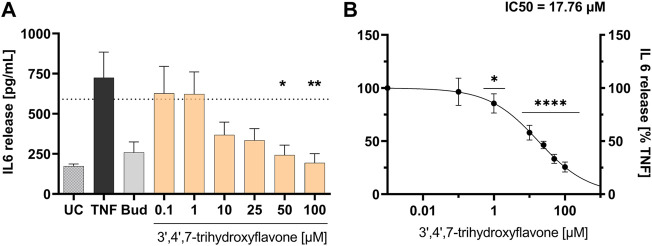
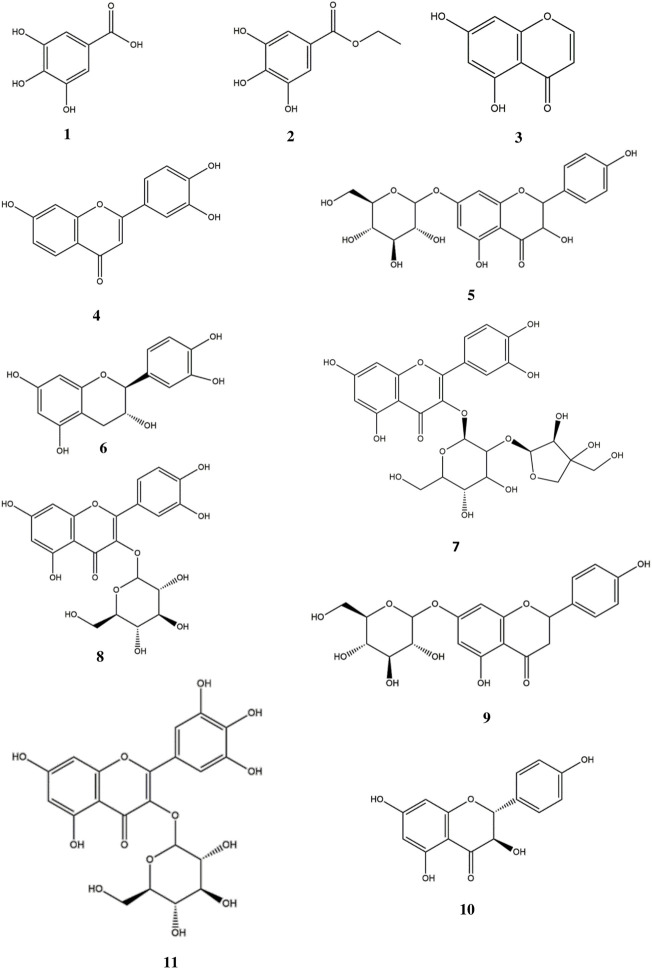
In West African medicine, Guill. & Perr. from the family of Fabaceae is used to treat inflammatory conditions in the management of fractures, wounds, and sprains in the northern region of the Republic of Benin. The aim of the present study was to isolate and elucidate phenolic compounds from a hydroalcoholic leaf extract from and to identify compounds with anti-inflammatory activity . Eleven compounds were purified from three fractions, which have shown strong to medium anti-inflammatory activity. The isolated compounds were characterized by HRESI-MS and NMR methods as gallic acid (), ethyl gallate (), 5,7-dihydroxychromen-4-one (), 3',4',7-trihydroxyflavone (), dihydrokaempferol-7--glucoside (), catechin (), quercetin-3--[β-apiosyl-(1‴→2″)-β-glucoside] (), quercetin-3--glucoside (), naringenin-7--glucoside (), aromadendrin (), and myricetin-3--glucoside (). Nine of the major phenolic compounds were tested using TNF-α stimulated human keratinocytes (HaCaT) as skin inflammation model to identify molecules, which may explain the use of the plant leaves as an anti-inflammatory remedy by assessing the release of proinflammatory cytokines IL-8 and IL-6. The hydroacoholic leaf extract of exerted a medium inhibitory effect on the release of IL-8. 3',4',7-trihydroxyflavone, aromadendrin, dihydrokaempferol-7--glucoside and ethyl gallate demonstrated a strong to medium effect on the release of IL-6. For the release of IL-8, 3',4',7-trihydroxyflavone demonstrated a medium activity. This study provides for the first time a detailed screening of phenolic compounds occurring in the hydroethanolic leaf extract of . Additionally, it is shown that contains active compounds which may justify its traditional medicinal use as an anti-inflammatory remedy to treat inflammatory and pain-related skin conditions in the Republic of Benin.
在西非医学中,豆科的Guill. & Perr.被用于治疗贝宁共和国北部地区骨折、伤口和扭伤管理中的炎症。本研究的目的是从其水醇叶提取物中分离并阐明酚类化合物,并鉴定具有抗炎活性的化合物。从三个馏分中纯化出了11种化合物,它们表现出强到中等的抗炎活性。通过高分辨电喷雾电离质谱(HRESI-MS)和核磁共振(NMR)方法将分离出的化合物鉴定为没食子酸、没食子酸乙酯、5,7-二羟基色原酮、3',4',7-三羟基黄酮、二氢山奈酚-7-O-葡萄糖苷、儿茶素、槲皮素-3-O-[β-芹菜糖基-(1‴→2″)-β-葡萄糖苷]、槲皮素-3-O-葡萄糖苷、柚皮素-7-O-葡萄糖苷、芳樟醇、杨梅素-3-O-葡萄糖苷。使用肿瘤坏死因子-α刺激的人角质形成细胞(HaCaT)作为皮肤炎症模型,对9种主要酚类化合物进行了测试,以通过评估促炎细胞因子白细胞介素-8(IL-8)和白细胞介素-6(IL-6)的释放来鉴定可能解释该植物叶作为抗炎药物用途的分子。该植物的水醇叶提取物对IL-8的释放具有中等抑制作用。3',4',7-三羟基黄酮、芳樟醇、二氢山奈酚-7-O-葡萄糖苷和没食子酸乙酯对IL-6的释放表现出强到中等的作用。对于IL-8的释放,3',4',7-三羟基黄酮表现出中等活性。本研究首次对该植物水乙醇叶提取物中存在的酚类化合物进行了详细筛选。此外,研究表明该植物含有活性化合物,这可能证明其在贝宁共和国作为抗炎药物治疗炎症和疼痛相关皮肤疾病的传统药用价值。