Hatami Elham, B Nagesh Prashanth K, Sikander Mohammed, Dhasmana Anupam, Chauhan Subhash C, Jaggi Meena, Yallapu Murali M
Department of Pharmaceutical Sciences, University of Tennessee Health Science Center, Memphis, Tennessee 38163, United States.
Department of Bioengineering, University of California, Los Angeles, California 90095, United States.
ACS Omega. 2022 Jun 28;7(27):23939-23949. doi: 10.1021/acsomega.2c02727. eCollection 2022 Jul 12.
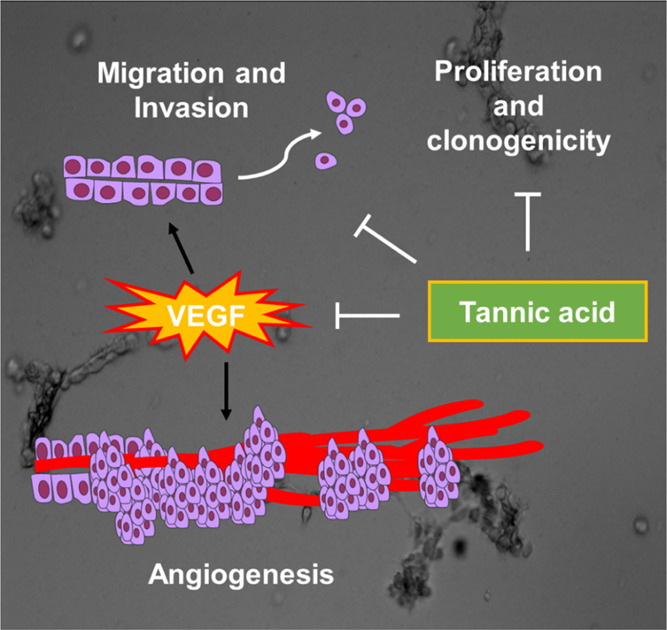
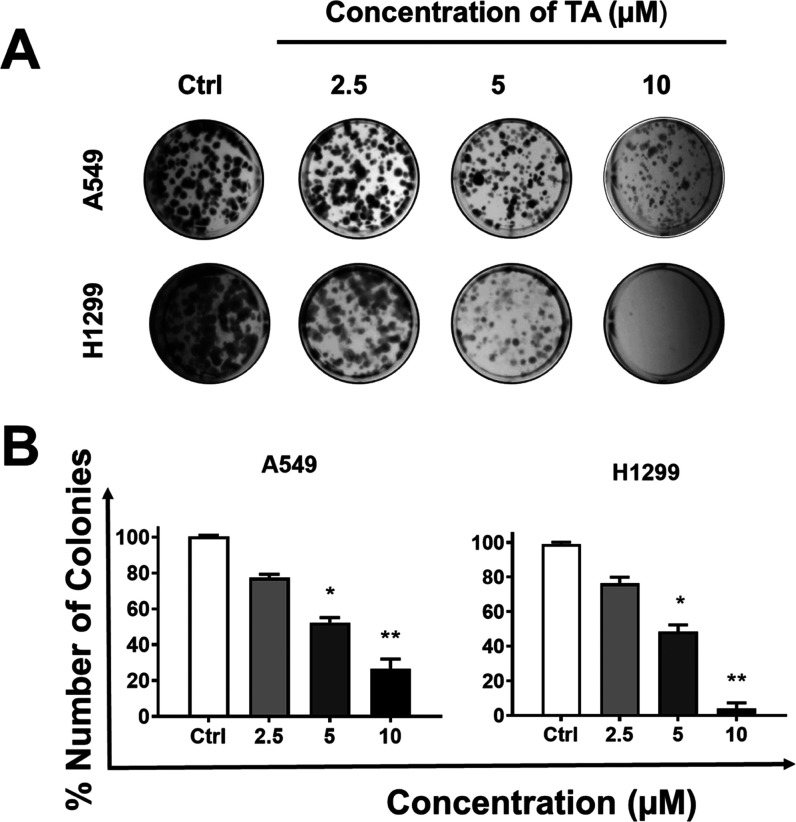
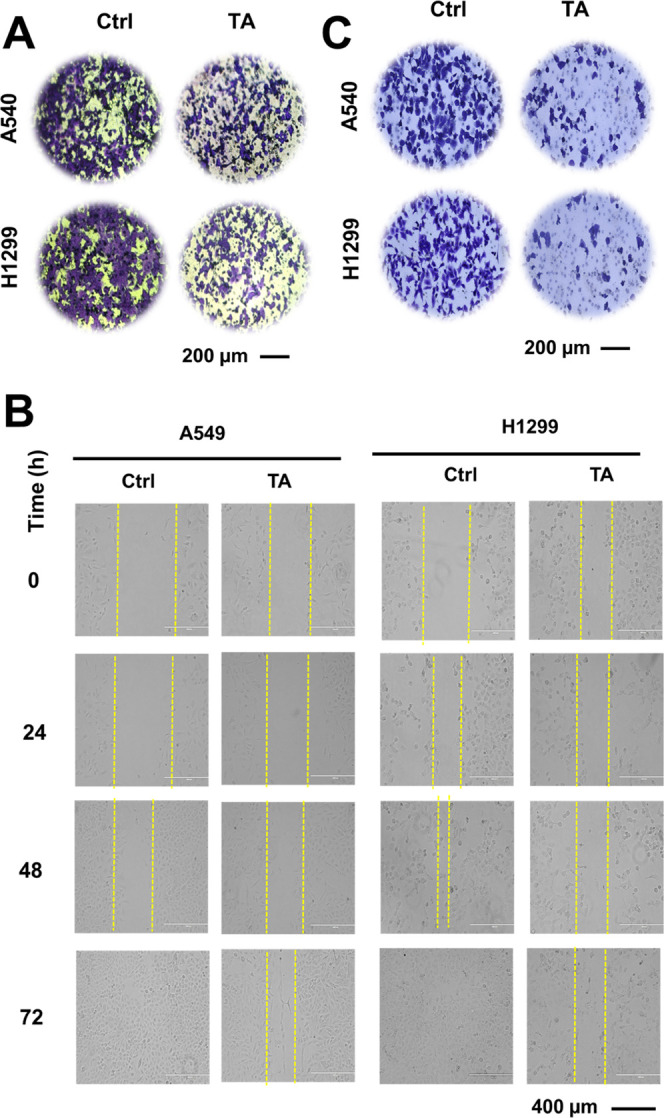
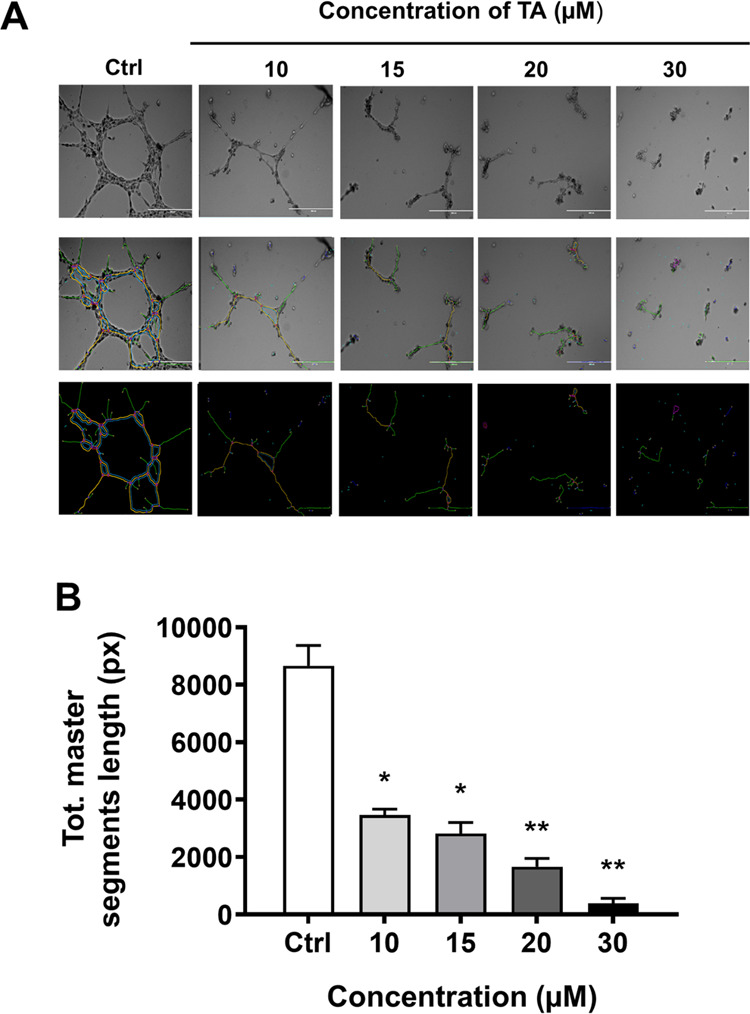
Nonsmall-cell lung cancer (NSCLC) is the most common type of lung cancer, with a dismal prognosis. NSCLC is a highly vascularized tumor, and chemotherapy is often hampered by the development of angiogenesis. Therefore, suppression of angiogenesis is considered a potential treatment approach. Tannic acid (TA), a natural polyphenol, has been demonstrated to have anticancer properties in a variety of cancers; however, its angiogenic properties have yet to be studied. Hence, in the current study, we investigated the antiproliferative and antiangiogenic effects of TA on NSCLC cells. The (3-(4,5-dimethylthiazol-2-yl)-5-(3-carboxymethoxyphenyl)-2-(4-sulfophenyl)-2-tetrazolium) (MTS) assay revealed that TA induced a dose- and time-dependent decrease in the proliferation of A549 and H1299 cells. However, TA had no significant toxicity effects on human bronchial epithelial cells. Clonogenicity assay revealed that TA suppressed colony formation ability in NSCLC cells in a dose-dependent manner. The anti-invasiveness and antimigratory potential of TA were confirmed by Matrigel and Boyden chamber studies, respectively. Importantly, TA also decreased the ability of human umbilical vein endothelial cells (HUVEC) to form tube-like networks, demonstrating its antiangiogenic properties. Extracellular vascular endothelial growth factor (VEGF) release was reduced in TA-treated cells compared to that in control cells, as measured by the enzyme-linked immunosorbent assay (ELISA). Overall, these results demonstrate that TA can induce antiproliferative and antiangiogenic effects against NSCLC.
非小细胞肺癌(NSCLC)是最常见的肺癌类型,预后不佳。NSCLC是一种血管高度丰富的肿瘤,化疗常常因血管生成的发展而受到阻碍。因此,抑制血管生成被认为是一种潜在的治疗方法。单宁酸(TA)是一种天然多酚,已被证明在多种癌症中具有抗癌特性;然而,其血管生成特性尚未得到研究。因此,在本研究中,我们研究了TA对NSCLC细胞的抗增殖和抗血管生成作用。(3-(4,5-二甲基噻唑-2-基)-5-(3-羧甲氧基苯基)-2-(4-磺基苯基)-2-四唑)(MTS)试验表明,TA诱导A549和H1299细胞的增殖呈剂量和时间依赖性下降。然而,TA对人支气管上皮细胞没有明显的毒性作用。克隆形成试验表明,TA以剂量依赖性方式抑制NSCLC细胞的集落形成能力。Matrigel和Boyden小室研究分别证实了TA的抗侵袭和抗迁移潜力。重要的是,TA还降低了人脐静脉内皮细胞(HUVEC)形成管状网络的能力,证明了其抗血管生成特性。通过酶联免疫吸附测定(ELISA)测量,与对照细胞相比,TA处理的细胞中细胞外血管内皮生长因子(VEGF)释放减少。总体而言,这些结果表明TA可以诱导对NSCLC的抗增殖和抗血管生成作用。