Pollyea Daniel A, George Tracy I, Abedi Mehrdad, Bejar Rafael, Cogle Christopher R, Foucar Kathryn, Garcia-Manero Guillermo, Grinblatt David L, Komrokji Rami S, Maciejewski Jaroslaw P, Revicki Dennis A, Roboz Gail J, Savona Michael R, Scott Bart L, Sekeres Mikkael A, Thompson Michael A, Kurtin Sandra E, Louis Chrystal U, Nifenecker Melissa, Flick E Dawn, Swern Arlene S, Kiselev Pavel, Steensma David P, Erba Harry P
Department of Medicine Division of Hematology University of Colorado Aurora Colorado USA.
University of Utah and ARUP Laboratories Salt Lake City Utah USA.
EJHaem. 2020 Jun 30;1(1):58-68. doi: 10.1002/jha2.16. eCollection 2020 Jul.
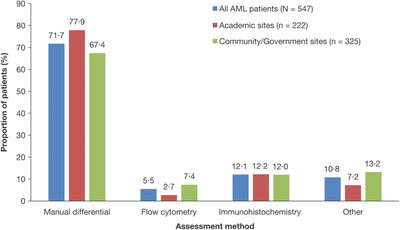
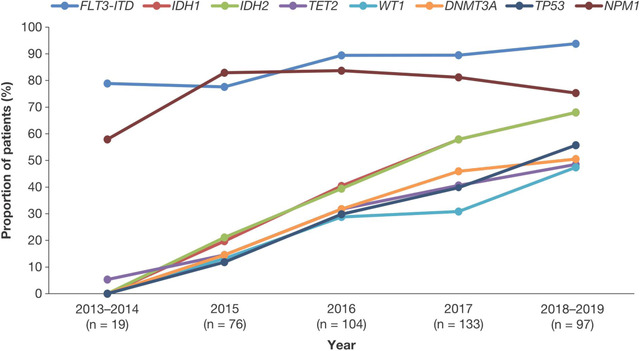
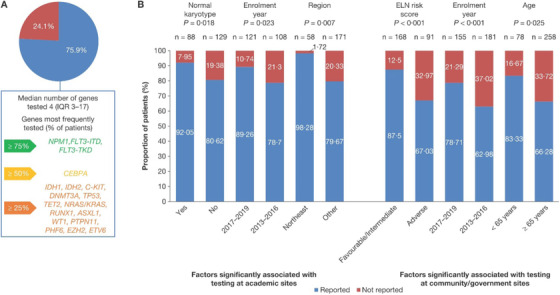
Diagnostic and molecular genetic testing are key in advancing the treatment of acute myeloid leukemia (AML), yet little is known about testing patterns outside of clinical trials, especially in older patients. We analyzed diagnostic and molecular testing patterns over time in 565 patients aged ≥ 55 years with newly diagnosed AML enrolled in the Connect MDS/AML Disease Registry (NCT01688011) in the United States. Diagnostic data were recorded at enrolment and compared with published guidelines. The percentage of bone marrow blasts was reported for 82.1% of patients, and cellularity was the most commonly reported bone marrow morphological feature. Flow cytometry, karyotyping, molecular testing, and fluorescence in situ hybridization were performed in 98.8%, 95.4%, 75.9%, and 75.7% of patients, respectively. Molecular testing was done more frequently at academic than community/government sites (84.3% vs 70.2%; < .001). Enrolment to the Registry after 2016 was significantly associated with molecular testing at academic sites (odds ratio [OR] 2.59; = .023) and at community/government sites (OR 4.85; < .001) in logistic regression analyses. Better understanding of practice patterns may identify unmet needs and inform institutional protocols regarding the diagnosis of patients with AML.
诊断和分子基因检测是推进急性髓系白血病(AML)治疗的关键,但对于临床试验之外的检测模式,尤其是老年患者的检测模式,我们所知甚少。我们分析了美国565名年龄≥55岁、新诊断为AML且参加了Connect MDS/AML疾病登记处(NCT01688011)的患者随时间推移的诊断和分子检测模式。在入组时记录诊断数据,并与已发表的指南进行比较。82.1%的患者报告了骨髓原始细胞百分比,细胞密度是最常报告的骨髓形态学特征。分别有98.8%、95.4%、75.9%和75.7% 的患者进行了流式细胞术、核型分析、分子检测和荧光原位杂交。学术机构进行分子检测的频率高于社区/政府机构(84.3% 对70.2%;P<0.001)。在逻辑回归分析中,2016年后入组登记处与学术机构(优势比[OR] 2.59;P=0.023)和社区/政府机构(OR 4.85;P<0.001)的分子检测显著相关。更好地了解实际检测模式可能有助于识别未满足的需求,并为AML患者的诊断制定机构方案提供参考。