Li Jiaqi, Li Yingxue, Zou Yaowei, Chen Yaode, He Lizhen, Wang Ying, Zhou Jingxuan, Xiao Fangqi, Niu Hongxin, Lu Lingli
Division of Nephrology, Zhujiang Hospital, Southern Medical University, Guangzhou, PR China.
Department of General Practice, Zhujiang Hospital, Southern Medical University, Guangzhou, PR China.
Ren Fail. 2022 Dec;44(1):1227-1235. doi: 10.1080/0886022X.2022.2100262.
The systemic inflammatory response index (SIRI), a novel inflammation maker, has proven to be associated with prognostic outcomes in various diseases. However, few studies have been conducted assessing how SIRI may influence outcomes of patients on peritoneal dialysis (PD). Herein, we assessed the predictive value of SIRI on mortality all-cause mortality, including cardiovascular disease (CVD) in PD patients.
A total of 646 PD patients were enrolled in this study. PD patients received regular PD treatments at the Zhujiang Hospital from 1 January 2011 to 31 December 2018. SIRI values could be computed as follows: neutrophil count × monocyte count/lymphocyte count. Patients were divided into two groups according to the median level of SIRI. Cox regression analysis and Kaplan-Meier methods were applied to analyze the relationship between SIRI and mortality outcomes in PD patients.
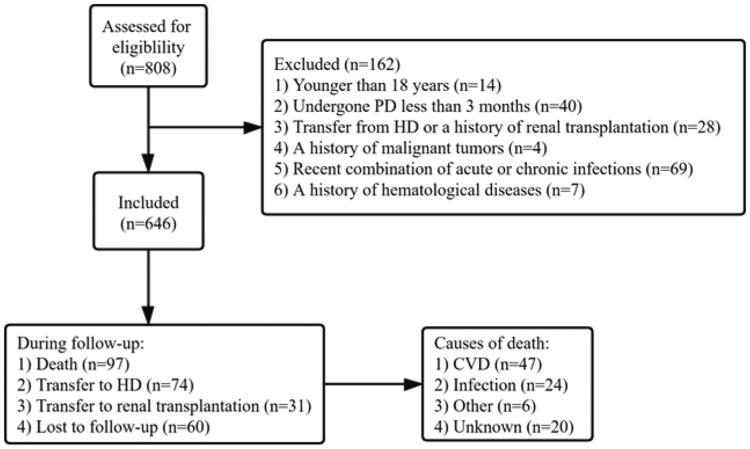
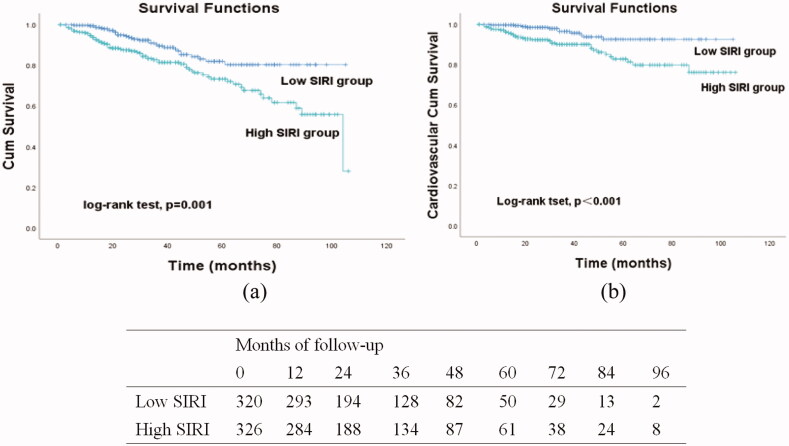
During the median 31-month follow-up period, 97 (15.0%) PD patients died from all-causes, and 47 (49.0%) died of CVD. Kaplan-Meier analyses revealed that a high SIRI corresponded to the high mortality of all-cause deaths, including CVD (both < 0.001) in patients on PD. After adjusting for potential confounders, the higher SIRI level was significantly associated with an increased all-cause mortality (HR: 2.007, 95% CI: 1.304-3.088, = 0.002) and cardiovascular mortality (HR: 2.847, 95% CI: 1.445-5.608, = 0.002).
SIRI was a promising predictor of mortality in PD patients, with a higher SIRI corresponding to increased risk of mortality.
全身炎症反应指数(SIRI)作为一种新型炎症标志物,已被证明与多种疾病的预后结果相关。然而,很少有研究评估SIRI如何影响腹膜透析(PD)患者的预后。在此,我们评估了SIRI对PD患者全因死亡率(包括心血管疾病(CVD))的预测价值。
本研究共纳入646例PD患者。这些PD患者于2011年1月1日至2018年12月31日在珠江医院接受常规PD治疗。SIRI值可按以下公式计算:中性粒细胞计数×单核细胞计数/淋巴细胞计数。根据SIRI的中位数水平将患者分为两组。采用Cox回归分析和Kaplan-Meier方法分析SIRI与PD患者死亡率之间的关系。
在中位31个月的随访期内,97例(15.0%)PD患者死于全因,47例(49.0%)死于CVD。Kaplan-Meier分析显示,高SIRI与PD患者全因死亡(包括CVD)的高死亡率相关(两者均<0.001)。在调整潜在混杂因素后,较高的SIRI水平与全因死亡率增加显著相关(HR:2.007,95%CI:1.304-3.088,P=0.002)和心血管死亡率增加显著相关(HR:2.847,95%CI:1.445-5.608,P=0.002)。
SIRI是PD患者死亡率的一个有前景的预测指标,较高的SIRI对应着更高的死亡风险。