Department of Nephrology, The Third Affiliated Hospital of Soochow University, Changzhou, China.
Ren Fail. 2023 Dec;45(1):2160348. doi: 10.1080/0886022X.2022.2160348.
Chronic inflammation is a common complication in peritoneal dialysis (PD) patients. The aim of this study is to investigate the capacity of aggregate index of systemic inflammation (AISI), systemic immune-inflammation index (SII), and systemic inflammation response index (SIRI) to predict all-cause mortality in PD patients.
This was a single-center retrospective study. The optimal cutoff values were identified by receiver operating characteristic (ROC) curve analysis. The area under the curve (AUC) was calculated to evaluate the predictive ability of these indexes. The Kaplan-Meier curves and log-rank test were performed to estimate cumulative survival rate. Cox proportional hazards regression analyses were conducted to determine the independent prognostic power of inflammation indexes.
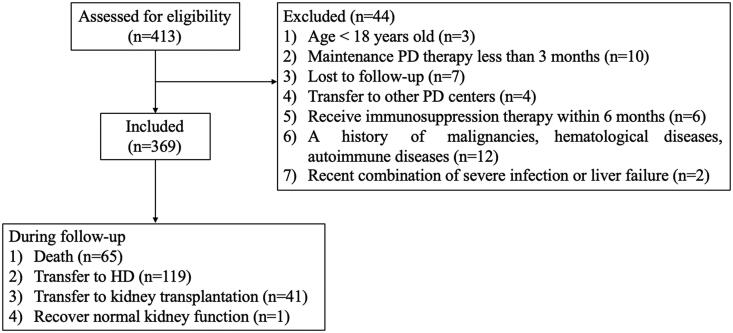
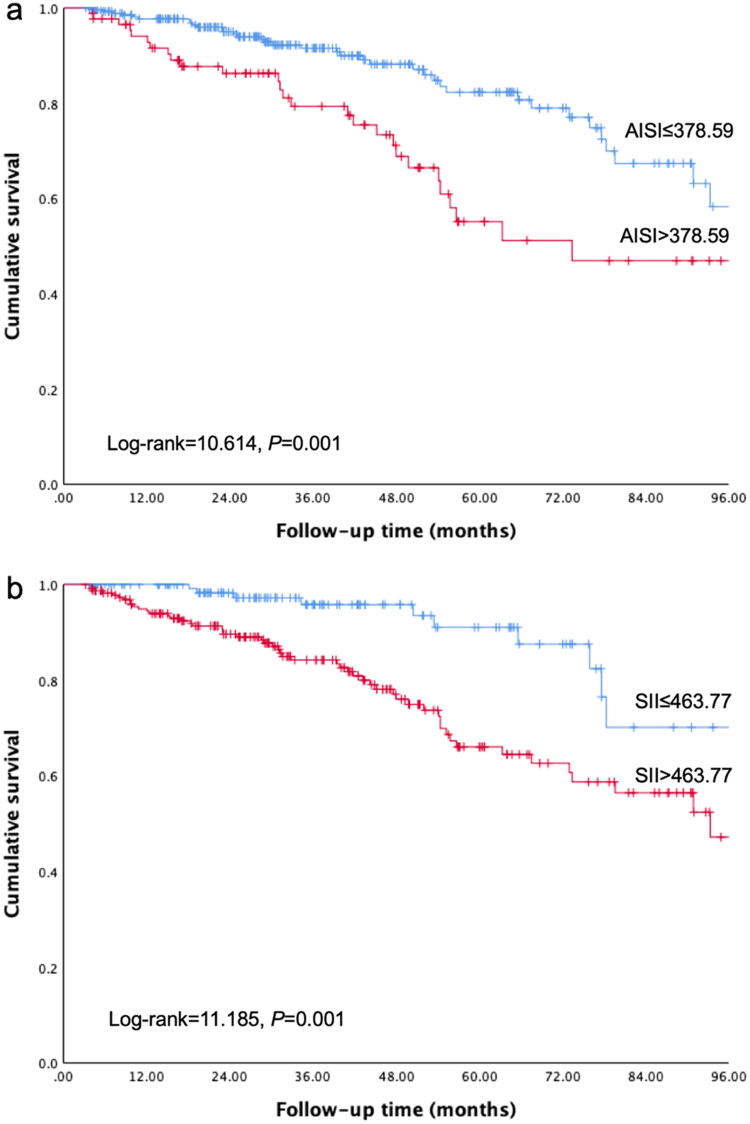
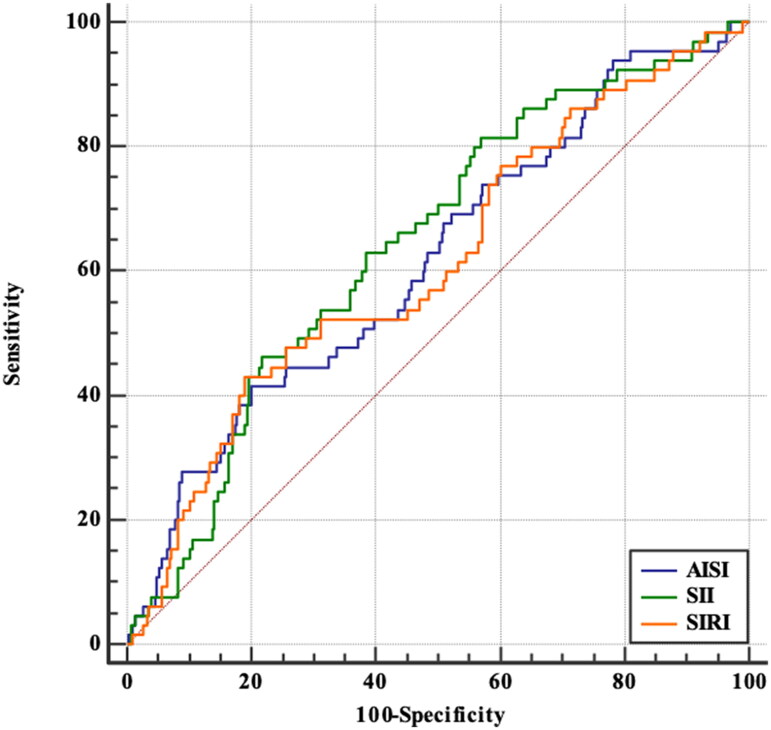
A total of 369 incident PD patients were involved. During a median follow-up period of 32.83 months, 65 patients (24.2%) died. The ROC analysis indicated the largest value of AUC was obtained for SII (AUC = 0.644, 95% CI = 0.573-0.715, < .001), followed in order by AISI (AUC = 0.617, 95% CI = 0.541-0.693, = .003), and SIRI (AUC = 0.612, 95% CI = 0.535-0.688, = .004). The Kaplan-Meier survival curves revealed significantly lower survival rate with higher AISI ( = .001), higher SSI ( = .001), and higher SIRI ( = .003). Even after adjustment for the confounding factors, higher AISI [hazard ratio (HR)=2.508, 95% confidence intervals (CI)=1.505-4.179, < .001), SII (HR = 3.477, 95% CI = 1.785-6.775, < .001), and SIRI (HR = 1.711, 95% CI = 1.012-2.895, = .045) remained as independent predictors of all-cause mortality.
The higher AISI, SII, and SIRI were independent indicators of all-cause mortality in PD patients. Furthermore, they could provide comparable predictive value and assist clinicians to ameliorate PD management.
慢性炎症是腹膜透析(PD)患者的常见并发症。本研究旨在探讨全身炎症综合指数(AISI)、全身免疫炎症指数(SII)和全身炎症反应指数(SIRI)对 PD 患者全因死亡率的预测能力。
这是一项单中心回顾性研究。通过接受者操作特征(ROC)曲线分析确定最佳截断值。计算曲线下面积(AUC)以评估这些指标的预测能力。采用 Kaplan-Meier 曲线和对数秩检验估计累积生存率。采用 Cox 比例风险回归分析确定炎症指标的独立预后能力。
共纳入 369 例初发 PD 患者。在中位随访 32.83 个月期间,65 例患者(24.2%)死亡。ROC 分析表明,SII 的 AUC 值最大(AUC = 0.644,95%CI = 0.573-0.715, < .001),其次是 AISI(AUC = 0.617,95%CI = 0.541-0.693, = .003),SIRI(AUC = 0.612,95%CI = 0.535-0.688, = .004)。Kaplan-Meier 生存曲线显示,AISI 越高( = .001)、SII 越高( = .001)和 SIRI 越高( = .003),生存率越低。即使在调整混杂因素后,较高的 AISI [风险比(HR)=2.508,95%置信区间(CI)=1.505-4.179, < .001]、SII(HR = 3.477,95% CI = 1.785-6.775, < .001)和 SIRI(HR = 1.711,95% CI = 1.012-2.895, = .045)仍然是全因死亡率的独立预测因素。
较高的 AISI、SII 和 SIRI 是 PD 患者全因死亡率的独立指标。此外,它们可以提供可比的预测价值,并有助于临床医生改善 PD 管理。