Department of Physics & I3N, University of Aveiro, Aveiro, Portugal.
J Biol Rhythms. 2022 Oct;37(5):545-561. doi: 10.1177/07487304221107834. Epub 2022 Jul 17.
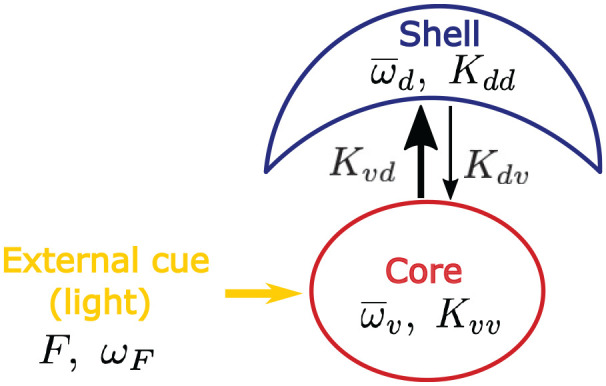
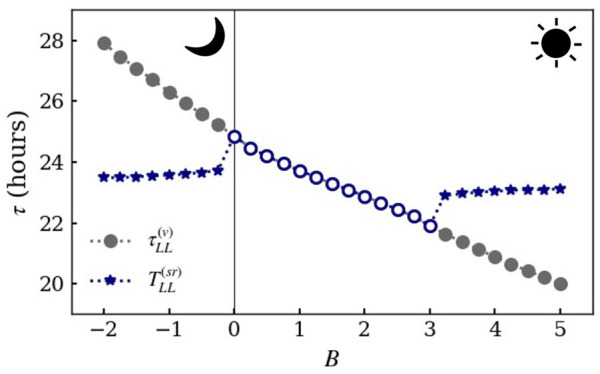
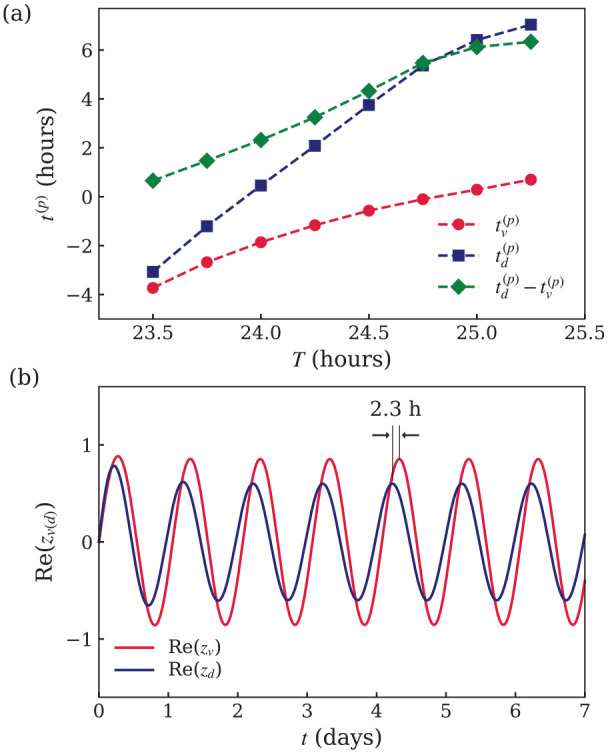
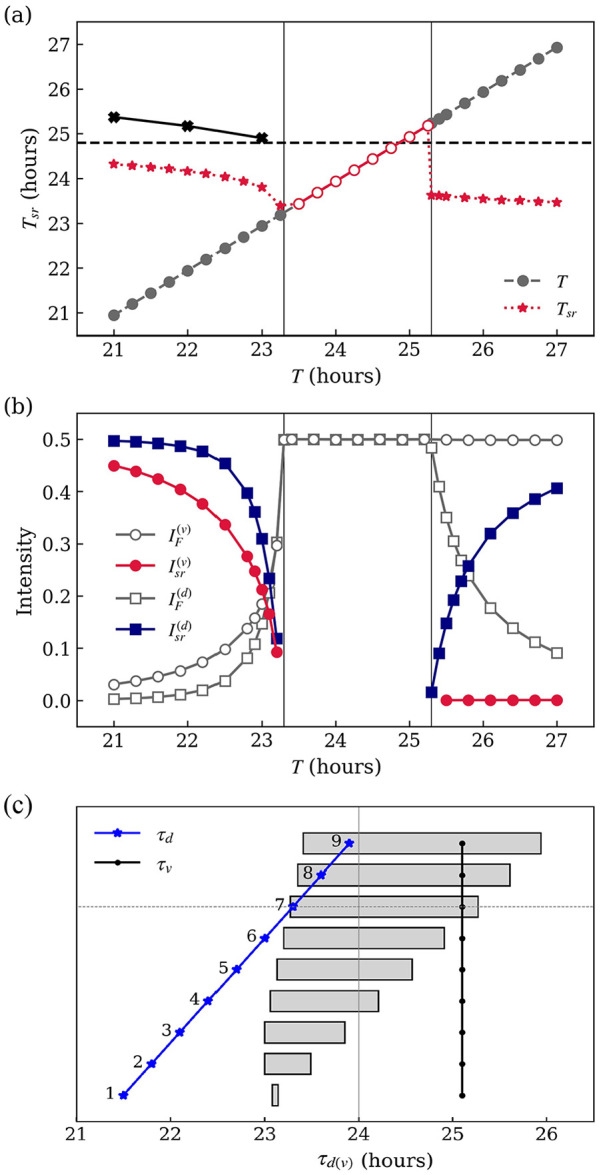
We focus our research on how the core-shell organization controls behavior of the suprachiasmatic nucleus (SCN), how the core and shell are synchronized to the environment, what impact they have on the behavior of the SCN under different lighting conditions, and what mechanisms disrupt synchronization. To this end, we use a reduced Kuramoto model, with parameters inferred from experimental observations and calibrated for mice, and perform a detailed comparison between the model and experimental data under light-dark (LD), dark-dark (DD), and light-light (LL) conditions. The operating limits of free-running and entrained SCN activity under symmetric LD cycles are analyzed, with particular focus on the phenomena of anticipation and dissociation. Results reveal that the core-shell organization of the SCN enables anticipation of future events over circadian cycles. The model predicts the emergence of a second (dissociated) rhythm for large and small LD periods. Our results are in good qualitative and quantitative agreement with experimental observations of circadian dissociation. We further describe SCN activity under LL conditions and show that our model satisfies Aschoff's first rule, according to which the endogenous free-running circadian period observed under complete darkness will shorten in diurnal animals and lengthen in nocturnal animals under constant light. Our results strongly suggest that the Kuramoto model captures essential features of synchronization and entrainment in the SCN. Moreover, our approach is easily extendible to an arbitrary number of groups, with dynamics described by explicit equations for the group phase and synchronization index. Viewed together, the reduced Kuramoto model presents itself as a useful tool for exploring open problems in the study of circadian rhythms, one that can account for evolving views of the circadian system's organization, including peripheral clocks and inter-hemispheric interaction, and can be translated to other nocturnal and diurnal animals, including humans.
我们的研究重点是核(SCN)的核心-壳组织如何控制行为,核心和壳如何与环境同步,它们对不同光照条件下 SCN 行为的影响,以及哪些机制会破坏同步。为此,我们使用了一个简化的 Kuramoto 模型,其参数是根据实验观察推断出来的,并针对小鼠进行了校准,然后在光暗(LD)、暗暗(DD)和光光(LL)条件下对模型和实验数据进行了详细比较。分析了自由运行和受约束的 SCN 活动在对称 LD 周期下的运行限制,特别关注预期和分离现象。结果表明,SCN 的核心-壳组织能够预测未来的昼夜节律事件。该模型预测了大 LD 和小 LD 周期下出现第二个(分离)节律的现象。我们的结果与昼夜节律分离的实验观察结果具有良好的定性和定量一致性。我们进一步描述了 LL 条件下 SCN 的活动,并表明我们的模型满足 Aschoff 的第一定律,根据该定律,在完全黑暗下观察到的内源性自由运行昼夜周期在昼行动物中会缩短,在夜行动物中会在恒定光下延长。我们的结果强烈表明,Kuramoto 模型捕获了 SCN 中同步和约束的基本特征。此外,我们的方法很容易扩展到任意数量的组,组相和同步指数的动力学由显式方程描述。总的来说,简化的 Kuramoto 模型本身就是探索昼夜节律研究中开放性问题的有用工具,它可以解释昼夜系统组织的不断发展的观点,包括外周时钟和半球间相互作用,并可以转化为其他夜间和日间动物,包括人类。