Faculty of Life Sciences and Medicine, King's College London, London, UK.
Centre for Education, Faculty of Life Sciences and Medicine, King's College London, London, UK.
Clin Exp Med. 2023 Aug;23(4):969-991. doi: 10.1007/s10238-022-00851-y. Epub 2022 Jul 18.
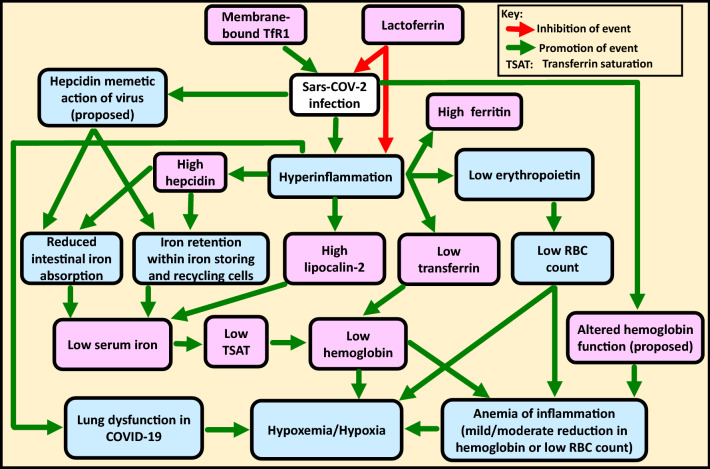
COVID-19 can cause detrimental effects on health. Vaccines have helped in reducing disease severity and transmission but their long-term effects on health and effectiveness against future viral variants remain unknown. COVID-19 pathogenesis involves alteration in iron homeostasis. Thus, a contextual understanding of iron-related parameters would be very valuable for disease prognosis and therapeutics.Accordingly, we reviewed the status of iron and iron-related proteins in COVID-19. Iron-associated alterations in COVID-19 reported hitherto include anemia of inflammation, low levels of serum iron (hypoferremia), transferrin and transferrin saturation, and high levels of serum ferritin (hyperferritinemia), hepcidin, lipocalin-2, catalytic iron, and soluble transferrin receptor (in ICU patients). Hemoglobin levels can be low or normal, and compromised hemoglobin function has been proposed. Membrane-bound transferrin receptor may facilitate viral entry, so it acts as a potential target for antiviral therapy. Lactoferrin can provide natural defense by preventing viral entry and/or inhibiting viral replication. Serum iron and ferritin levels can predict COVID-19-related hospitalization, severity, and mortality. Serum hepcidin and ferritin/transferrin ratio can predict COVID-19 severity. Here, serum levels of these iron-related parameters are provided, caveats of iron chelation for therapy are discussed and the interplay of these iron-related parameters in COVID-19 is explained.This synopsis is crucial as it clearly presents the iron picture of COVID-19. The information may assist in disease prognosis and/or in formulating iron-related adjunctive strategies that can help reduce infection/inflammation and better manage COVID-19 caused by future variants. Indeed, the current picture will augment as more is revealed about these iron-related parameters in COVID-19.
新型冠状病毒肺炎会对健康造成有害影响。疫苗有助于降低疾病严重程度和传播,但它们对健康的长期影响以及对未来病毒变异株的有效性仍不清楚。新型冠状病毒肺炎的发病机制涉及铁稳态的改变。因此,对于疾病预后和治疗,深入了解与铁相关的参数将非常有价值。
因此,我们综述了新型冠状病毒肺炎中与铁及铁相关蛋白有关的情况。迄今为止,报道的与新型冠状病毒肺炎相关的铁相关改变包括炎症性贫血、血清铁(低血症)、转铁蛋白和转铁蛋白饱和度降低,以及血清铁蛋白(高血症)、hepcidin、lipocalin-2、催化铁和可溶性转铁蛋白受体(在 ICU 患者中)水平升高。血红蛋白水平可能较低或正常,且功能受损。膜结合转铁蛋白受体可能有助于病毒进入,因此它可能成为抗病毒治疗的潜在靶点。乳铁蛋白可通过阻止病毒进入和/或抑制病毒复制来提供天然防御。血清铁和铁蛋白水平可预测与新型冠状病毒肺炎相关的住院、严重程度和死亡率。血清 hepcidin 和铁蛋白/转铁蛋白比值可预测新型冠状病毒肺炎的严重程度。
这里提供了这些与铁相关参数的血清水平,讨论了铁螯合治疗的注意事项,并解释了这些与铁相关参数在新型冠状病毒肺炎中的相互作用。这一综述非常重要,因为它清楚地呈现了新型冠状病毒肺炎的铁谱。这些信息可能有助于疾病预后,或者制定与铁相关的辅助策略,有助于减少感染/炎症,并更好地管理未来变异株引起的新型冠状病毒肺炎。实际上,随着对新型冠状病毒肺炎中这些与铁相关参数的了解增加,目前的情况将得到补充。