Shenzhen Third People's Hospital, Second Hospital Affiliated to Southern University of Science and Technology, Shenzhen, China.
Graduate Collaborative Training Base of Shenzhen Third People's Hospital, Hengyang Medical School, University of South China, Hengyang, China.
Front Public Health. 2022 Apr 26;10:881412. doi: 10.3389/fpubh.2022.881412. eCollection 2022.
Hepcidin has been identified as a systemic iron-regulatory hormone. Recent studies have suggested that iron metabolism disorders may be involved in the pathogenesis of acute respiratory distress syndrome and multiple organ dysfunction in coronavirus disease 2019 (COVID-19).
To re-evaluate the hepcidin-related iron metabolism parameters and explore the relationship between hepcidin-mediated iron dysmetabolism and COVID-19 severity.
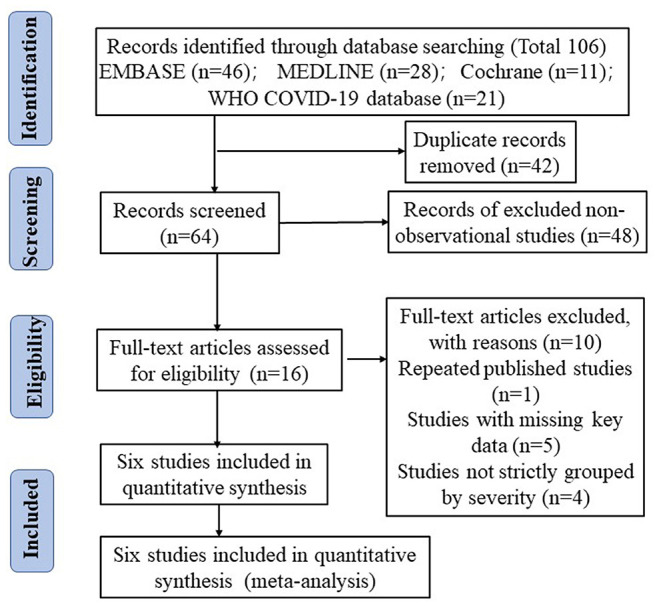
COVID-19 is classified as mild and moderate as non-severe, severe and critical as severe. A meta-analysis was conducted. Four bibliographic databases were comprehensively searched up to December 31st 2021.
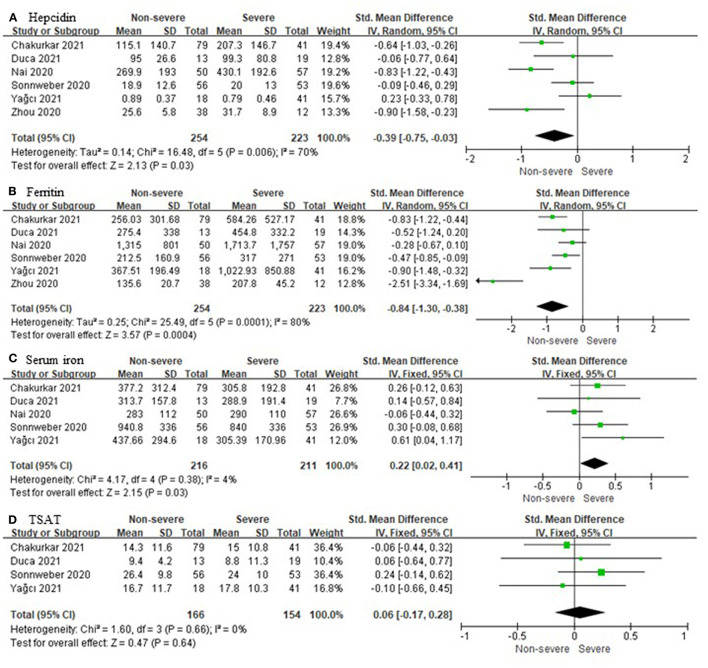
Six unique studies with data from 477 COVID-19 patients were included. Compared to non-severe cases, severe cases had higher hepcidin (standardized mean difference (SMD), -0.39; 95% Confidence Interval (CI) [-0.76, -0.03]; = 0.03) and ferritin (SMD, -0.84; 95% CI [-1.30, -0.38]; = 0.0004). In five out of six studies, a total of 427 patients were tested for serum iron, and there were significant differences in their levels between severe and non-severe cases (SMD, 0.22; 95% CI [0.02, 0.41]; = 0.03). A total of 320 patients from four out of six studies were tested for transferrin saturation, and the statistical difference was not significant (SMD, 0.06; 95% CI [-0.17, 0.28]; = 0.64).
Severe COVID-19 cases had higher serum levels of hepcidin and ferritin, and lower serum iron, without significant differences in transferrin saturation. Further studies are needed to verify whether targeting the hepcidin-mediated iron metabolism axis may influence the outcome and treatment of COVID-19.
铁调素已被确定为一种系统性铁调节激素。最近的研究表明,铁代谢紊乱可能与 2019 年冠状病毒病(COVID-19)中的急性呼吸窘迫综合征和多器官功能障碍有关。
重新评估与铁调素相关的铁代谢参数,并探讨铁调素介导的铁代谢紊乱与 COVID-19 严重程度之间的关系。
COVID-19 分为非重症(轻症和普通型)和重症(重型和危重型)。进行了一项荟萃分析。综合检索了截至 2021 年 12 月 31 日的四个文献数据库。
纳入了 6 项具有 477 例 COVID-19 患者数据的独特研究。与非重症病例相比,重症病例的铁调素(标准化均数差(SMD),-0.39;95%置信区间(CI)[-0.76,-0.03]; = 0.03)和铁蛋白(SMD,-0.84;95%CI[-1.30,-0.38]; = 0.0004)水平更高。在六项研究中的五项研究中,共 427 例患者进行了血清铁检测,重症和非重症病例的血清铁水平存在显著差异(SMD,0.22;95%CI[0.02,0.41]; = 0.03)。在六项研究中的四项研究中,共 320 例患者进行了转铁蛋白饱和度检测,但统计学差异不显著(SMD,0.06;95%CI[-0.17,0.28]; = 0.64)。
严重 COVID-19 病例的血清铁调素和铁蛋白水平较高,血清铁水平较低,转铁蛋白饱和度无显著差异。需要进一步研究以验证靶向铁调素介导的铁代谢轴是否会影响 COVID-19 的结局和治疗。