Human Advanced Microbiome Project-HMAP, Milan, Italy.
Department of Soil, Plant and Food Science, "Aldo Moro" University, Bari, Bari, Italy.
PLoS One. 2022 Jul 18;17(7):e0269933. doi: 10.1371/journal.pone.0269933. eCollection 2022.
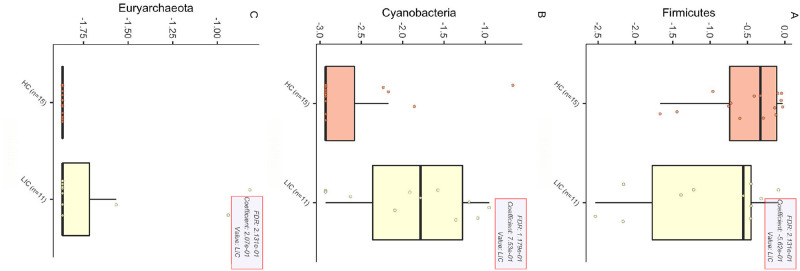
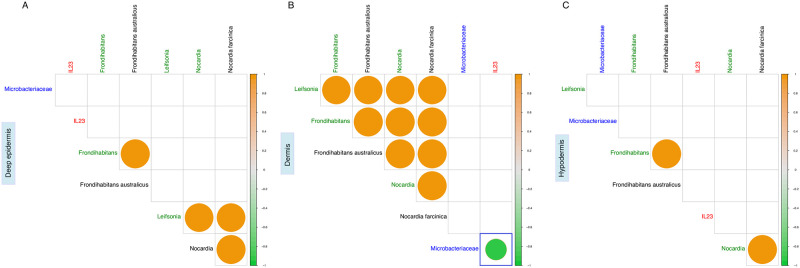
Lichen Planopilaris (LPP) is a lymphatic disease affecting the scalp that is characterized by a chronic and destructive inflammation process, named as 'cicatricial alopecia' in which the hair follicles are targeted and may involve predominantly lymphocytes or neutrophils. Scalp and biopsy layers have never been used to investigate microbial community composition and its relative taxa abundances in LPP. We sought to examine the significant taxa of this chronic relapsing inflammatory skin disease, together with inspect the existing connections with metabolic pathways featuring this microbial community. We used a multilevel analysis based on 16S rRNA marker sequencing in order to detect OTU abundances in pathologic/healthy samples, real time PCR for measuring the levels of IL-23 interleukin expression and urinary metabolomics to find out volatile organic metabolites (VOMs). By using a linear regression model, we described peculiar taxa that significantly differentiated LPP and healthy samples. We inspected taxa abundances and interleukin mRNA levels and the Microbacteriaceae family resulted negatively correlated with the IL-23 expression. Moreover, starting from 16S taxa abundances, we predicted the metabolic pathways featuring this microbial community. By inspecting microbial composition, sample richness, metabolomics profiles and the relative metabolic pathways in a cohort of LPP and healthy samples we deepened the contribution of significant taxa that are connected to inflammation maintenance and microbiota plasticity in LPP pathology.
瘢痕性类天疱疮(LPP)是一种影响头皮的淋巴疾病,其特征是慢性和破坏性炎症过程,被称为“瘢痕性脱发”,其中毛囊是靶向的,可能主要涉及淋巴细胞或中性粒细胞。头皮和活检层从未用于研究 LPP 中的微生物群落组成及其相对分类群丰度。我们试图检查这种慢性复发性炎症性皮肤病的重要分类群,同时检查与该微生物群落相关的代谢途径的现有联系。我们使用基于 16S rRNA 标记测序的多层次分析来检测病理/健康样本中的 OTU 丰度,使用实时 PCR 测量白细胞介素 23(IL-23)表达水平,并用尿代谢组学检测挥发性有机代谢物(VOM)。通过使用线性回归模型,我们描述了可显著区分 LPP 和健康样本的特有分类群。我们检查了分类群丰度和白细胞介素 mRNA 水平,并且 Microbacteriaceae 家族与 IL-23 表达呈负相关。此外,我们从 16S 分类群丰度开始,预测了具有这种微生物群落特征的代谢途径。通过检查 LPP 和健康样本的微生物组成、样本丰富度、代谢组学谱和相对代谢途径,我们深入探讨了与炎症维持和微生物群可塑性相关的重要分类群在 LPP 发病机制中的作用。