Department of Preventive Medicine and Public Health, Faculty of Medicine, University of Granada, Campus de la Salud. Avda. de la Investigación 11, 18016, Granada, Spain.
Preventive Medicine Unit, Universitary Hospital Virgen de Las Nieves, Granada, Spain.
Sci Rep. 2022 Jul 18;12(1):12252. doi: 10.1038/s41598-022-15770-x.
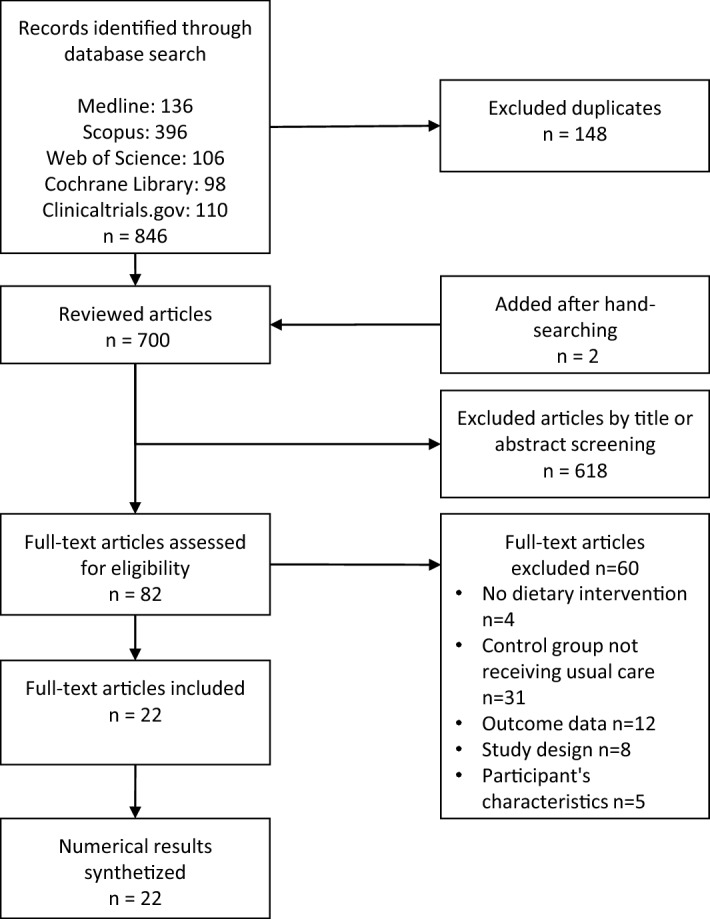
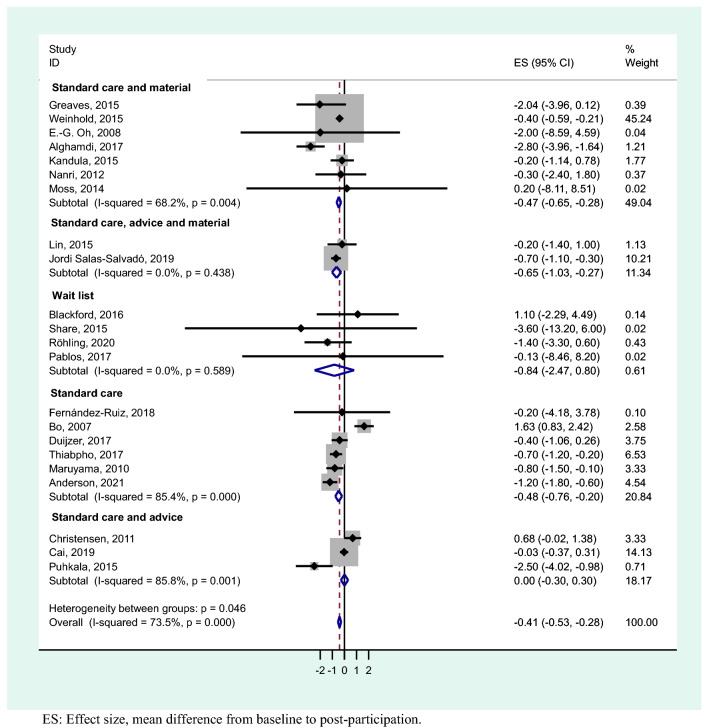
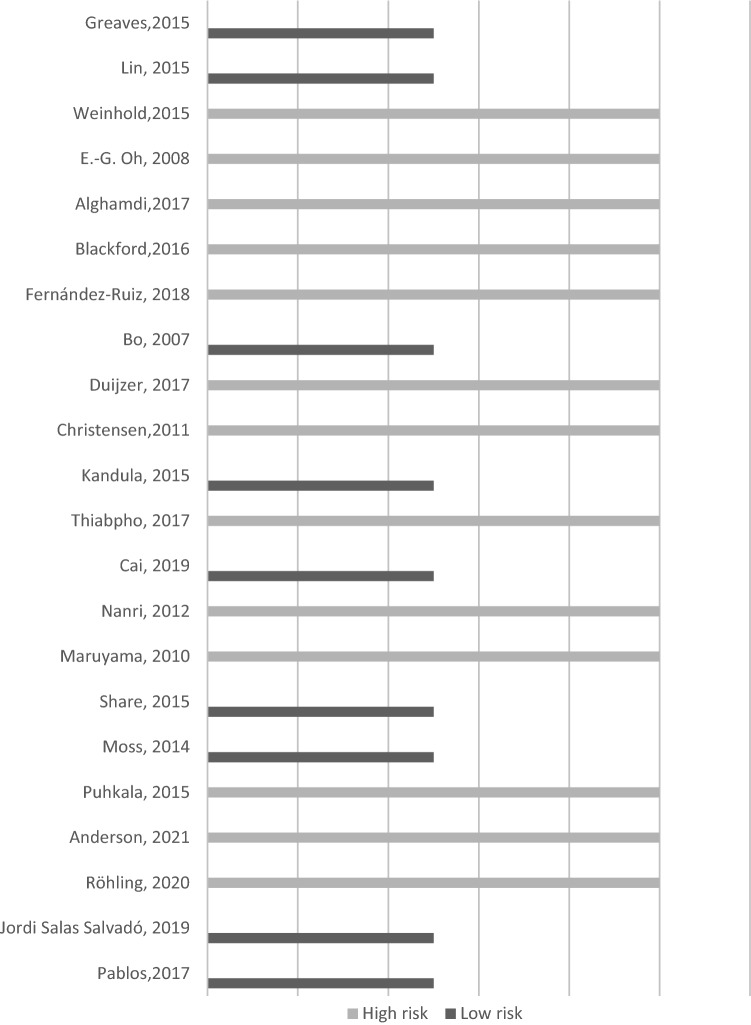
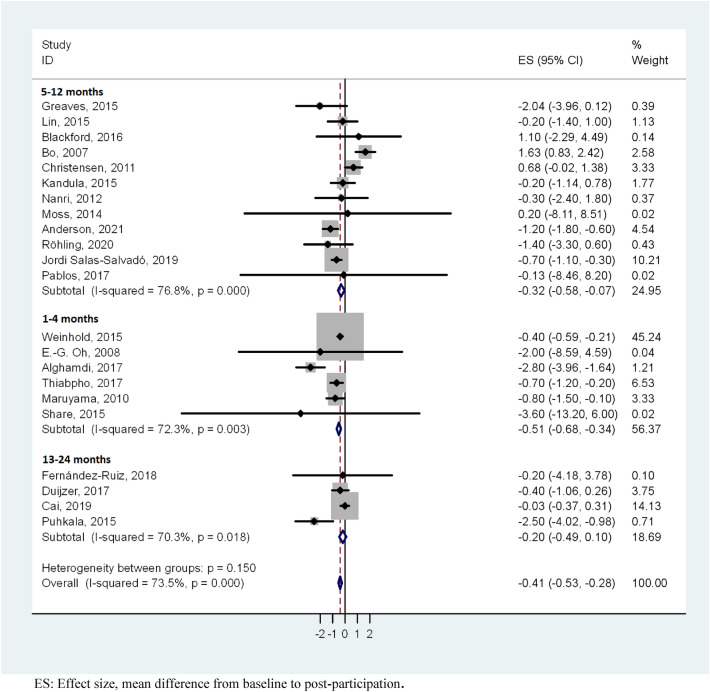
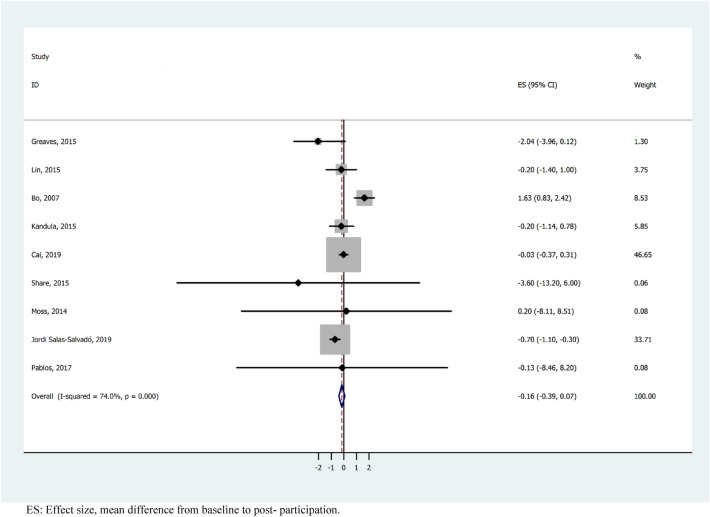
Randomized clinical trials (RCTs) of lifestyle modification have reported beneficial effects of interventions, compared to control. Whether participation in the control group has benefits is unknown. To determine whether control group participants experience weight loss during the course of RCTs. After prospective registration (PROSPERO CRD42021233070), we conducted searches in Medline, Scopus, Web of Science, Cochrane library and Clinicaltrials.gov databases from inception to May 2021 without language restriction to capture RCTs on dietary advice or physical activity interventions in adults with overweight, obesity or metabolic syndrome. Data extraction and study quality assessment was performed by two independent reviewers. Weight loss in the control group, i.e., the difference between baseline and post-intervention, was pooled using random effects model generating mean difference and 95% confidence interval (CI). Heterogeneity was assessed using the I statistical test. Subgroup meta-analysis was performed stratifying by follow-up period, type of control group protocols and high-quality studies. Among the 22 included studies (4032 participants), the risk of bias was low in 9 (40%) studies. Overall, the controls groups experienced weight loss of - 0.41 kg (95% CI - 0.53 to - 0.28; I = 73.5% p < 0.001). To identify a result that is an outlier, we inspected the forest plot for spread of the point estimates and the confidence intervals. The magnitude of the benefit was related to the duration of follow-up (- 0.51 kg, 95% CI - 0.68, - 0.3, for 1-4 months follow-up; - 0.32 kg, 95% CI - 0.58, - 0.07, 5-12 months; - 0.20 kg, 95% CI - 0.49, 0.10, ≥ 12 months). In high-quality studies we found an overall weight loss mean difference of - 0.16 (95% CI - 0.39, 0.09) with a considerable heterogeneity (I = 74%; p < 0.000). Among studies including control group in waiting lists and combining standard care, advice and material, no heterogeneity was found (I = 0%, p = 0.589) and (I = 0%, p = 0.438); and the mean difference was - 0.84 kg (95% CI - 2.47, 0.80) and - 0.65 kg (95% CI - 1.03, - 0.27) respectively. Participation in control groups of RCTs of lifestyle interventions had a benefit in terms of weight loss in meta-analysis with heterogeneity. These results should be used to interpret the benefits observed with respect to intervention effect in trials. That control groups accrue benefits should be included in patient information sheets to encourage participation in future trials among patients with overweight and obesity.
随机临床试验(RCTs)的生活方式干预已经报告了干预的有益效果,与对照组相比。目前尚不清楚对照组的参与者是否会减肥。为了确定对照组的参与者在 RCT 过程中是否会减肥。在进行前瞻性注册(PROSPERO CRD42021233070)后,我们在 Medline、Scopus、Web of Science、Cochrane 图书馆和 Clinicaltrials.gov 数据库中进行了搜索,从成立到 2021 年 5 月,没有语言限制,以捕获关于饮食建议或体力活动干预的成年人超重、肥胖或代谢综合征的 RCTs。数据提取和研究质量评估由两名独立评审员进行。使用随机效应模型生成平均差异和 95%置信区间(CI)来汇总对照组的体重减轻量,即基线和干预后之间的差异。使用 I 统计检验评估异质性。根据随访时间、对照组方案类型和高质量研究进行亚组荟萃分析。在纳入的 22 项研究(4032 名参与者)中,有 9 项(40%)研究的偏倚风险较低。总体而言,对照组的体重减轻了 -0.41kg(95%CI-0.53 至-0.28;I=73.5%,p<0.001)。为了确定一个异常值的结果,我们检查了森林图中的点估计值和置信区间的分布。获益的幅度与随访时间有关(-0.51kg,95%CI-0.68,-0.3,1-4 个月随访;-0.32kg,95%CI-0.58,-0.07,5-12 个月;-0.20kg,95%CI-0.49,0.10,≥12 个月)。在高质量的研究中,我们发现总体体重减轻的平均差异为 -0.16(95%CI-0.39,0.09),异质性相当大(I=74%;p<0.000)。在包括等待名单对照组和结合标准护理、建议和材料的研究中,没有发现异质性(I=0%,p=0.589)和(I=0%,p=0.438);平均差异分别为 -0.84kg(95%CI-2.47,0.80)和 -0.65kg(95%CI-1.03,-0.27)。生活方式干预 RCT 中对照组的参与在荟萃分析中具有体重减轻的益处,存在异质性。这些结果应用于解释试验中干预效果观察到的益处。对照组获得益处应包含在患者信息表中,以鼓励超重和肥胖患者参与未来的试验。