School of Psychology, University of Queensland, Brisbane, Queensland, Australia.
National Centre for Youth Substance Use Research (NCYSUR), University of Queensland, Brisbane, Queensland, Australia.
Addiction. 2022 Dec;117(12):3110-3120. doi: 10.1111/add.16008. Epub 2022 Aug 5.
People with substance use disorders (SUDs) frequently present to treatment with polysubstance use and mental health comorbidities. Different combinations of substance use and mental health problems require different treatment approaches. Our study aimed to: (i) identify the shared substance use classes among young people at treatment admission, (ii) determine which mental health symptoms, quality of life (QoL) and service types were associated with the identified substance use classes, and (iii) prospectively determine which substance use classes and service types were more likely to complete treatment.
Cross-sectional and prospective study using service and outcome data.
Substance use treatment services in Queensland and New South Wales, Australia.
De-identified service and outcome measure data were extracted from the files of 744 clients aged 18-35 years (48% male) admitted into seven residential and four day-treatment programmes.
Substance use and severity among tobacco, alcohol, cannabis, cocaine, amphetamine-type stimulants, opioids, sedatives and inhalants. Other variables included: depression, anxiety, post-traumatic stress and psychotic symptoms, as well as QoL.
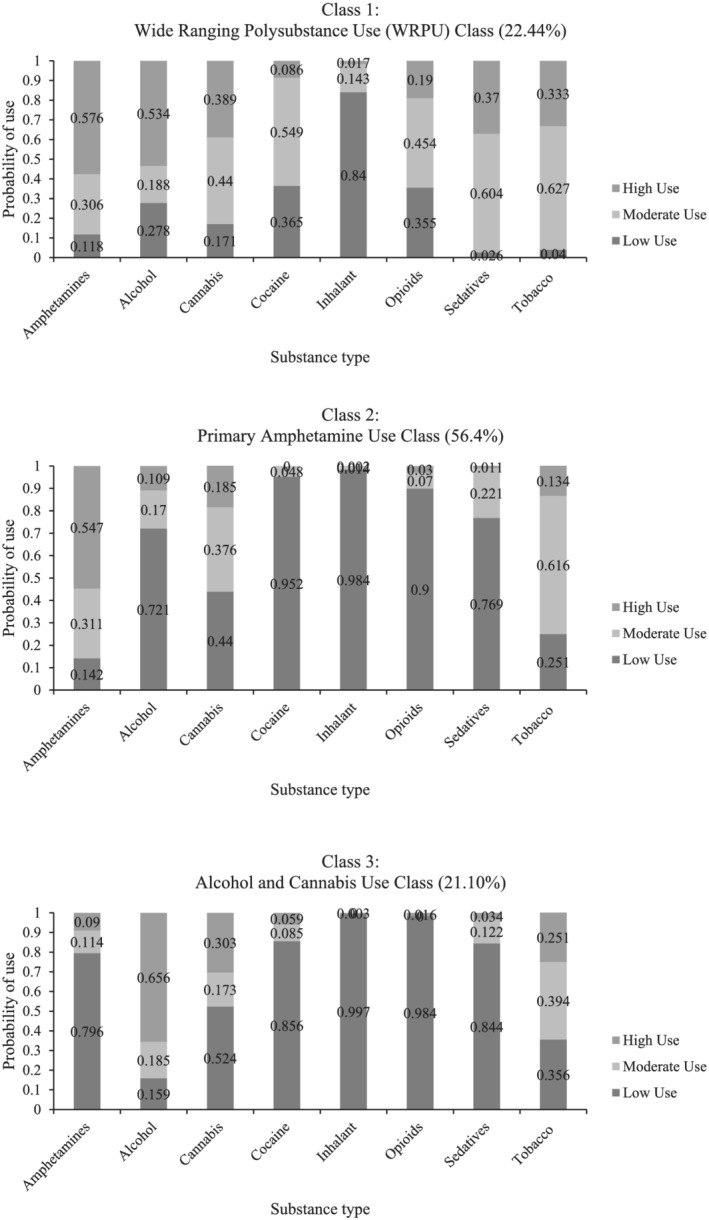
Latent class analysis identified three polysubstance use classes: wide-ranging polysubstance users (WRPU; 22.45%), primary amphetamine users (56.45%) and alcohol and cannabis users (21.10%). The WRPU class had higher odds of psychotic symptoms than the alcohol and cannabis use class [odds ratio (OR) = 1.30; 95% confidence interval (CI) = 1.11-1.11]; and double the odds of residential programme enrolment than those in the amphetamine use class (OR = 2.35; 95% CI = 1.50-3.68). No other class differences on mental health or QoL variables were found. Clients enrolled in day-programmes had higher odds of completing treatment.
There appear to be high levels of polysubstance use among young people entering substance use treatment in Australia. Wide-ranging polysubstance users were more likely to report psychotic symptoms and be enrolled into a residential programme than primary amphetamine users and alcohol and cannabis users.
患有物质使用障碍(SUD)的人经常同时存在多种物质使用和精神健康共病。不同的物质使用和精神健康问题组合需要不同的治疗方法。我们的研究旨在:(i)确定治疗入院时年轻人共有的物质使用类别,(ii)确定哪些精神健康症状、生活质量(QoL)和服务类型与确定的物质使用类别相关,以及(iii)前瞻性确定哪些物质使用类别和服务类型更有可能完成治疗。
使用服务和结果数据进行的横断面和前瞻性研究。
澳大利亚昆士兰州和新南威尔士州的物质使用治疗服务。
从 744 名年龄在 18-35 岁(48%为男性)的接受住院和 4 天治疗计划的客户的档案中提取了去识别的服务和结果测量数据。
烟草、酒精、大麻、可卡因、苯丙胺类兴奋剂、阿片类药物、镇静剂和吸入剂的物质使用和严重程度。其他变量包括:抑郁、焦虑、创伤后应激和精神病症状,以及生活质量。
潜在类别分析确定了三种多物质使用类别:广泛的多物质使用者(WRPU;22.45%)、主要安非他命使用者(56.45%)和酒精和大麻使用者(21.10%)。WRPU 类别的精神病症状发生率高于酒精和大麻使用类别的精神病症状发生率[优势比(OR)=1.30;95%置信区间(CI)=1.11-1.11];与安非他命使用类别相比,住院计划入学的可能性增加了一倍(OR=2.35;95%CI=1.50-3.68)。在心理健康或生活质量变量上没有发现其他类别差异。参加日间计划的客户完成治疗的可能性更高。
澳大利亚进入物质使用治疗的年轻人中似乎存在高水平的多种物质使用。与主要安非他命使用者和酒精及大麻使用者相比,广泛的多物质使用者更有可能报告精神病症状并被纳入住院计划。