Juniar Dilfa, van Ballegooijen Wouter, Schulte Mieke, van Schaik Anneke, Passchier Jan, Heber Elena, Lehr Dirk, Sadarjoen Sawitri Supardi, Riper Heleen
Faculty of Psychology, YARSI University, Jakarta, Indonesia.
Department of Clinical, Neuro and Developmental Psychology, Vrije Universiteit, Amsterdam, Netherlands.
JMIR Form Res. 2022 Jul 19;6(7):e37278. doi: 10.2196/37278.
University students are susceptible to excessive stress. A web-based stress management intervention holds promise to improve stress but is still at a novel stage in Indonesia.
The aim of this paper was to report the feasibility of the intervention we developed-Rileks-among university students in Indonesia in terms of acceptability and usability, and to propose recommendations for future improvements.
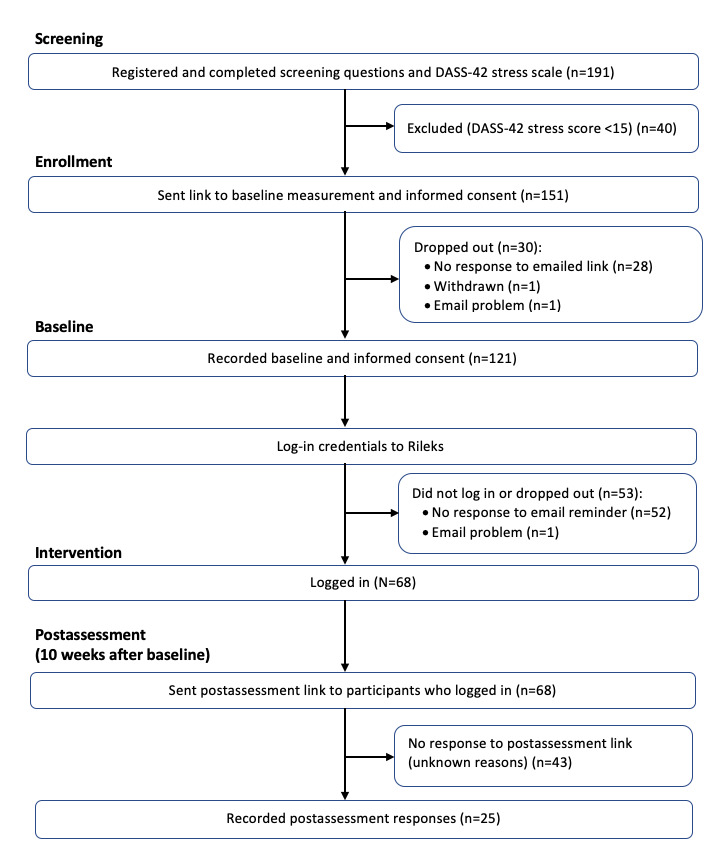
A single-group pretest and posttest design was used. Participants with scores of 15 or higher on the stress subscale of the 42-item Depression Anxiety Stress Scales were given access to the intervention (N=68). The main outcome measures were the 8-item Client Satisfaction Questionnaire (CSQ-8) score, the System Usability Scale (SUS) score, and intervention uptake. Participants' experience in each session was evaluated using closed- and open-ended questions for future improvements. Descriptive statistics were used to examine primary outcome and qualitative session evaluations. Participants' responses to each topic of the open questions were summarized.
The intervention was evaluated as being satisfactory (CSQ-8 mean score 21.89, SD 8.72; range 8-32). However, the intervention's usability was still below expectation (SUS mean score 62.8, SD 14.74; range 0-100). The core modules were completed by 10 out of 68 participants (15%), and the study dropout rate was 63% (43/68) at postassessment. In general, the module content was rated positively, with some notes for improvement covering content and technical aspects.
This study indicates that Rileks is potentially feasible for Indonesian university students. In order to be optimally applied in such a context and before scaling up web-based interventions in Indonesia, in general, further development and refinement are needed.
INTERNATIONAL REGISTERED REPORT IDENTIFIER (IRRID): RR2-10.2196/11493.
大学生容易受到过度压力的影响。基于网络的压力管理干预有望改善压力状况,但在印度尼西亚仍处于新的阶段。
本文旨在报告我们开发的干预措施——Rileks,在印度尼西亚大学生中的可接受性和可用性方面的可行性,并为未来改进提出建议。
采用单组前后测设计。在42项抑郁焦虑压力量表的压力子量表上得分15分或更高的参与者可以使用该干预措施(N = 68)。主要结局指标为8项客户满意度问卷(CSQ - 8)得分、系统可用性量表(SUS)得分和干预措施的采用情况。使用封闭式和开放式问题评估参与者在每个环节的体验,以便未来改进。描述性统计用于检查主要结局和定性的环节评估。总结了参与者对开放式问题各主题的回答。
该干预措施被评估为令人满意(CSQ - 8平均得分21.89,标准差8.72;范围8 - 32)。然而,该干预措施的可用性仍低于预期(SUS平均得分62.8,标准差14.74;范围0 - 100)。68名参与者中有10名(15%)完成了核心模块,在评估后研究的退出率为63%(43/68)。总体而言,模块内容得到了积极评价,同时也有一些关于内容和技术方面改进的建议。
本研究表明,Rileks对印度尼西亚大学生具有潜在可行性。为了在这种背景下得到最佳应用,并在印度尼西亚扩大基于网络的干预措施之前,总体上需要进一步开发和完善。
国际注册报告识别号(IRRID):RR2 - 10.2196/11493。