• 文献检索
  • 文档翻译
  • 深度研究
  • 学术资讯
  • Suppr Zotero 插件Zotero 插件
  • 邀请有礼
  • 套餐&价格
  • 历史记录
应用&插件
Suppr Zotero 插件Zotero 插件浏览器插件Mac 客户端Windows 客户端微信小程序
定价
高级版会员购买积分包购买API积分包
服务
文献检索文档翻译深度研究API 文档MCP 服务
关于我们
关于 Suppr公司介绍联系我们用户协议隐私条款
关注我们

Suppr 超能文献

核心技术专利:CN118964589B侵权必究
粤ICP备2023148730 号-1Suppr @ 2026

文献检索

告别复杂PubMed语法,用中文像聊天一样搜索,搜遍4000万医学文献。AI智能推荐,让科研检索更轻松。

立即免费搜索

文件翻译

保留排版,准确专业,支持PDF/Word/PPT等文件格式,支持 12+语言互译。

免费翻译文档

深度研究

AI帮你快速写综述,25分钟生成高质量综述,智能提取关键信息,辅助科研写作。

立即免费体验

2006 年至 2015 年菲律宾马尼拉都会区人类狂犬病病例的临床、流行病学和空间特征。

Clinical, epidemiological, and spatial features of human rabies cases in Metro Manila, the Philippines from 2006 to 2015.

机构信息

San Lazaro Hospital, Manila, Philippines.

School of Tropical Medicine and Global Health, Nagasaki University, Nagasaki, Japan.

出版信息

PLoS Negl Trop Dis. 2022 Jul 19;16(7):e0010595. doi: 10.1371/journal.pntd.0010595. eCollection 2022 Jul.

DOI:10.1371/journal.pntd.0010595
PMID:35852994
原文链接:https://pmc.ncbi.nlm.nih.gov/articles/PMC9295989/
Abstract

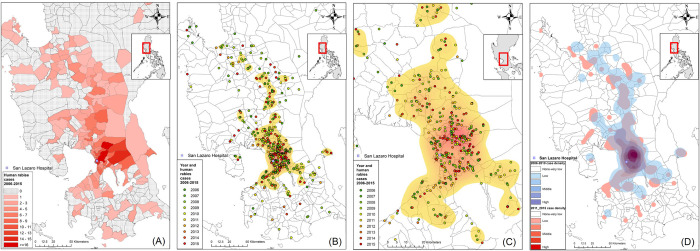
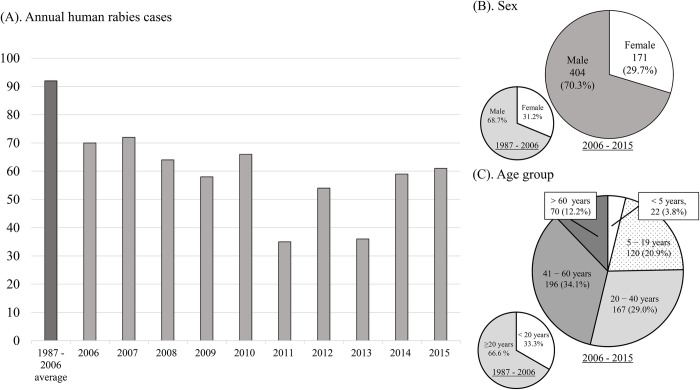
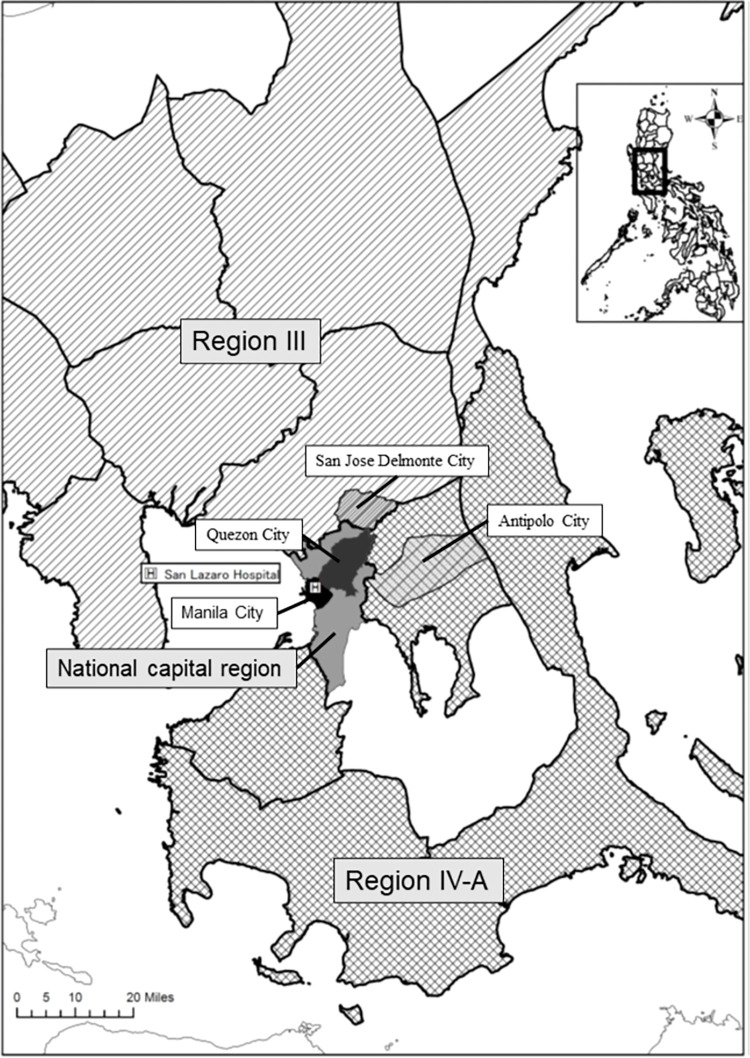
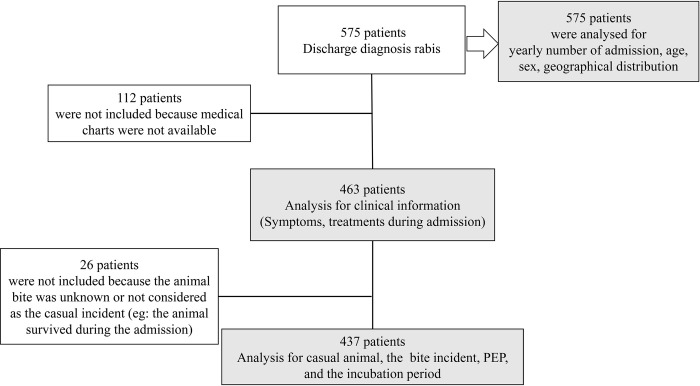
Rabies remains a public health problem in the Philippines despite the widespread provision of rabies vaccines and rabies immunoglobulin (RIG) as post-exposure prophylaxis (PEP). Detailed descriptions of recent human rabies cases in the Philippines are scarce. This study aimed to describe the clinical, epidemiological, and spatial features of human rabies cases between January 1, 2006, and December 31, 2015. We conducted a retrospective hospital-based case record review of all patients admitted to one referral hospital in Manila who received a clinical diagnosis of rabies. During the 10-year study period there were 575 patients (average 57.5 cases per year, range 57 to 119) with a final diagnosis of rabies. Most patients were male (n = 404, 70.3%) and aged ≥ 20 years (n = 433, 75.3%). Patients mostly came from the National Capital Region (n = 160, 28.0%) and the adjacent Regions III (n = 197, 34.4%) and IV-A (n = 168, 29.4%). Case mapping and heatmaps showed that human rabies cases were continuously observed in similar areas throughout the study period. Most patients had hydrophobia (n = 444, 95.5%) and/or aerophobia (n = 432, 93.3%). The leading causative animals were dogs (n = 421, 96.3%) and cats (n = 16, 3.7%). Among 437 patients with animal exposure history, only 42 (9.6%) had been administered at least one rabies vaccine. Two patients (0.5%), young children bitten on their face, had received and a full course of rabies vaccine. Human rabies patients were continuously admitted to the hospital, with no notable decline over the study period. The geographical area in which human rabies cases commonly occurred also did not change. Few patients received PEP and there were two suspected cases of PEP failure. The retrospective design of this study was a limitation; thus, prospective studies are required.

摘要

尽管在菲律宾广泛提供狂犬病疫苗和狂犬病免疫球蛋白(RIG)作为暴露后预防(PEP),狂犬病仍然是一个公共卫生问题。最近菲律宾发生的人类狂犬病病例的详细描述很少。本研究旨在描述 2006 年 1 月 1 日至 2015 年 12 月 31 日期间在马尼拉一家转诊医院住院的所有患者的临床、流行病学和空间特征。我们对所有被临床诊断为狂犬病的患者进行了回顾性基于医院的病例记录审查。在 10 年的研究期间,共有 575 名患者(平均每年 57.5 例,范围为 57 至 119 例)被确诊患有狂犬病。大多数患者为男性(n = 404,70.3%)和年龄≥20 岁(n = 433,75.3%)。患者主要来自国家首都地区(n = 160,28.0%)和相邻的第 III 区(n = 197,34.4%)和第 IV-A 区(n = 168,29.4%)。病例绘图和热点图显示,在整个研究期间,人类狂犬病病例在相似地区持续观察到。大多数患者有恐水症(n = 444,95.5%)和/或恐风症(n = 432,93.3%)。主要致病动物是狗(n = 421,96.3%)和猫(n = 16,3.7%)。在 437 名有动物接触史的患者中,只有 42 名(9.6%)至少接种过一剂狂犬病疫苗。两名患者(0.5%),即脸部被咬伤的幼儿,已接受并完成了狂犬病疫苗全程接种。人类狂犬病患者持续住院,在研究期间没有明显下降。人类狂犬病病例常见发生的地理区域也没有改变。很少有患者接受 PEP,有两例疑似 PEP 失败。本研究的回顾性设计是一个限制;因此,需要进行前瞻性研究。
https://cdn.ncbi.nlm.nih.gov/pmc/blobs/0d9e/9295989/06bac14e5b93/pntd.0010595.g004.jpg
https://cdn.ncbi.nlm.nih.gov/pmc/blobs/0d9e/9295989/fc568cd0f974/pntd.0010595.g001.jpg
https://cdn.ncbi.nlm.nih.gov/pmc/blobs/0d9e/9295989/4ec869d1916c/pntd.0010595.g002.jpg
https://cdn.ncbi.nlm.nih.gov/pmc/blobs/0d9e/9295989/a829f9646ab5/pntd.0010595.g003.jpg
https://cdn.ncbi.nlm.nih.gov/pmc/blobs/0d9e/9295989/06bac14e5b93/pntd.0010595.g004.jpg
https://cdn.ncbi.nlm.nih.gov/pmc/blobs/0d9e/9295989/fc568cd0f974/pntd.0010595.g001.jpg
https://cdn.ncbi.nlm.nih.gov/pmc/blobs/0d9e/9295989/4ec869d1916c/pntd.0010595.g002.jpg
https://cdn.ncbi.nlm.nih.gov/pmc/blobs/0d9e/9295989/a829f9646ab5/pntd.0010595.g003.jpg
https://cdn.ncbi.nlm.nih.gov/pmc/blobs/0d9e/9295989/06bac14e5b93/pntd.0010595.g004.jpg

相似文献

1
Clinical, epidemiological, and spatial features of human rabies cases in Metro Manila, the Philippines from 2006 to 2015.2006 年至 2015 年菲律宾马尼拉都会区人类狂犬病病例的临床、流行病学和空间特征。
PLoS Negl Trop Dis. 2022 Jul 19;16(7):e0010595. doi: 10.1371/journal.pntd.0010595. eCollection 2022 Jul.
2
Clinical and epidemiological features of human rabies cases in the Philippines: a review from 1987 to 2006.菲律宾人间狂犬病病例的临床和流行病学特征:1987 年至 2006 年的回顾。
Int J Infect Dis. 2011 Jul;15(7):e495-9. doi: 10.1016/j.ijid.2011.03.023. Epub 2011 May 20.
3
Rabies post-exposure prophylaxis with purified equine rabies immunoglobulin: one-year follow-up of patients with laboratory-confirmed category III rabies exposure in the Philippines.狂犬病暴露后预防用纯化马抗狂犬病免疫球蛋白:菲律宾实验室确诊的狂犬病 III 级暴露患者的一年随访。
Vaccine. 2009 Nov 27;27(51):7162-6. doi: 10.1016/j.vaccine.2009.09.036.
4
Epidemiology and surveillance of human animal-bite injuries and rabies post-exposure prophylaxis, in selected counties in Kenya, 2011-2016.肯尼亚部分县 2011-2016 年人间动物咬伤和狂犬病暴露后预防的流行病学和监测。
BMC Public Health. 2018 Aug 9;18(1):996. doi: 10.1186/s12889-018-5888-5.
5
Post-exposure rabies prophylaxis in humans exposed to animals in Lublin province (Eastern Poland) in 2012-2015 - A retrospective study.2012 - 2015年波兰东部卢布林省动物致伤后人类狂犬病暴露后预防——一项回顾性研究
Hum Vaccin Immunother. 2017 Jun 3;13(6):1-6. doi: 10.1080/21645515.2017.1285474. Epub 2017 Feb 6.
6
Exposure History, Post-Exposure Prophylaxis Use, and Clinical Characteristics of Human Rabies Cases: A Twelve-Year Retrospective Review at a Tertiary Facility in Ghana.暴露史、暴露后预防用药使用情况以及人狂犬病病例的临床特征:加纳一家三级医疗机构 12 年回顾性研究
West Afr J Med. 2024 Jan 31;41(1):36-41.
7
The evaluation of operating Animal Bite Treatment Centers in the Philippines from a health provider perspective.从卫生服务提供者角度评估菲律宾的动物咬伤治疗中心运营情况。
PLoS One. 2018 Jul 12;13(7):e0199186. doi: 10.1371/journal.pone.0199186. eCollection 2018.
8
An epidemiological study of suspected rabies exposures and adherence to rabies post-exposure prophylaxis in Eastern Thailand, 2015.2015 年泰国东部疑似狂犬病暴露和狂犬病暴露后预防依从性的流行病学研究。
PLoS Negl Trop Dis. 2020 Feb 27;14(2):e0007248. doi: 10.1371/journal.pntd.0007248. eCollection 2020 Feb.
9
Rabies vaccine initiation and adherence among animal-bite patients in Haiti, 2015.2015 年海地动物咬伤患者狂犬病疫苗接种启动和依从性。
PLoS Negl Trop Dis. 2018 Nov 13;12(11):e0006955. doi: 10.1371/journal.pntd.0006955. eCollection 2018 Nov.
10
Human rabies post-exposure prophylaxis relative to the disease epidemiological status.相对于疾病流行病学状况的人类狂犬病暴露后预防
Cien Saude Colet. 2019 Jan;24(1):315-322. doi: 10.1590/1413-81232018241.32832016.

引用本文的文献

1
Rabies in Cats-An Emerging Public Health Issue.猫狂犬病:一个新出现的公共卫生问题。
Viruses. 2024 Oct 19;16(10):1635. doi: 10.3390/v16101635.
2
Rabies in the Philippines: a call to action.菲律宾的狂犬病:行动呼吁。
Lancet Reg Health West Pac. 2024 Jul 20;49:101156. doi: 10.1016/j.lanwpc.2024.101156. eCollection 2024 Aug.
3
Puppies as the primary causal animal for human rabies cases: three-year prospective study of human rabies in the Philippines.幼犬作为人类狂犬病病例的主要致病动物:菲律宾人类狂犬病的三年前瞻性研究

本文引用的文献

1
Household survey on owned dog population and rabies knowledge in selected municipalities in Bulacan, Philippines: A cross-sectional study.菲律宾布拉坎省选定市的家犬种群和狂犬病知识的入户调查:一项横断面研究。
PLoS Negl Trop Dis. 2022 Jan 18;16(1):e0009948. doi: 10.1371/journal.pntd.0009948. eCollection 2022 Jan.
2
Dog Ecology and Demographics in Several Areas in the Philippines and Its Application to Anti-Rabies Vaccination Programs.菲律宾若干地区的犬类生态学与种群统计学及其在抗狂犬病疫苗接种计划中的应用
Animals (Basel). 2022 Jan 2;12(1):105. doi: 10.3390/ani12010105.
3
Epidemiology of human rabies in the state of Ceará, Brazil, 1970 to 2019.
Front Microbiol. 2024 Jul 8;15:1425766. doi: 10.3389/fmicb.2024.1425766. eCollection 2024.
4
Rabies in a postpandemic world: resilient reservoirs, redoubtable riposte, recurrent roadblocks, and resolute recidivism.大流行后世界中的狂犬病:坚韧的储存宿主、强大的反击、反复出现的障碍以及顽固的复发
Anim Dis. 2023;3(1):15. doi: 10.1186/s44149-023-00078-8. Epub 2023 May 19.
5
Rabies in Southeast Asia: a systematic review of its incidence, risk factors and mortality.东南亚的狂犬病:发病率、风险因素和死亡率的系统评价。
BMJ Open. 2023 May 10;13(5):e066587. doi: 10.1136/bmjopen-2022-066587.
巴西塞阿拉州 1970 年至 2019 年人类狂犬病流行病学。
Epidemiol Serv Saude. 2021 Mar 12;30(1):e2020354. doi: 10.1590/S1679-49742021000100010. eCollection 2021.
4
Epidemiological study of human rabies cases in Bangladesh through verbal autopsy.通过口头尸检对孟加拉国人类狂犬病病例进行的流行病学研究。
Heliyon. 2020 Nov 17;6(11):e05521. doi: 10.1016/j.heliyon.2020.e05521. eCollection 2020 Nov.
5
Reevaluation of the efficacy of favipiravir against rabies virus using in vivo imaging analysis.利用体内成像分析重新评估法匹拉韦抗狂犬病毒的疗效。
Antiviral Res. 2019 Dec;172:104641. doi: 10.1016/j.antiviral.2019.104641. Epub 2019 Oct 28.
6
Human rabies in Brazil: a descriptive study, 2000-2017.巴西的人类狂犬病:一项2000 - 2017年的描述性研究。
Epidemiol Serv Saude. 2019 Jun 27;28(2):e2018275. doi: 10.5123/S1679-49742019000200001.
7
Failure of postexposure prophylaxis in a girl child attacked by rabid dog severing her facial nerve causing possible direct entry of rabies virus into the facial nerve.一女孩被狂犬袭击致面神经损伤,虽及时进行了暴露后预防处理,但仍发病,考虑狂犬病毒可能经损伤的面神经直接进入。
Hum Vaccin Immunother. 2019;15(11):2612-2614. doi: 10.1080/21645515.2019.1608131. Epub 2019 May 22.
8
Exposure history, post-exposure prophylaxis use, and clinical characteristics of human rabies cases in China, 2006-2012.2006-2012 年中国人间狂犬病病例的暴露史、暴露后预防使用情况和临床特征。
Sci Rep. 2018 Nov 21;8(1):17188. doi: 10.1038/s41598-018-35158-0.
9
Intradermal rabies post-exposure prophylaxis can be abridged with no measurable impact on clinical outcome in Cambodia, 2003-2014.2003-2014 年柬埔寨的研究表明,皮内狂犬病暴露后预防可简化,对临床结局无明显影响。
Vaccine. 2019 Oct 3;37 Suppl 1:A118-A127. doi: 10.1016/j.vaccine.2018.10.054. Epub 2018 Nov 16.
10
Introduction of intradermal rabies vaccination - A paradigm shift in improving post-exposure prophylaxis in Asia.皮内狂犬病疫苗接种介绍 - 改善亚洲暴露后预防的范式转变。
Vaccine. 2019 Oct 3;37 Suppl 1:A94-A98. doi: 10.1016/j.vaccine.2018.08.034. Epub 2018 Aug 24.