King's College London, School of Life Course & Population Sciences, London, United Kingdom.
National Institute for Health Research Biomedical Research Centre (BRC), Guy's and St Thomas' NHS Foundation Trust and King's College London, London, United Kingdom.
PLoS Med. 2022 Jul 19;19(7):e1004052. doi: 10.1371/journal.pmed.1004052. eCollection 2022 Jul.
Acute Coronavirus Disease 2019 (COVID-19) has been associated with new-onset cardiovascular disease (CVD) and diabetes mellitus (DM), but it is not known whether COVID-19 has long-term impacts on cardiometabolic outcomes. This study aimed to determine whether the incidence of new DM and CVDs are increased over 12 months after COVID-19 compared with matched controls.
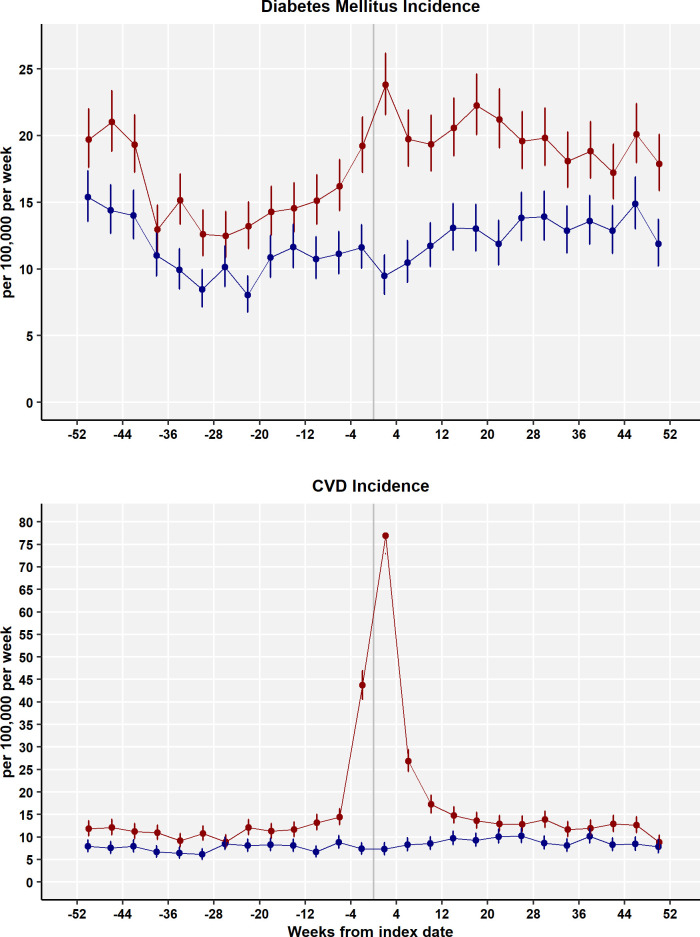
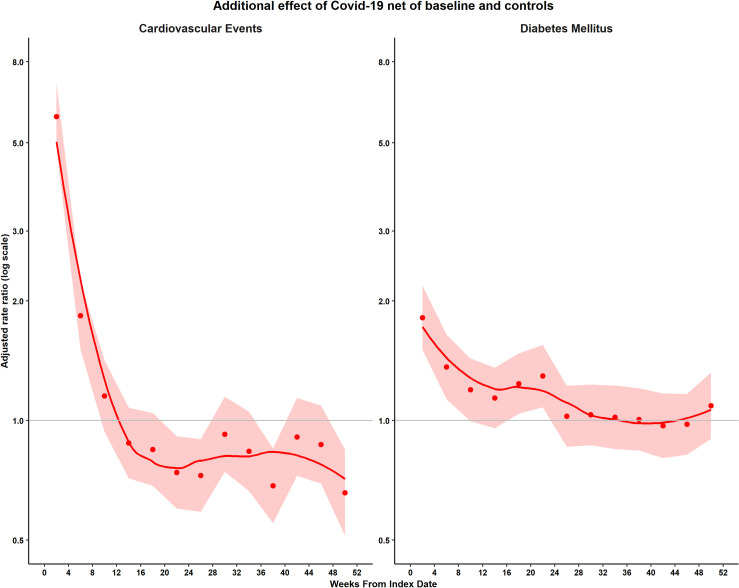
We conducted a cohort study from 2020 to 2021 analysing electronic records for 1,356 United Kingdom family practices with a population of 13.4 million. Participants were 428,650 COVID-19 patients without DM or CVD who were individually matched with 428,650 control patients on age, sex, and family practice and followed up to January 2022. Outcomes were incidence of DM and CVD. A difference-in-difference analysis estimated the net effect of COVID-19 allowing for baseline differences, age, ethnicity, smoking, body mass index (BMI), systolic blood pressure, Charlson score, index month, and matched set. Follow-up time was divided into 4 weeks from index date ("acute COVID-19"), 5 to 12 weeks from index date ("post-acute COVID-19"), and 13 to 52 weeks from index date ("long COVID-19"). Net incidence of DM increased in the first 4 weeks after COVID-19 (adjusted rate ratio, RR 1.81, 95% confidence interval (CI) 1.51 to 2.19) and remained elevated from 5 to 12 weeks (RR 1.27, 1.11 to 1.46) but not from 13 to 52 weeks overall (1.07, 0.99 to 1.16). Acute COVID-19 was associated with net increased CVD incidence (5.82, 4.82 to 7.03) including pulmonary embolism (RR 11.51, 7.07 to 18.73), atrial arrythmias (6.44, 4.17 to 9.96), and venous thromboses (5.43, 3.27 to 9.01). CVD incidence declined from 5 to 12 weeks (RR 1.49, 1.28 to 1.73) and showed a net decrease from 13 to 52 weeks (0.80, 0.73 to 0.88). The analyses were based on health records data and participants' exposure and outcome status might have been misclassified.
In this study, we found that CVD was increased early after COVID-19 mainly from pulmonary embolism, atrial arrhythmias, and venous thromboses. DM incidence remained elevated for at least 12 weeks following COVID-19 before declining. People without preexisting CVD or DM who suffer from COVID-19 do not appear to have a long-term increase in incidence of these conditions.
急性 2019 年冠状病毒病(COVID-19)与新发心血管疾病(CVD)和糖尿病(DM)有关,但尚不清楚 COVID-19 是否对心脏代谢结局有长期影响。本研究旨在确定与匹配对照组相比,COVID-19 后 12 个月新发 DM 和 CVD 的发病率是否增加。
我们进行了一项队列研究,分析了 2020 年至 2021 年期间来自英国 1356 家家庭实践的电子记录,该研究人群为 1340 万。参与者为 428650 名无 DM 或 CVD 的 COVID-19 患者,他们在年龄、性别和家庭实践方面与 428650 名匹配对照患者进行了个体匹配,并随访至 2022 年 1 月。结果是 DM 和 CVD 的发病率。差异分析估计了 COVID-19 的净效应,同时考虑了基线差异、年龄、种族、吸烟、体重指数(BMI)、收缩压、Charlson 评分、指数月和匹配组。随访时间分为从指数日期开始的 4 周(“急性 COVID-19”)、从指数日期开始的 5 至 12 周(“急性 COVID-19 后”)和从指数日期开始的 13 至 52 周(“长 COVID-19”)。COVID-19 后前 4 周内 DM 的净发病率增加(调整后的 RR 1.81,95%CI 1.51-2.19),从 5 至 12 周仍保持升高(RR 1.27,1.11-1.46),但从 13 至 52 周总体上并未升高(1.07,0.99-1.16)。急性 COVID-19 与心血管疾病发病率的净增加有关(5.82,4.82-7.03),包括肺栓塞(RR 11.51,7.07-18.73)、房性心律失常(6.44,4.17-9.96)和静脉血栓形成(5.43,3.27-9.01)。从 5 至 12 周,CVD 的发病率下降(RR 1.49,1.28-1.73),从 13 至 52 周,CVD 的发病率下降(0.80,0.73-0.88)。分析基于健康记录数据,参与者的暴露和结局状态可能存在错误分类。
在这项研究中,我们发现 COVID-19 后早期 CVD 增加,主要是由肺栓塞、房性心律失常和静脉血栓形成引起的。COVID-19 后 DM 的发病率至少在 12 周内持续升高,然后下降。没有预先存在的 CVD 或 DM 的 COVID-19 患者似乎没有长期增加这些疾病的发病率。