Ellwanger Joel Henrique, Byrne Loren B, Chies José Artur Bogo
Laboratory of Immunobiology and Immunogenetics, Postgraduate Program in Genetics and Molecular Biology - PPGBM, Department of Genetics, Universidade Federal do Rio Grande do Sul - UFRGS, Porto Alegre, Rio Grande do Sul Brazil.
Department of Biology, Marine Biology and Environmental Science, Roger Williams University, Bristol, RI USA.
Urban Ecosyst. 2022;25(6):1735-1744. doi: 10.1007/s11252-022-01260-5. Epub 2022 Jul 15.
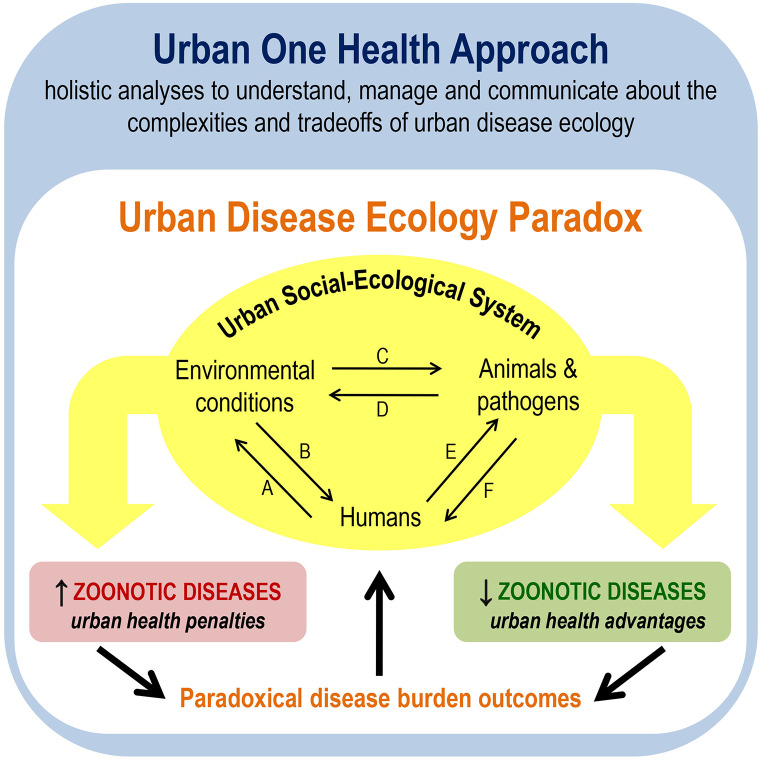
The ecology of zoonotic, including vector-borne, diseases in urban social-ecological systems is influenced by complex interactions among human and environmental factors. Several characteristics contribute to the emergence and spread of infectious diseases in urban places, such as high human population densities, favorable habitat for vectors, and humans' close proximity to animals and their pathogens. On the other hand, urban living can contribute to the improvement of public health through better access to health services and creation of ecological and technological infrastructure that reduces disease burdens. Therefore, urbanization creates a disease ecology paradox through the interplay of urban health penalties and advantages for individual and community outcomes. To address this contradiction, we advocate a holistic Urban One Health perspective for managing urban systems, especially their green spaces and animal populations, in ways that more effectively control the spread of zoonotic diseases. This view should be coupled with an Ecology with Cities approach which emphasizes actionable science needed for urban planning, management and policymaking; developing disease and vector surveillance programs using citizen and community science methods; and improving education and communication actions that help diverse stakeholders understand the complexities of urban disease ecology. Such measures will enable scholars from many disciplines to collaborate with professionals, government officials, and others to tackle challenges of the urban disease paradox and create more sustainable, health-promoting environments.
在城市社会生态系统中,包括媒介传播疾病在内的人畜共患病的生态受到人类和环境因素之间复杂相互作用的影响。城市地区传染病的出现和传播有几个特征因素,比如人口高度密集、媒介适宜的栖息地以及人类与动物及其病原体的近距离接触。另一方面,城市生活可以通过更好地获得医疗服务以及创建减少疾病负担的生态和技术基础设施,促进公共卫生状况的改善。因此,城市化通过城市健康惩罚与个体和社区结果优势之间的相互作用,创造了一种疾病生态悖论。为解决这一矛盾,我们倡导采用整体的城市“同一健康”视角来管理城市系统,特别是其绿地和动物种群,以更有效地控制人畜共患病的传播。这一观点应与“城市生态”方法相结合,该方法强调城市规划、管理和决策所需的可付诸行动的科学;利用公民和社区科学方法制定疾病和媒介监测计划;以及改进教育和宣传行动,以帮助不同利益相关者理解城市疾病生态的复杂性。这些措施将使来自许多学科的学者能够与专业人员、政府官员及其他人员合作,应对城市疾病悖论带来的挑战,并创造更具可持续性、促进健康的环境。