Department of Emergency Medical Center, Affiliated Hospital of Guangdong Medical University, Guangdong, China.
Department of Pulmonary and Critical Care Medicine, Wuhan Jinyintan Hospital, Tongji Medical College of Huazhong University of Science and Technology; Hubei Clinical Research Center for Infectious Diseases; Wuhan Research Center for Communicable Disease Diagnosis and Treatment, Chinese Academy of Medical Sciences; Joint Laboratory of Infectious Diseases and Health, Wuhan Institute of Virology and Wuhan Jinyintan Hospital, Chinese Academy of Sciences, Hubei, China.
Int Wound J. 2023 Feb;20(2):448-457. doi: 10.1111/iwj.13893. Epub 2022 Jul 19.
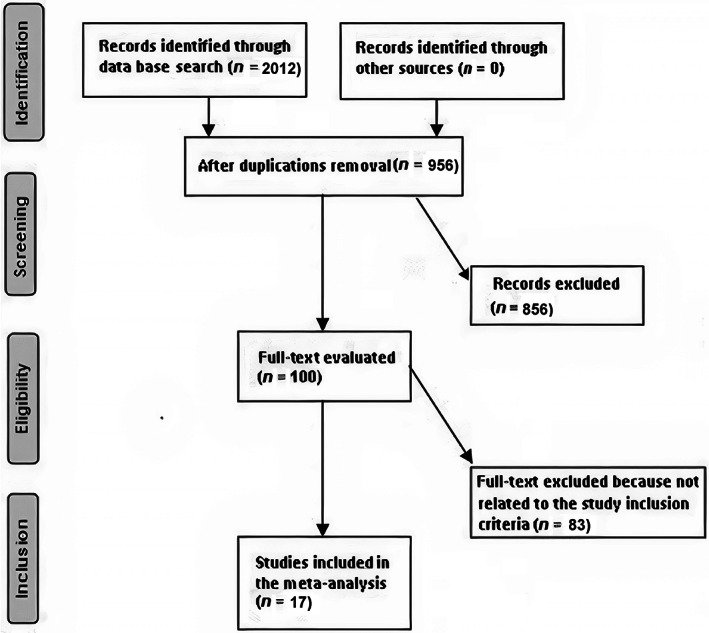
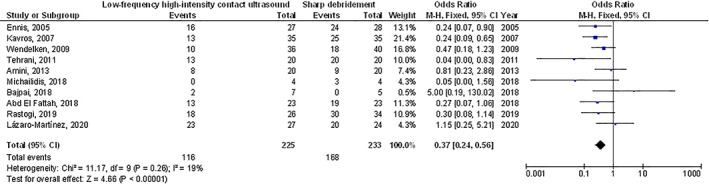
We performed a meta-analysis to evaluate the effect of low-frequency ultrasound as an added treatment for chronic wounds. A systematic literature search up to May 2022 was performed and 838 subjects with chronic wounds at the baseline of the studies; 412 of them were using the low-frequency ultrasound (225 low-frequency high-intensity contact ultrasound for diabetic foot wound ulcers, and 187 low-frequency low-intensity non-contact ultrasound for a venous leg wound ulcers), and 426 were using standard care (233 sharp debridements for diabetic foot wound ulcers and 193 sham treatments for venous leg wound ulcers). Odds ratio (OR), and mean difference (MD) with 95% confidence intervals (CIs) were calculated to assess the effect of low-frequency ultrasound as an added treatment for chronic wounds using the dichotomous, and contentious methods with a random or fixed-effect model. The low-frequency high-intensity contact ultrasound for diabetic foot wound ulcers had significantly lower non-healed diabetic foot wound ulcers at ≥3 months (OR, 0.37; 95% CI, 0.24-0.56, P < .001), a higher percentage of diabetic foot wound ulcers area reduction (MD, 17.18; 95% CI, 6.62-27.85, P = .002) compared with sharp debridement for diabetic foot wound ulcers. The low-frequency low-intensity non-contact ultrasound for a venous leg wound ulcers had a significantly lower non-healed venous leg wound ulcers at ≥3 months (OR, 0.31; 95% CI, 0.15-0.62, P = .001), and higher percentage venous leg wound ulcers area reduction (MD, 18.96; 95% CI, 2.36-35.57, P = .03) compared with sham treatments for a venous leg wound ulcers. The low-frequency ultrasound as an added treatment for diabetic foot wound ulcers and venous leg wound ulcers had significantly lower non-healed chronic wound ulcers at ≥3 months, a higher percentage of chronic wound ulcers area reduction compared with standard care. The analysis of outcomes should be with caution because of the low sample size of all the 17 studies in the meta-analysis and a low number of studies in certain comparisons.
我们进行了一项荟萃分析,以评估低频超声作为慢性伤口附加治疗的效果。系统文献检索截至 2022 年 5 月,共有 838 名处于研究基线的慢性伤口患者;其中 412 名使用低频超声(225 例用于治疗糖尿病足溃疡的低频高强度接触超声,187 例用于治疗静脉腿部溃疡的低频低强度非接触超声),426 名使用标准护理(233 例用于治疗糖尿病足溃疡的锐性清创术,193 例用于治疗静脉腿部溃疡的假处理)。使用二项和争议性方法,采用随机或固定效应模型,计算比值比(OR)和均数差(MD)及 95%置信区间(CI),以评估低频超声作为慢性伤口附加治疗的效果。对于糖尿病足溃疡,低频高强度接触超声治疗后,≥3 个月未愈合的糖尿病足溃疡明显减少(OR,0.37;95%CI,0.24-0.56,P<0.001),糖尿病足溃疡面积减少率更高(MD,17.18;95%CI,6.62-27.85,P<.001)与糖尿病足溃疡的锐性清创术相比。对于静脉腿部溃疡,低频低强度非接触超声治疗后,≥3 个月未愈合的静脉腿部溃疡明显减少(OR,0.31;95%CI,0.15-0.62,P=0.001),静脉腿部溃疡面积减少率更高(MD,18.96;95%CI,2.36-35.57,P=0.03)与静脉腿部溃疡的假处理相比。低频超声作为糖尿病足溃疡和静脉腿部溃疡的附加治疗,在≥3 个月时可显著减少未愈合的慢性伤口溃疡,与标准护理相比,慢性伤口溃疡面积减少的比例更高。由于荟萃分析中所有 17 项研究的样本量都很小,并且某些比较的研究数量较少,因此应谨慎分析结果。