Skin Wounds and Trauma Research Centre, The Royal College of Surgeons in Ireland (RCSI), University of Medicine and Health Sciences, Dublin, Ireland.
School of Nursing and Midwifery, The Royal College of Surgeons in Ireland (RCSI), University of Medicine and Health Sciences, Dublin, Ireland.
Int Wound J. 2023 Feb;20(2):430-447. doi: 10.1111/iwj.13891. Epub 2022 Jul 18.
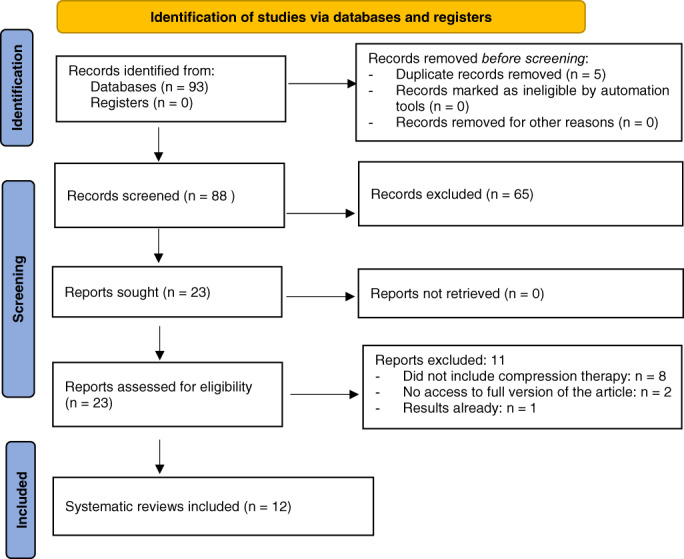
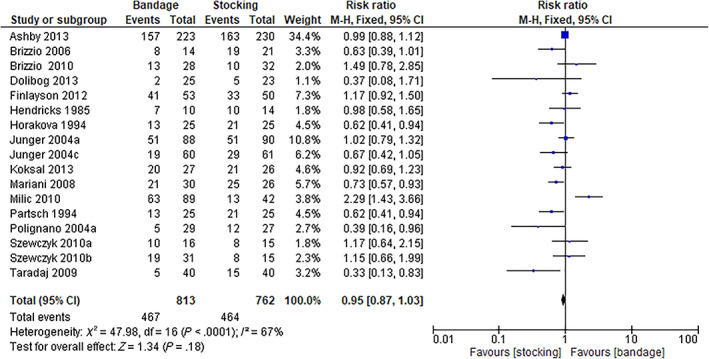
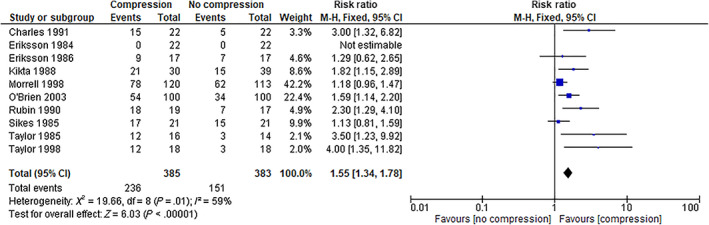
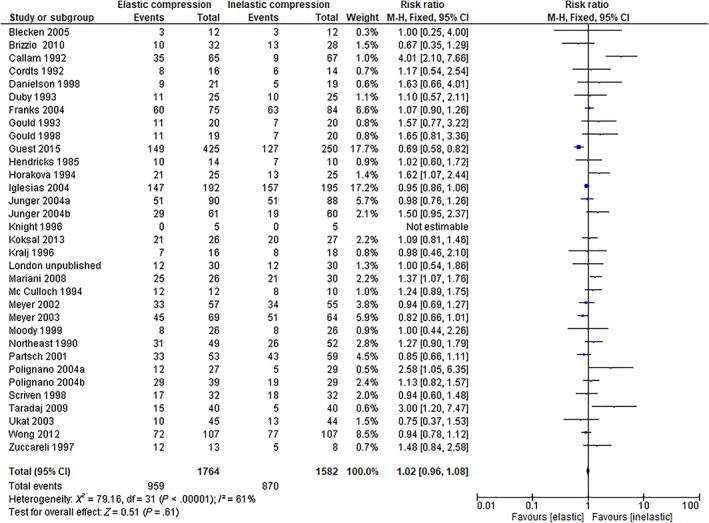
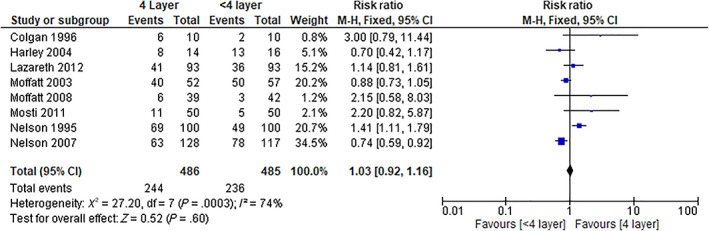
This meta-review aimed to appraise and synthesise findings from existing systematic reviews that measured the impact of compression therapy on venous leg ulcers healing. We searched five databases to identify potential papers; three authors extracted data, and a fourth author adjudicated the findings. The AMSTAR-2 tool was used for quality appraisal and the certainty of the evidence was appraised using GRADEpro. Data analysis was undertaken using RevMan. We identified 12 systematic reviews published between 1997 and 2021. AMSTAR-2 assessment identified three as high quality, five as moderate quality, and four as low quality. Seven comparisons were reported, with a meta-analysis undertaken for five of these comparisons: compression vs no compression (risk ratio [RR]: 1.55; 95% confidence interval [CI] 1.34-1.78; P < .00001; moderate-certainty evidence); elastic compression vs inelastic compression (RR: 1.02; 95% CI: 0.96-1.08; P < .61 moderate-certainty evidence); four layer vs <four-layer bandage systems (RR: 1.07; 95% CI: 0.82-1.40; P < .63; moderate-certainty evidence); comparison between different four-layer bandage systems (RR: 1.08; 95% CI: 0.93-1.25; P = .34; moderate-certainty evidence); compression bandage vs compression stocking (RR 0.95; 95% CI 0.87-1.03; P = .18; moderate-certainty evidence). The main conclusion from this review is that there is a statistically significant difference in healing rates when compression is used compared with no compression, with moderate-certainty evidence. Otherwise, there is no statistically different difference in healing rates using elastic compression vs inelastic compression, four layer vs <four-layer bandage systems, different four-layer bandage systems, or compression bandages vs compression stockings.
本元分析旨在评估和综合现有的系统评价,这些评价衡量了压迫疗法对静脉溃疡愈合的影响。我们检索了五个数据库以确定潜在的论文;三位作者提取数据,第四位作者裁决结果。使用 AMSTAR-2 工具进行质量评估,并使用 GRADEpro 评估证据的确定性。使用 RevMan 进行数据分析。我们确定了 1997 年至 2021 年间发表的 12 项系统评价。AMSTAR-2 评估将其中 3 项评为高质量,5 项评为中等质量,4 项评为低质量。报告了 7 项比较,其中 5 项进行了荟萃分析:压迫治疗与非压迫治疗(风险比 [RR]:1.55;95%置信区间 [CI]:1.34-1.78;P<.00001;中等确定性证据);弹性压迫与非弹性压迫(RR:1.02;95% CI:0.96-1.08;P<.61 中等确定性证据);四层与<四层绷带系统(RR:1.07;95% CI:0.82-1.40;P<.63;中等确定性证据);不同四层绷带系统之间的比较(RR:1.08;95% CI:0.93-1.25;P=0.34;中等确定性证据);压迫绷带与压迫袜(RR 0.95;95% CI 0.87-1.03;P=0.18;中等确定性证据)。本综述的主要结论是,与不使用压迫相比,使用压迫时愈合速度有统计学显著差异,具有中等确定性证据。否则,使用弹性压迫与非弹性压迫、四层与<四层绷带系统、不同四层绷带系统或压迫绷带与压迫袜时,愈合速度没有统计学差异。