Laboratory of Plant and Environmental Biotechnology, Department of Biochemistry and Biotechnology, University of Thessaly, Larissa, Greece.
Laboratory of Environmental Microbiology, Department of Environmental Sciences, University of Thessaly, Larissa, Greece.
Microbiol Spectr. 2022 Aug 31;10(4):e0240321. doi: 10.1128/spectrum.02403-21. Epub 2022 Jul 20.
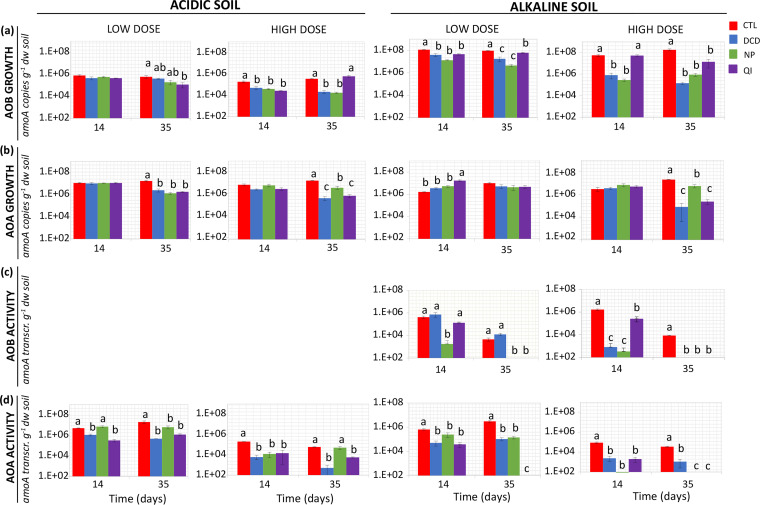
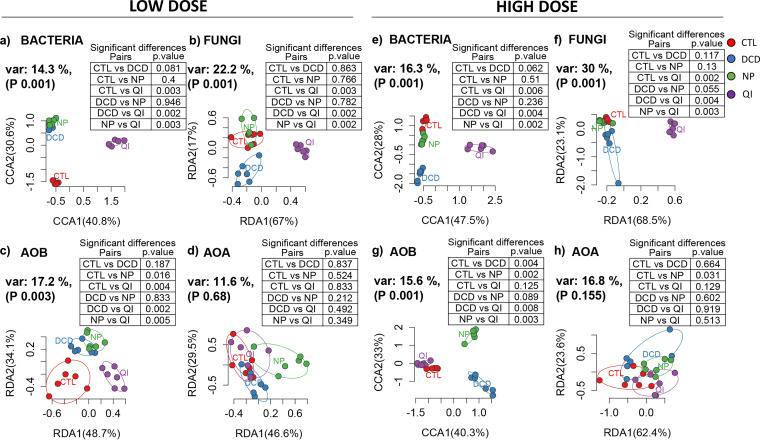
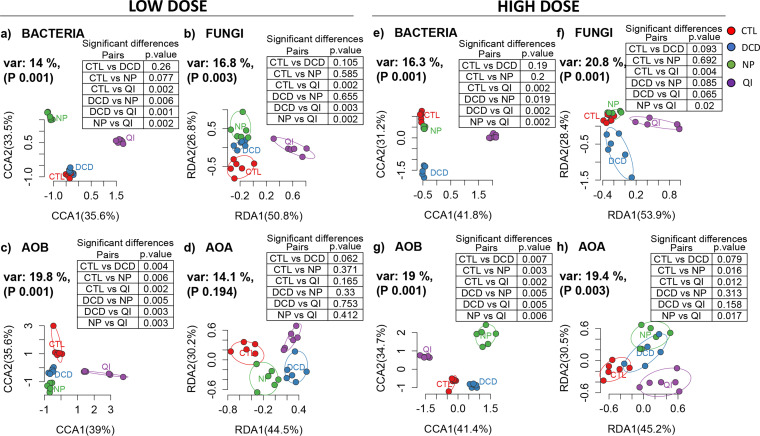
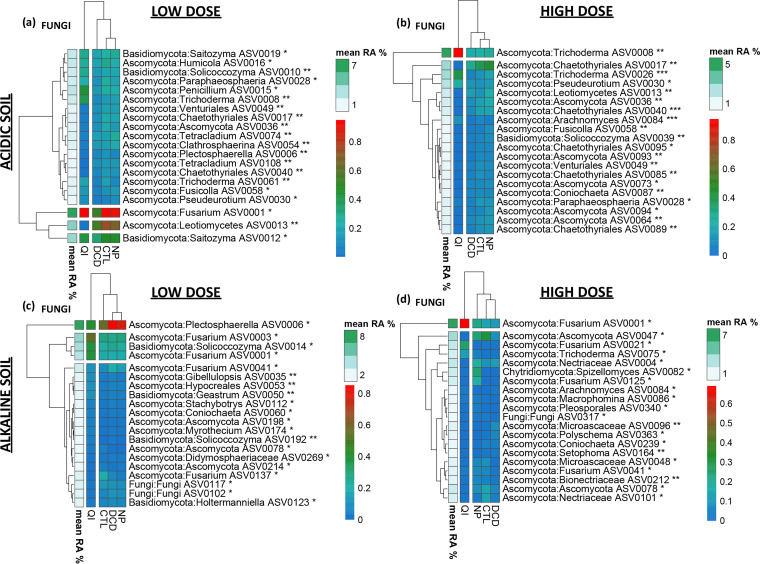
Dicyandiamide (DCD) and nitrapyrin (NP) are nitrification inhibitors (NIs) used in agriculture for over 40 years. Recently, ethoxyquin (EQ) was proposed as a novel potential NI, acting through its derivative quinone imine (QI). Still, the specific activity of these NIs on the different groups of ammonia-oxidizing microorganisms (AOM), and mostly their effects on other soil microbiota remain unknown. We determined the impact of QI, and comparatively of DCD and NP, applied at two doses (regular versus high), on the function, diversity, and dynamics of target (AOM), functionally associated (nitrite-oxidizing bacteria-NOB), and off-target prokaryotic and fungal communities in two soils mainly differing in pH (5.4 versus 7.9). QI was equally effective to DCD but more effective than NP in inhibiting nitrification in the acidic soil, while in the alkaline soil QI was less efficient than DCD and NP. This was attributed to the higher activity of QI toward AOA prevailing in the acidic soil. All NIs induced significant effects on the composition of the AOB community in both soils, unlike AOA, which were less responsive. Beyond on-target effects, we noted an inhibitory effect of all NIs on the abundance of NOB in the alkaline soil, with being more sensitive than . QI, unlike the other NIs, induced significant changes in the composition of the bacterial and fungal communities in both soils. Our findings have serious implications for the efficiency and future use of NIs on agriculture and provide unprecedented evidence for the potential off-target effects of NIs on soil microbiota. NIs could improve N use efficiency and decelerate N cycling. Still, we know little about their activity on the distinct AOM groups and about their effects on off-target soil microorganisms. Here, we studied the behavior of a new potent NI, QI, compared to established NIs. We show that (i) the variable efficacy of NIs across soils with different pH reflects differences in the inherent specific activity of the NIs to AOA and AOB; (ii) beyond AOM, NIs exhibit negative effects on other nitrifiers, like NOB; (iii) QI was the sole NI that significantly affected prokaryotic and fungal diversity. Our findings (i) highlight the need for novel NI strategies that consider the variable sensitivity of AOM groups to the different NIs (ii) identify QI as a potent AOA inhibitor, and (iii) stress the need for monitoring NIs' impact on off-target soil microorganisms to ensure sustainable N fertilizers use and soil ecosystem functioning.
双氰胺(DCD)和硝呋草腙(NP)是农业中使用了 40 多年的硝化抑制剂(NIs)。最近,乙氧喹啉(EQ)被提议作为一种新型潜在的 NI,通过其衍生物醌亚胺(QI)发挥作用。然而,这些 NI 对不同氨氧化微生物(AOM)群体的具体活性,以及它们对其他土壤微生物区系的影响仍然未知。我们确定了 QI(与 DCD 和 NP 相比),以及相对较高剂量(常规与高剂量)对两种土壤中目标(AOM)、功能相关(亚硝酸盐氧化菌-NOB)以及非目标原核和真菌群落的功能、多样性和动态的影响,这两种土壤主要在 pH 值上存在差异(5.4 与 7.9)。在酸性土壤中,QI 与 DCD 同样有效,但比 NP 更能抑制硝化作用,而在碱性土壤中,QI 的效果不如 DCD 和 NP。这归因于在酸性土壤中占主导地位的 AOA 对 QI 具有更高的活性。所有 NIs 都对两种土壤中的 AOB 群落组成产生了显著影响,而 AOA 则反应较小。除了对靶效应外,我们还注意到所有 NIs 对碱性土壤中 NOB 丰度的抑制作用, 比 更敏感。QI 与其他 NIs 不同,它会引起两种土壤中细菌和真菌群落组成的显著变化。我们的研究结果对农业中 NIs 的效率和未来使用具有严重影响,并为 NIs 对土壤微生物区系的潜在非靶标效应提供了前所未有的证据。NIs 可以提高氮素利用效率并减缓氮循环。然而,我们对它们在不同 AOM 群体中的活性以及对非靶标土壤微生物的影响知之甚少。在这里,我们研究了一种新的强效 NI,QI,与已建立的 NIs 相比。我们表明:(i)不同 pH 值土壤中 NIs 的功效差异反映了 NIs 对 AOA 和 AOB 的固有特定活性的差异;(ii)除了 AOM 之外,NIs 对其他硝化菌,如 NOB,也有负面影响;(iii)QI 是唯一显著影响原核生物和真菌多样性的 NI。我们的研究结果:(i)强调需要针对不同 NIs 考虑 AOM 群体的可变敏感性的新型 NI 策略;(ii)确定 QI 是一种有效的 AOA 抑制剂;(iii)强调需要监测 NIs 对非靶标土壤微生物的影响,以确保可持续使用氮肥和土壤生态系统功能。