Department of Neurology, Wuhan Brain Hospital, General Hospital of the YANGTZE River Shipping, Wuhan, China.
PLoS One. 2022 Jul 20;17(7):e0270880. doi: 10.1371/journal.pone.0270880. eCollection 2022.
Studies have indicated vascular smooth muscle cells (VSMCs) played a crucial role in atherosclerosis and microRNAs (miRNAs) played key roles in biological functions of VSMCs. Whereas, the potential function and mechanism of miR-552 in VSMCs remains unclear. Our aim was to explore the role of miR-552 on VSMCs and underlying mechanism.
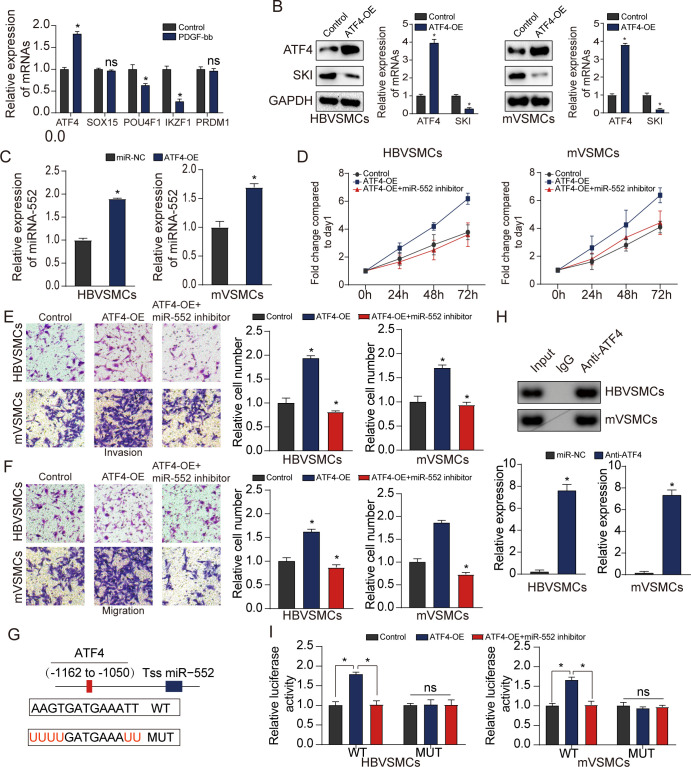
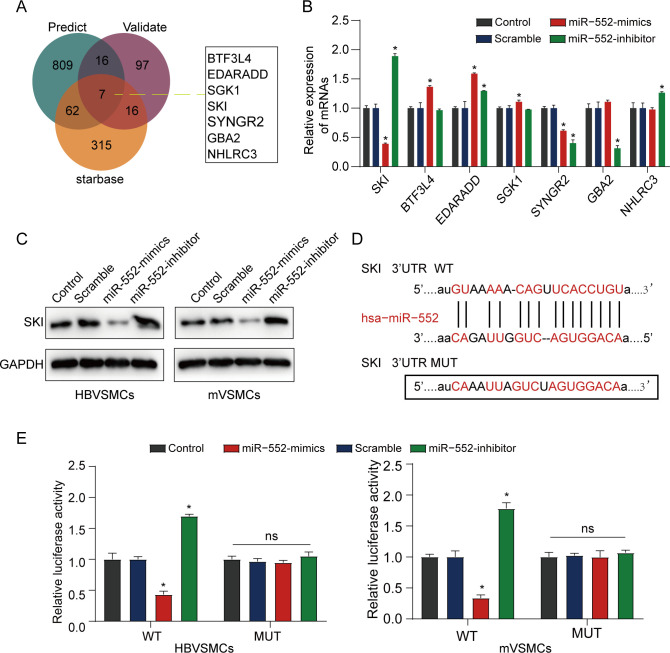
MATERIAL/METHODS: MTT assay and transwell assay were used to measure the proliferation, invasion, and migration of human brain VSMCs (HBVSMCs) and mice VSMCs (mVSMCs), respectively. Bioinformatics tools and luciferase assay were adopted to verify the association between miR-552 and SKI. Rescue experiments were employed to assess the interaction of miR-552 and SKI in modulating biological functions in HBVSMCs and mVSMCs. The expression level of transcription factors (TFs)was measured via qRT-PCR assay. The effect of ATF4 on miR-552 and SKI expression was tested by qRT-PCR or western blot assay. Finally, chromatin immunoprecipitation (ChIP) assay and JASPAR databases were used to analyze the regulatory linkage between ATF4 and miR-552.
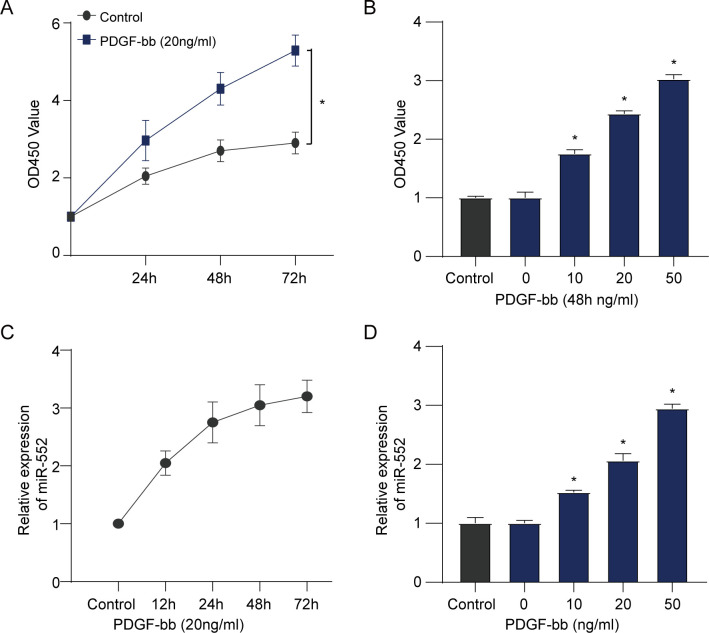
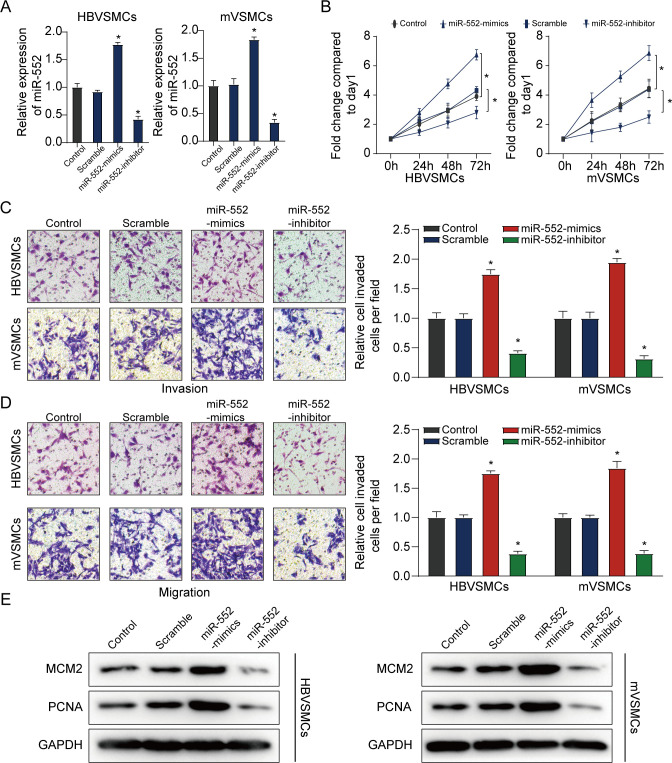
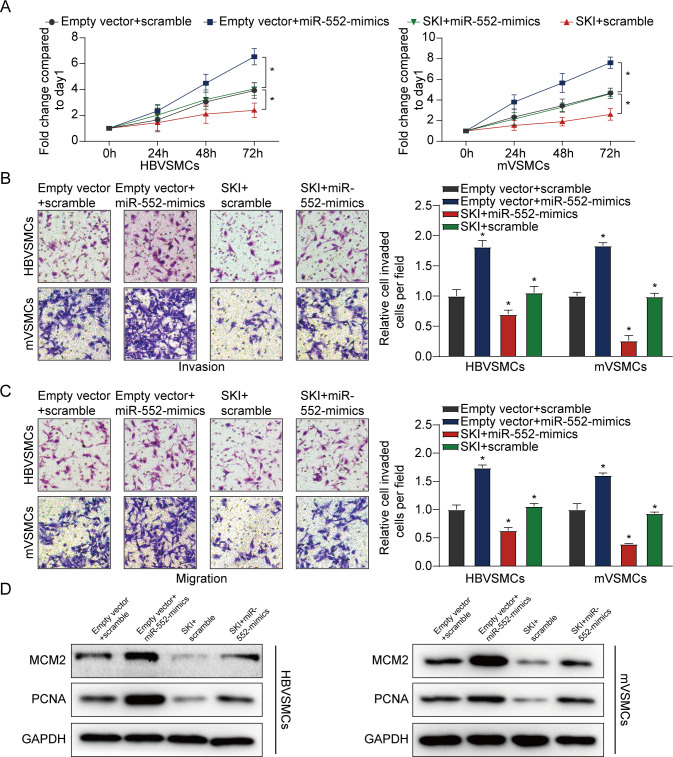
We found that miR-552 was upregulated in HBVSMCs treated with PDGF-bb and miR-552 overexpression could promote proliferation, invasion, and migration of HBVSMCs and mVSMCs, whereas, miR-552 knockdown had the opposite impact. In addition, we also found that SKI was a direct target of miR-552, which reversed miR-552-mediated proliferation, invasion, and migration in HBVSMCs and mVSMCs. Furthermore, we also discovered that miR-552 overexpression promoted the effects of ATF4 elevation on proliferation, migration and invasion of HBVSMCs and mVSMCs, but, miR-552 decline had the opposite impact.
ATF4-miR-552-SKI axis played critical roles in the proliferation and migration of HBVSMCs and mVSMCs, which were closely involved in atherosclerosis (AS). Therefore, our findings might offer a novel therapeutic target for AS.
研究表明血管平滑肌细胞(VSMCs)在动脉粥样硬化中起着关键作用,微小 RNA(miRNAs)在 VSMCs 的生物学功能中起着关键作用。然而,miR-552 在 VSMCs 中的潜在功能和机制尚不清楚。我们的目的是探讨 miR-552 对 VSMCs 的作用及其潜在机制。
材料/方法:MTT 法和 Transwell 法分别用于测量人脑血管平滑肌细胞(HBVSMCs)和小鼠血管平滑肌细胞(mVSMCs)的增殖、侵袭和迁移。采用生物信息学工具和荧光素酶报告基因实验验证 miR-552 与 SKI 的关联。采用挽救实验评估 miR-552 和 SKI 在调节 HBVSMCs 和 mVSMCs 生物学功能中的相互作用。通过 qRT-PCR 检测转录因子(TFs)的表达水平。通过 qRT-PCR 或 Western blot 检测 ATF4 对 miR-552 和 SKI 表达的影响。最后,采用染色质免疫沉淀(ChIP)实验和 JASPAR 数据库分析 ATF4 与 miR-552 之间的调控关系。
我们发现,PDGF-bb 处理的 HBVSMCs 中 miR-552 表达上调,miR-552 过表达可促进 HBVSMCs 和 mVSMCs 的增殖、侵袭和迁移,而 miR-552 下调则产生相反的影响。此外,我们还发现 SKI 是 miR-552 的直接靶标,可逆转 miR-552 介导的 HBVSMCs 和 mVSMCs 的增殖、侵袭和迁移。此外,我们还发现 miR-552 过表达促进了 ATF4 升高对 HBVSMCs 和 mVSMCs 增殖、迁移和侵袭的影响,但 miR-552 下调则产生相反的影响。
ATF4-miR-552-SKI 轴在 HBVSMCs 和 mVSMCs 的增殖和迁移中起着关键作用,与动脉粥样硬化(AS)密切相关。因此,我们的研究结果可能为 AS 提供了一个新的治疗靶点。