Laboratory of Neuroimaging, National Institute on Alcohol Abuse and Alcoholism, National Institutes of Health, Bethesda, MD 20892.
Division of Data Services, NIH Library, Office of Research Services, National Institutes of Health, Bethesda, MD 20892.
Proc Natl Acad Sci U S A. 2022 Jul 26;119(30):e2120009119. doi: 10.1073/pnas.2120009119. Epub 2022 Jul 18.
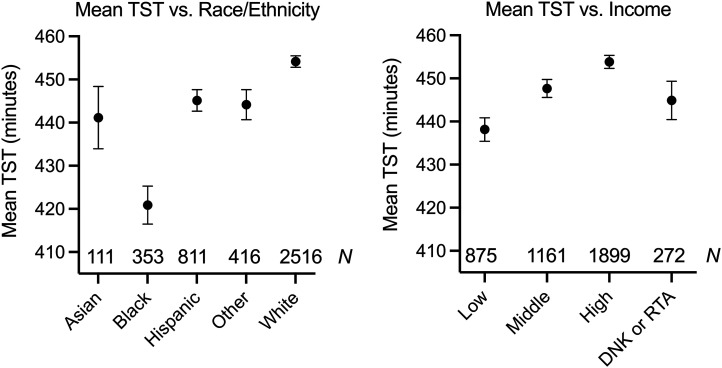
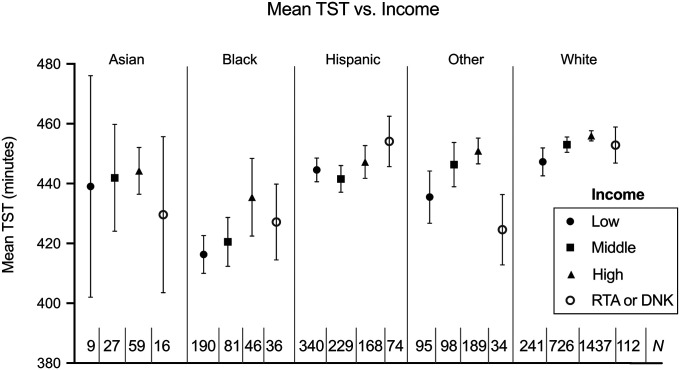
Children in the United States sleep less than the recommended amount and sleep deficiencies may be worse among disadvantaged children. Prior studies that compared sleep time in children of different race/ethnic groups mostly relied on questionnaires or were limited to small sample sizes. Our study takes advantage of the Adolescent Brain Cognitive Development study to compare total sleep time using a week of actigraphy data among American children (n = 4,207, 9 to 13 y old) of different racial/ethnic and income groups. We also assessed the effects of neighborhood deprivation, experience of discrimination, parent's age at child's birth, body mass index (BMI), and time the child fell asleep on sleep times. Daily total sleep time for the sample was 7.45 h and race/ethnicity, income, sex, age, BMI, were all significant predictors of total sleep time. Black children slept less than White children (∼34 min; Cohen's d = 0.95), children from lower income families slept less than those from higher incomes (∼16 min; Cohen's d = 0.44), boys slept less than girls (∼7 min; Cohen's d = 0.18), and older children slept less than younger ones (∼32 min; Cohen's d = 0.91); mostly due to later sleep times. Children with higher BMI also had shorter sleep times. Neither area deprivation index, experience of discrimination, or parent's age at child's birth significantly contributed to sleep time. Our findings indicate that children in the United States sleep significantly less than the recommended amount for healthy development and identifies significant racial and income disparities. Interventions to improve sleep hygiene in children will help improve health and ameliorate racial disparities in health outcomes.
美国儿童的睡眠时间少于推荐量,而贫困儿童的睡眠不足情况可能更严重。先前比较不同种族/族裔儿童睡眠时间的研究大多依赖于问卷,或者样本量较小。我们的研究利用青少年大脑认知发展研究,利用一周的活动记录仪数据比较了不同种族/族裔和收入群体的美国儿童(n=4207,9-13 岁)的总睡眠时间。我们还评估了邻里剥夺、歧视经历、孩子出生时父母的年龄、体重指数(BMI)和孩子入睡时间对睡眠时间的影响。该样本的每日总睡眠时间为 7.45 小时,种族/族裔、收入、性别、年龄、BMI 都是总睡眠时间的重要预测因素。黑人儿童比白人儿童睡眠时间少(约 34 分钟;Cohen's d=0.95),来自低收入家庭的儿童比来自高收入家庭的儿童睡眠时间少(约 16 分钟;Cohen's d=0.44),男孩比女孩睡眠时间少(约 7 分钟;Cohen's d=0.18),年龄较大的儿童比年龄较小的儿童睡眠时间少(约 32 分钟;Cohen's d=0.91);这主要是由于入睡时间较晚。BMI 较高的儿童睡眠时间也较短。区域剥夺指数、歧视经历或孩子出生时父母的年龄对睡眠时间没有显著影响。我们的研究结果表明,美国儿童的睡眠时间明显少于健康发育所需的睡眠时间,而且存在显著的种族和收入差距。改善儿童睡眠卫生的干预措施将有助于改善健康状况,并减轻健康结果方面的种族差异。