Department of Sociology, Utah State University, Logan, UT, USA.
Department of Health & Behavioral Sciences, University of Colorado-Denver, CO, USA.
Int J Obes (Lond). 2014 Jul;38(7):944-9. doi: 10.1038/ijo.2014.18. Epub 2014 Jan 31.
We investigate whether differences in sleep duration help explain ethnic disparities in body mass index (BMI) among US adolescents. We also evaluate the functional form of the association between sleep duration and BMI, and investigate whether this association varies by sex and ethnicity.
We analyzed restricted-use data from the first two waves of the National Longitudinal Study of Adolescent Health (n=30 133) to evaluate linear and quadratic associations between sleep duration and BMI. Through a series of models that incorporated interaction terms between sex, ethnicity and sleep duration, we also assessed whether (1) sleep duration mediates associations between ethnicity and BMI, and (2) associations between sleep duration and BMI differ for girls and boys from different ethnic groups.
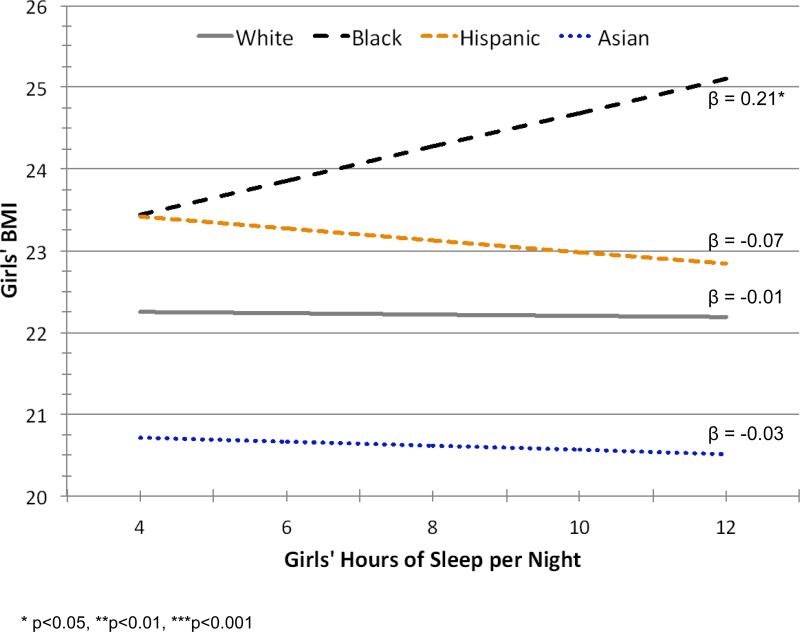
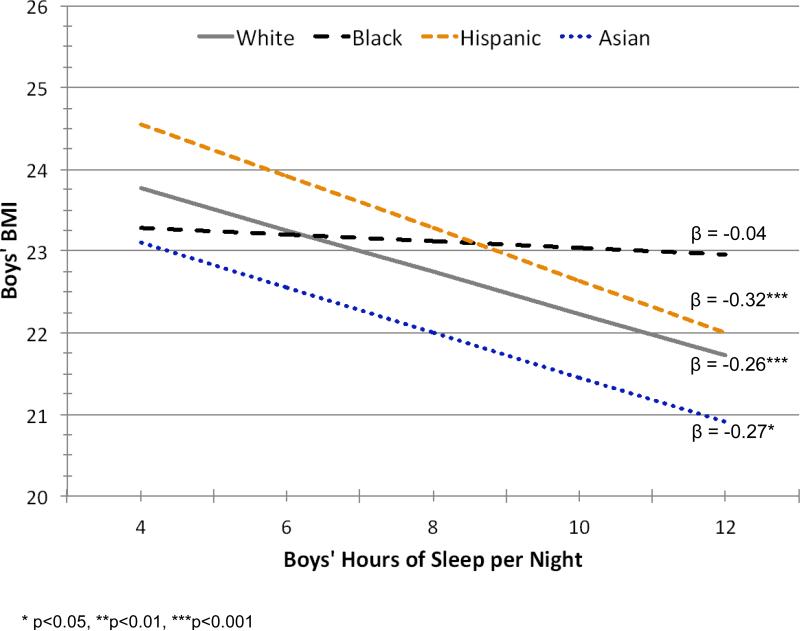
A linear association between sleep duration and BMI best fits the data in this large sample of US adolescents. We find no evidence that sleep duration contributes substantially to ethnic disparities in BMI. However, we detect significant differences in the association between sleep duration and BMI by sex and ethnicity. Sleep duration is negatively associated with BMI among White, Hispanic and Asian boys, positively associated with BMI among Black girls and is not related to BMI among Black boys or girls from White, Hispanic or Asian ethnic groups.
Despite significant associations between sleep duration and BMI for certain groups of adolescents, we find no evidence that ethnic differences in sleep duration exacerbate ethnic disparities in BMI. Future research should explore mechanisms that underlie ethnic differences in the association between sleep and BMI.
我们研究睡眠时间的差异是否有助于解释美国青少年的体重指数(BMI)的种族差异。我们还评估了睡眠时间与 BMI 之间的关联的函数形式,并调查这种关联是否因性别和种族而异。
我们分析了国家青少年健康纵向研究(n=30133)的前两个波次的受限使用数据,以评估睡眠时间与 BMI 之间的线性和二次关联。通过一系列纳入性别、种族和睡眠时间之间交互项的模型,我们还评估了(1)睡眠时间是否在种族和 BMI 之间的关联中起中介作用,以及(2)不同种族的女孩和男孩的睡眠时间与 BMI 之间的关联是否存在差异。
在这个大型美国青少年样本中,睡眠时间与 BMI 之间的线性关联最符合数据。我们没有发现证据表明睡眠时间会大大加剧 BMI 的种族差异。然而,我们发现睡眠时间与 BMI 之间的关联因性别和种族而存在显著差异。睡眠时间与 BMI 呈负相关的是白人、西班牙裔和亚裔男孩,与 BMI 呈正相关的是黑人女孩,而与 BMI 不相关的是黑人男孩或来自白人、西班牙裔或亚裔的男孩和女孩。
尽管睡眠时间与某些青少年群体的 BMI 之间存在显著关联,但我们没有发现证据表明睡眠时间的种族差异会加剧 BMI 的种族差异。未来的研究应该探索睡眠与 BMI 之间关联的种族差异的潜在机制。