Population Health Sciences, University of Bristol, Bristol, UK.
NIHR Bristol Biomedical Research Centre, Bristol, UK.
BMJ. 2022 Jul 20;378:e071249. doi: 10.1136/bmj-2022-071249.
To estimate waning of covid-19 vaccine effectiveness over six months after second dose.
Cohort study, approved by NHS England.
Linked primary care, hospital, and covid-19 records within the OpenSAFELY-TPP database.
Adults without previous SARS-CoV-2 infection were eligible, excluding care home residents and healthcare professionals.
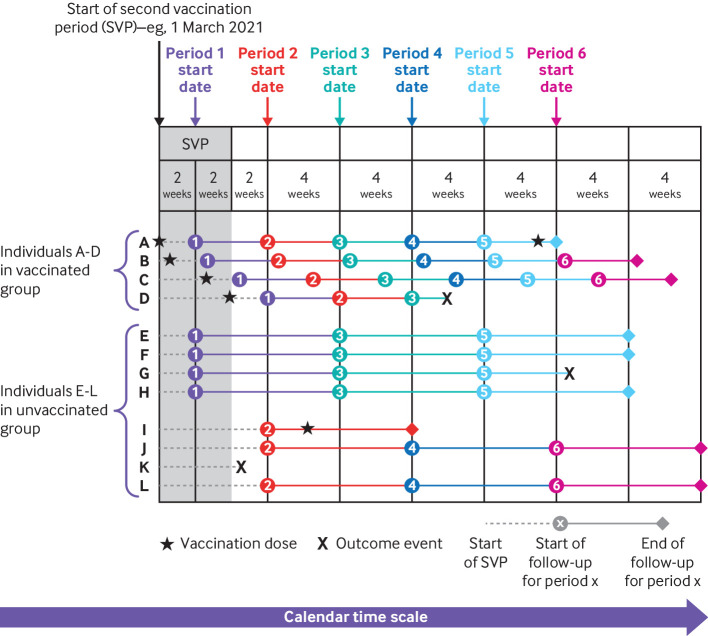
People who had received two doses of BNT162b2 or ChAdOx1 (administered during the national vaccine rollout) were compared with unvaccinated people during six consecutive comparison periods, each of four weeks.
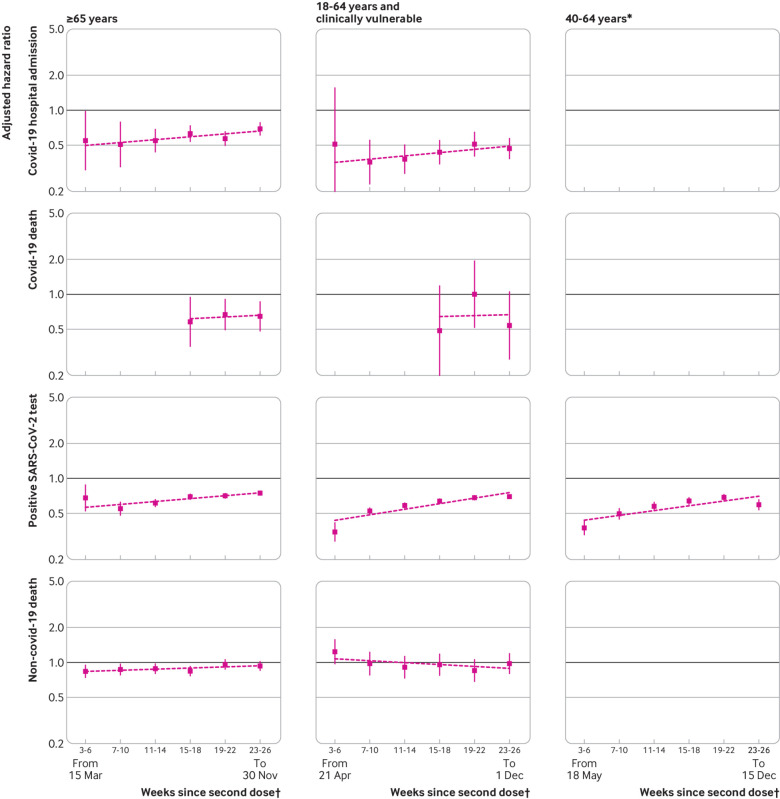
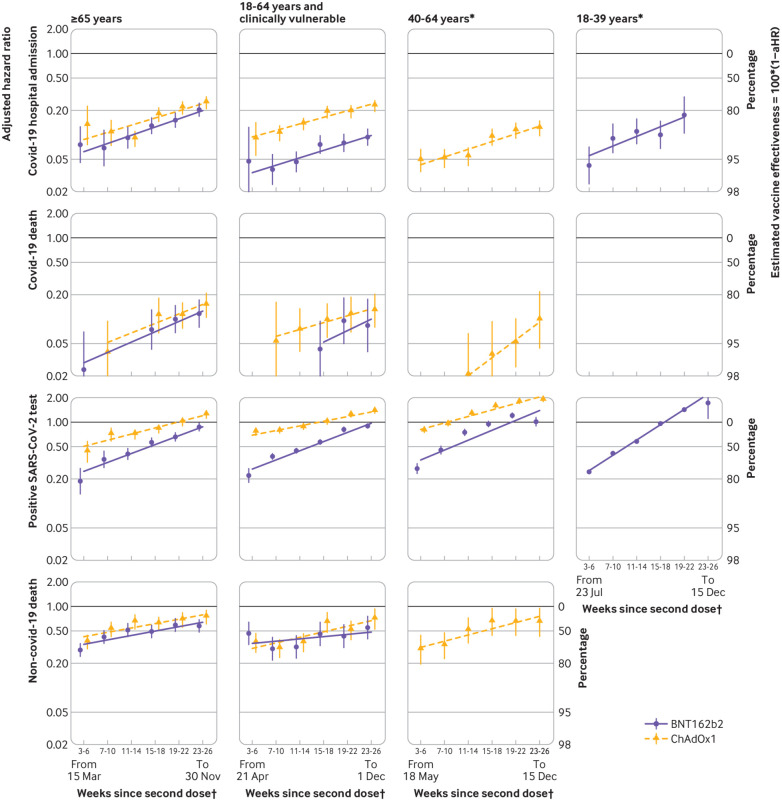
Adjusted hazard ratios for covid-19 related hospital admission, covid-19 related death, positive SARS-CoV-2 test, and non-covid-19 related death comparing vaccinated with unvaccinated people. Waning vaccine effectiveness was quantified as ratios of adjusted hazard ratios per four week period, separately for subgroups aged ≥65 years, 18-64 years and clinically vulnerable, 40-64 years, and 18-39 years.
1 951 866 and 3 219 349 eligible adults received two doses of BNT162b2 and ChAdOx1, respectively, and 2 422 980 remained unvaccinated. Waning of vaccine effectiveness was estimated to be similar across outcomes and vaccine brands. In the ≥65 years subgroup, ratios of adjusted hazard ratios for covid-19 related hospital admission, covid-19 related death, and positive SARS-CoV-2 test ranged from 1.19 (95% confidence interval 1.14 to 1.24)to 1.34 (1.09 to 1.64) per four weeks. Despite waning vaccine effectiveness, rates of covid-19 related hospital admission and death were substantially lower among vaccinated than unvaccinated adults up to 26 weeks after the second dose, with estimated vaccine effectiveness ≥80% for BNT162b2, and ≥75% for ChAdOx1. By weeks 23-26, rates of positive SARS-CoV-2 test in vaccinated people were similar to or higher than in unvaccinated people (adjusted hazard ratios up to 1.72 (1.11 to 2.68) for BNT162b2 and 1.86 (1.79 to 1.93) for ChAdOx1).
The rate at which estimated vaccine effectiveness waned was consistent for covid-19 related hospital admission, covid-19 related death, and positive SARS-CoV-2 test and was similar across subgroups defined by age and clinical vulnerability. If sustained to outcomes of infection with the omicron variant and to booster vaccination, these findings will facilitate scheduling of booster vaccination.
估计第二剂疫苗接种后 6 个月内 COVID-19 疫苗效力的衰减情况。
在 NHS England 批准下进行的队列研究。
OpenSAFELY-TPP 数据库中的初级保健、医院和 COVID-19 记录的链接。
没有 SARS-CoV-2 既往感染史的成年人有资格参加,不包括养老院居民和医护人员。
在连续的 6 个比较期内,每 4 周比较一次接受两剂 BNT162b2 或 ChAdOx1(在国家疫苗接种计划期间接种)的人群与未接种疫苗的人群。
比较接种疫苗和未接种疫苗人群的 COVID-19 相关住院、COVID-19 相关死亡、SARS-CoV-2 检测阳性和非 COVID-19 相关死亡的校正危险比。通过每个 4 周的时间间隔,分别为年龄≥65 岁、18-64 岁和临床脆弱人群、40-64 岁和 18-39 岁的亚组,量化疫苗效力的衰减。
分别有 1951866 名和 3219349 名符合条件的成年人接受了两剂 BNT162b2 和 ChAdOx1,2422980 人未接种疫苗。在所有结局和疫苗品牌中,疫苗效力的衰减估计相似。在≥65 岁亚组中,COVID-19 相关住院、COVID-19 相关死亡和 SARS-CoV-2 检测阳性的校正危险比比值范围为每 4 周 1.19(95%置信区间 1.14 至 1.24)至 1.34(1.09 至 1.64)。尽管疫苗效力下降,但在第二剂疫苗接种后 26 周内,接种疫苗的成年人 COVID-19 相关住院和死亡的发生率明显低于未接种疫苗的成年人,BNT162b2 的疫苗有效性估计≥80%,ChAdOx1 的疫苗有效性估计≥75%。在第 23-26 周,接种疫苗者的 SARS-CoV-2 检测阳性率与未接种疫苗者相似或更高(BNT162b2 高达 1.72(1.11 至 2.68),ChAdOx1 高达 1.86(1.79 至 1.93))。
COVID-19 相关住院、COVID-19 相关死亡和 SARS-CoV-2 检测阳性的估计疫苗效力衰减率是一致的,并且在按年龄和临床脆弱性定义的亚组中相似。如果这种情况持续到感染奥密克戎变异株和加强针接种的结果,这些发现将有助于安排加强针接种。