The Bennett Institute for Applied Data Science, Nuffield Department of Primary Care Health Sciences, University of Oxford, Oxford, UK
Population Health Sciences, University of Bristol, Bristol, UK.
BMJ. 2023 Mar 15;380:e072808. doi: 10.1136/bmj-2022-072808.
To compare the effectiveness of the BNT162b2 mRNA (Pfizer-BioNTech) and mRNA-1273 (Moderna) covid-19 vaccines during the booster programme in England.
Matched cohort study, emulating a comparative effectiveness trial.
Linked primary care, hospital, and covid-19 surveillance records available within the OpenSAFELY-TPP research platform, covering a period when the SARS-CoV-2 delta and omicron variants were dominant.
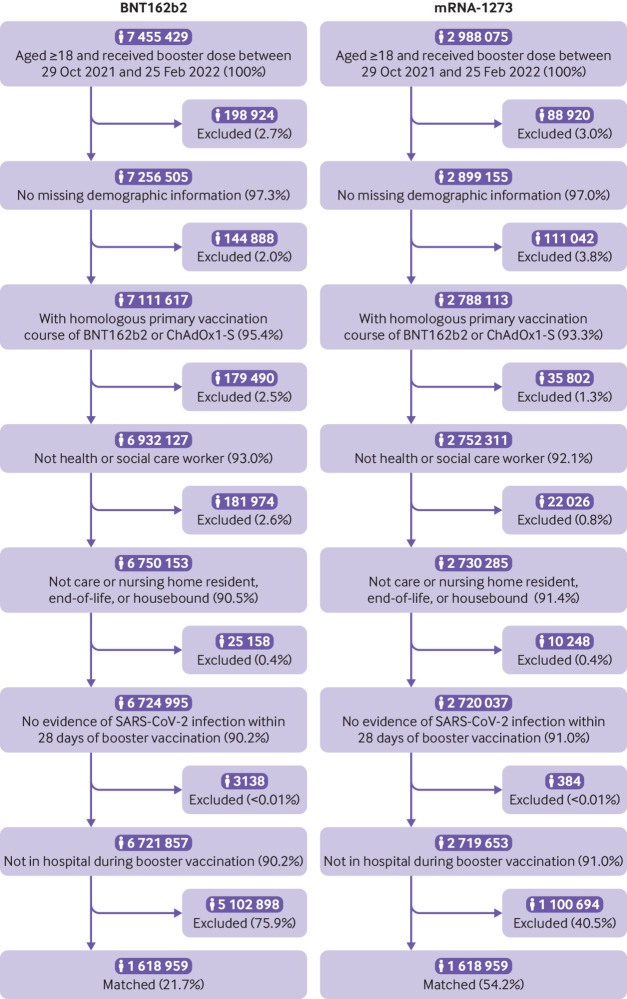
3 237 918 adults who received a booster dose of either vaccine between 29 October 2021 and 25 February 2022 as part of the national booster programme in England and who received a primary course of BNT162b2 or ChAdOx1.
Vaccination with either BNT162b2 or mRNA-1273 as a booster vaccine dose.
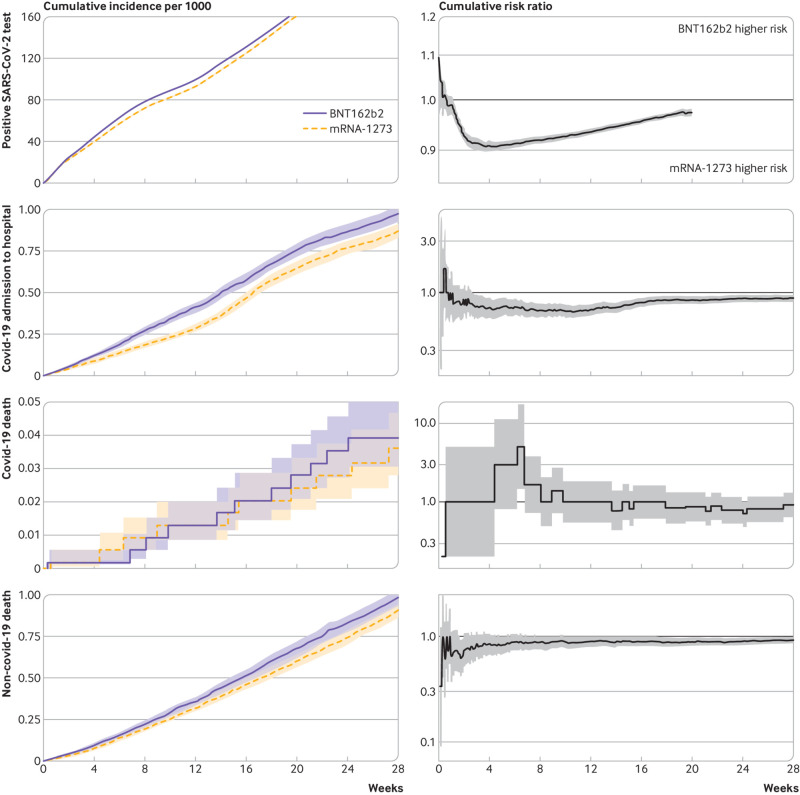
Recorded SARS-CoV-2 positive test, covid-19 related hospital admission, covid-19 related death, and non-covid-19 related death at 20 weeks after receipt of the booster dose.
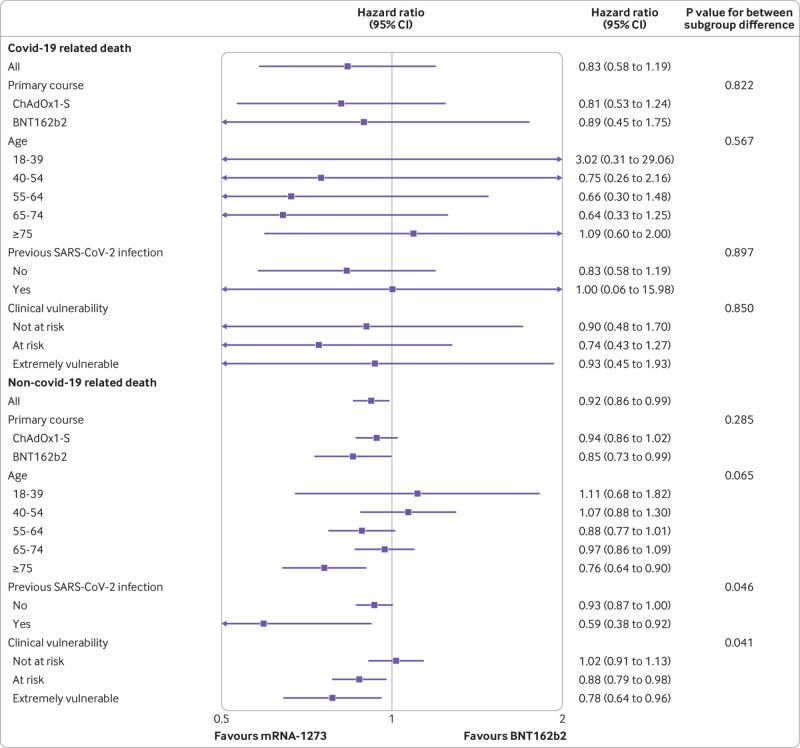
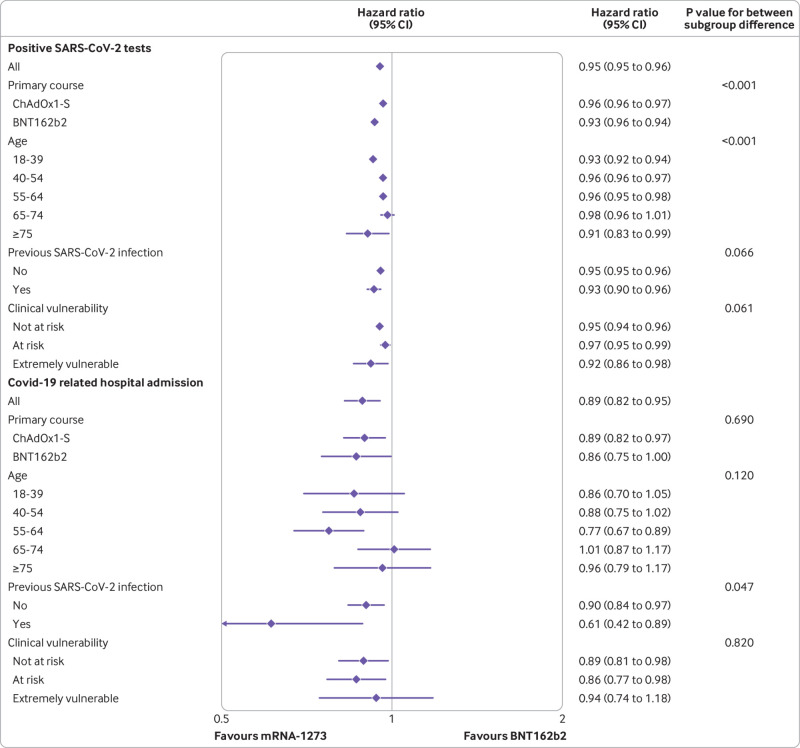
1 618 959 people were matched in each vaccine group, contributing a total 64 546 391 person weeks of follow-up. The 20 week risks per 1000 for a positive SARS-CoV-2 test were 164.2 (95% confidence interval 163.3 to 165.1) for BNT162b2 and 159.9 (159.0 to 160.8) for mRNA-1273; the hazard ratio comparing mRNA-1273 with BNT162b2 was 0.95 (95% confidence interval 0.95 to 0.96). The 20 week risks per 1000 for hospital admission with covid-19 were 0.75 (0.71 to 0.79) for BNT162b2 and 0.65 (0.61 to 0.69) for mRNA-1273; the hazard ratio was 0.89 (0.82 to 0.95). Covid-19 related deaths were rare: the 20 week risks per 1000 were 0.028 (0.021 to 0.037) for BNT162b2 and 0.024 (0.018 to 0.033) for mRNA-1273; hazard ratio 0.83 (0.58 to 1.19). Comparative effectiveness was generally similar within subgroups defined by the primary course vaccine brand, age, previous SARS-CoV-2 infection, and clinical vulnerability. Relative benefit was similar when vaccines were compared separately in the delta and omicron variant eras.
This matched observational study of adults estimated a modest benefit of booster vaccination with mRNA-1273 compared with BNT162b2 in preventing positive SARS-CoV-2 tests and hospital admission with covid-19 20 weeks after vaccination, during a period of delta followed by omicron variant dominance.
比较 BNT162b2 mRNA(辉瑞-生物技术)和 mRNA-1273(莫德纳)新冠疫苗在英格兰加强针计划中的有效性。
匹配队列研究,模拟比较有效性试验。
在 OpenSAFELY-TPP 研究平台中可获得的链接初级保健、医院和新冠监测记录,涵盖 SARS-CoV-2 德尔塔和奥密克戎变体占主导地位的时期。
3237918 名成年人在 2021 年 10 月 29 日至 2022 年 2 月 25 日期间作为英格兰全国加强针计划的一部分接受了 BNT162b2 或 ChAdOx1 的初级疗程,并接受了加强针剂量的任何一种疫苗接种。
接种 BNT162b2 或 mRNA-1273 作为加强疫苗剂量。
接种加强针后 20 周内记录的 SARS-CoV-2 阳性检测、与新冠相关的住院、与新冠相关的死亡和非新冠相关的死亡。
每组 1618959 人匹配,共提供了 64546391 人周的随访。接种加强针后 20 周每 1000 人 SARS-CoV-2 阳性检测的风险分别为 BNT162b2 组的 164.2(95%置信区间 163.3 至 165.1)和 mRNA-1273 组的 159.9(159.0 至 160.8);mRNA-1273 与 BNT162b2 相比的风险比为 0.95(95%置信区间 0.95 至 0.96)。接种加强针后 20 周每 1000 人因新冠住院的风险分别为 BNT162b2 组的 0.75(0.71 至 0.79)和 mRNA-1273 组的 0.65(0.61 至 0.69);风险比为 0.89(0.82 至 0.95)。与新冠相关的死亡很少见:接种加强针后 20 周每 1000 人的风险分别为 BNT162b2 组的 0.028(0.021 至 0.037)和 mRNA-1273 组的 0.024(0.018 至 0.033);风险比为 0.83(0.58 至 1.19)。在初级疗程疫苗品牌、年龄、既往 SARS-CoV-2 感染和临床脆弱性定义的亚组中,相对有效性通常相似。在 delta 和奥密克戎变体主导时期分别比较疫苗时,相对益处相似。
本项针对成年人的匹配观察性研究估计,在 delta 随后奥密克戎变体占主导地位的时期,接种加强针后 20 周,mRNA-1273 与 BNT162b2 相比,在预防 SARS-CoV-2 阳性检测和新冠住院方面具有适度益处。