School of Medicine, University of Nottingham, Nottingham, NG7 2TU, UK.
Philipps-University Marburg, Marburg, Germany.
BMC Geriatr. 2022 Jul 21;22(1):605. doi: 10.1186/s12877-022-03239-5.
The potential decrease in daily physical activity associated with the COVID-19 pandemic lockdowns may have a negative impact on people living with dementia. Given the limited literature around the effects of home confinement in people living with dementia, this study investigated changes in physical exercise levels of participants in the intervention arm of the Promoting Activity, Independence and Stability in Early Dementia (PrAISED) Randomised Controlled Trial during the first COVID-19 national lockdown. It hypothesised that participants would maintain physical exercise levels.
A repeated measure (three time points) study involving 30 participants (mean age = 78.0 years, 15 male and 15 female, 22 (73.0%) living with their primary caregiver), from four regions in England receiving the PrAISED intervention. PrAISED is an individually tailored intervention of physical exercises and functional activities. Trained therapists deliver therapy sessions over a period of 52 weeks. Study participants received therapy sessions via phone or video calling during the COVID-19 lockdown. This study investigated self-reported minutes of physical exercise recorded on study calendars for the months of February (i.e., baseline - pre-lockdown), May (i.e., T1 - during lockdown), and August (i.e., T2-post-lockdown) 2020.
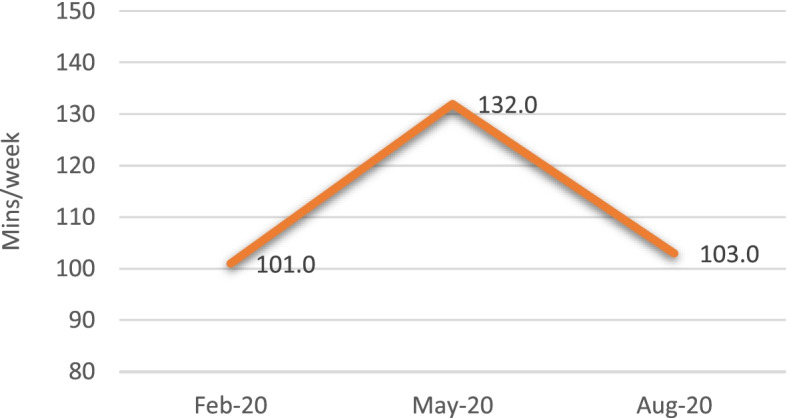
Participants reported a statistically significant increase in activity levels between February and May (Wilcoxon Z = -2.013, p = 0.044) and a statistically significant decrease between May and August (Wilcoxon Z = -2.726, p = 0.004). No significant difference was found in the physical activity levels from pre- to post-lockdown (Wilcoxon Z = 0.485, p = 0.620).
Despite concerns that the restrictions associated with the COVID-19 pandemic might lead to reductions in physical exercise, participants in receipt of the PrAISED intervention increased their amount of physical exercise during lockdown. Our findings support the potential of remote support for people living with dementia to help them maintain physical exercise levels in circumstances where face-to-face service provision is not possible.
The PrAISED trial and process evaluation have received ethical approval number 18/YH/0059 from the Bradford/Leeds Ethics Committee. The Clinical Trial Identifier for PrAISED is: ISRCTN15320670 ( https://doi.org/10.1186/ISRCTN15320670 ). Registration was made on 04/09/2018.
与 COVID-19 大流行封锁相关的日常体力活动的潜在减少,可能对患有痴呆症的人产生负面影响。鉴于有关痴呆症患者居家隔离影响的文献有限,本研究调查了在第一次 COVID-19 全国封锁期间,接受预防早期痴呆症中活动、独立性和稳定性(PrAISED)随机对照试验干预组的参与者的体育锻炼水平的变化。研究假设参与者将保持体育锻炼水平。
这是一项重复测量(三个时间点)研究,涉及来自英格兰四个地区的 30 名参与者(平均年龄 78.0 岁,男性 15 名,女性 15 名,22 名(73.0%)与主要护理者同住),他们正在接受 PrAISED 干预。PrAISED 是一项个性化的体育锻炼和功能活动干预措施。经过培训的治疗师在 52 周的时间内提供治疗课程。在 COVID-19 封锁期间,研究参与者通过电话或视频通话接受治疗课程。本研究调查了 2020 年 2 月(即基线-封锁前)、5 月(即 T1-封锁期间)和 8 月(即 T2-封锁后)记录在研究日历上的自我报告的体育锻炼分钟数。
参与者报告称,他们的活动水平在 2 月至 5 月之间呈统计学显著增加(Wilcoxon Z=-2.013,p=0.044),而在 5 月至 8 月之间呈统计学显著下降(Wilcoxon Z=-2.726,p=0.004)。从封锁前到封锁后,体力活动水平没有显著差异(Wilcoxon Z=0.485,p=0.620)。
尽管人们担心 COVID-19 大流行带来的限制可能会导致体力活动减少,但接受 PrAISED 干预的参与者在封锁期间增加了体力活动量。我们的研究结果支持在无法提供面对面服务的情况下,为痴呆症患者提供远程支持以帮助他们保持体力活动水平的潜力。
PrAISED 试验和过程评估已获得布拉德福德/利兹伦理委员会的伦理批准编号 18/YH/0059。PrAISED 的临床试验标识符为:ISRCTN15320670(https://doi.org/10.1186/ISRCTN15320670)。注册于 2018 年 9 月 4 日进行。