
猕猴皮层多区域脉冲神经网络模型在MPI-GPU集群上的快速模拟
Fast Simulation of a Multi-Area Spiking Network Model of Macaque Cortex on an MPI-GPU Cluster.
作者信息
Tiddia Gianmarco, Golosio Bruno, Albers Jasper, Senk Johanna, Simula Francesco, Pronold Jari, Fanti Viviana, Pastorelli Elena, Paolucci Pier Stanislao, van Albada Sacha J
机构信息
Department of Physics, University of Cagliari, Monserrato, Italy.
Istituto Nazionale di Fisica Nucleare (INFN), Sezione di Cagliari, Monserrato, Italy.
出版信息
Front Neuroinform. 2022 Jul 4;16:883333. doi: 10.3389/fninf.2022.883333. eCollection 2022.
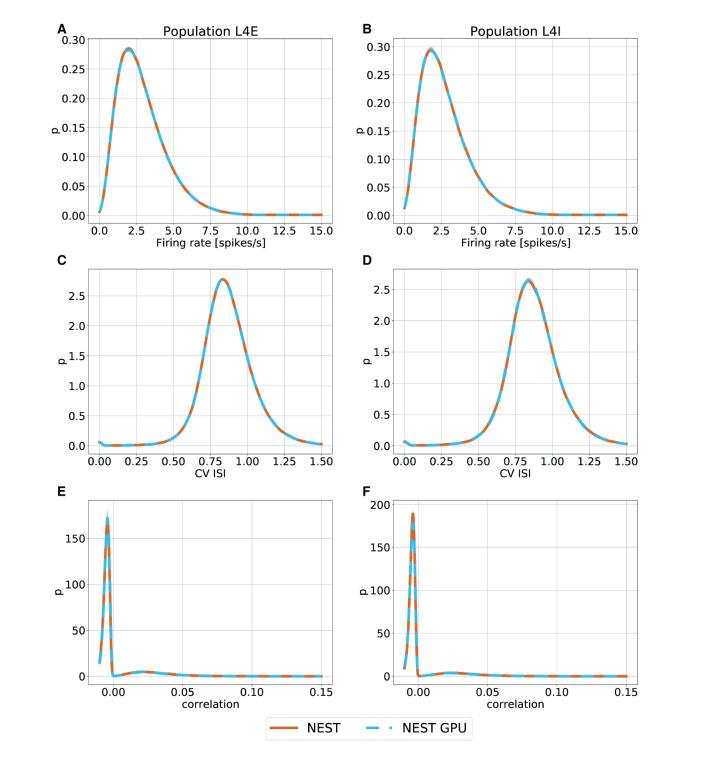
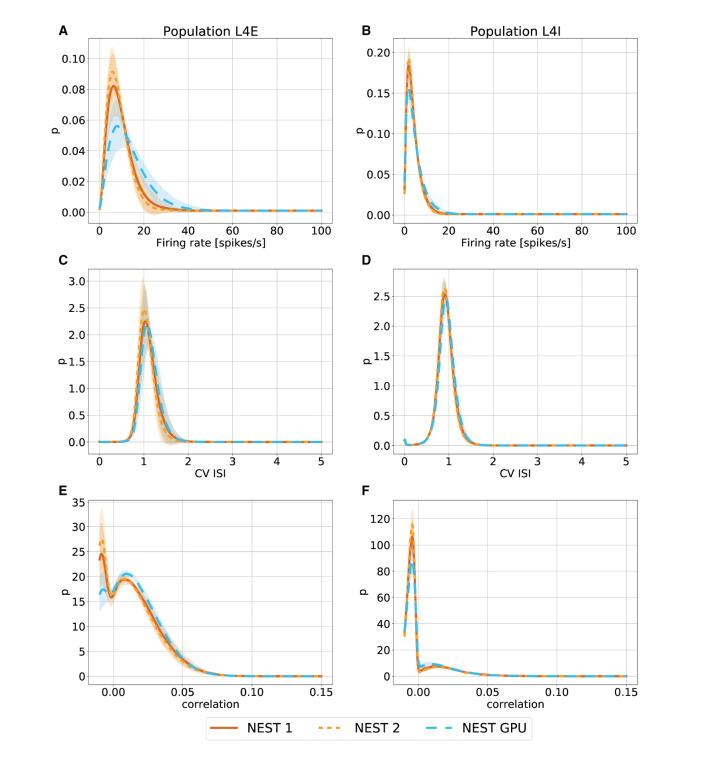
Spiking neural network models are increasingly establishing themselves as an effective tool for simulating the dynamics of neuronal populations and for understanding the relationship between these dynamics and brain function. Furthermore, the continuous development of parallel computing technologies and the growing availability of computational resources are leading to an era of large-scale simulations capable of describing regions of the brain of ever larger dimensions at increasing detail. Recently, the possibility to use MPI-based parallel codes on GPU-equipped clusters to run such complex simulations has emerged, opening up novel paths to further speed-ups. NEST GPU is a GPU library written in CUDA-C/C++ for large-scale simulations of spiking neural networks, which was recently extended with a novel algorithm for remote spike communication through MPI on a GPU cluster. In this work we evaluate its performance on the simulation of a multi-area model of macaque vision-related cortex, made up of about 4 million neurons and 24 billion synapses and representing 32 mm surface area of the macaque cortex. The outcome of the simulations is compared against that obtained using the well-known CPU-based spiking neural network simulator NEST on a high-performance computing cluster. The results show not only an optimal match with the NEST statistical measures of the neural activity in terms of three informative distributions, but also remarkable achievements in terms of simulation time per second of biological activity. Indeed, NEST GPU was able to simulate a second of biological time of the full-scale macaque cortex model in its metastable state 3.1× faster than NEST using 32 compute nodes equipped with an NVIDIA V100 GPU each. Using the same configuration, the ground state of the full-scale macaque cortex model was simulated 2.4× faster than NEST.
脉冲神经网络模型正日益成为模拟神经元群体动态以及理解这些动态与脑功能之间关系的有效工具。此外,并行计算技术的不断发展以及计算资源可用性的不断提高,正引领着一个大规模模拟的时代,能够越来越详细地描述更大尺寸的脑区。最近,在配备GPU的集群上使用基于MPI的并行代码来运行此类复杂模拟的可能性已经出现,为进一步加速开辟了新途径。NEST GPU是一个用CUDA-C/C++编写的用于脉冲神经网络大规模模拟的GPU库,最近它通过一种用于在GPU集群上通过MPI进行远程脉冲通信的新算法得到了扩展。在这项工作中,我们评估了它在模拟猕猴视觉相关皮层的多区域模型时的性能,该模型由约400万个神经元和240亿个突触组成,代表猕猴皮层32平方毫米的表面积。将模拟结果与在高性能计算集群上使用著名的基于CPU的脉冲神经网络模拟器NEST所获得的结果进行了比较。结果不仅在三种信息分布方面与NEST对神经活动的统计测量结果实现了最佳匹配,而且在每秒生物活动的模拟时间方面也取得了显著成就。事实上,NEST GPU能够以比NEST快3.1倍的速度,使用32个每个都配备NVIDIA V100 GPU的计算节点,模拟全尺寸猕猴皮层模型处于亚稳态时的一秒生物时间。使用相同配置,全尺寸猕猴皮层模型的基态模拟速度比NEST快2.4倍。




 Zotero 插件