Chen Chien-An, Ho Chung-Han, Wu Yu-Cih, Chen Yi-Chen, Wang Jhi-Joung, Liao Kuang-Ming
Division of Hepatogastroenterology, Department of Internal Medicine, Chi Mei Medical Center, Tainan, 71004, Taiwan.
Division of Hospital Medicine, Department of Internal Medicine, Chi Mei Medical Center, Tainan, 71004, Taiwan.
Infect Drug Resist. 2022 Jul 13;15:3757-3766. doi: 10.2147/IDR.S370967. eCollection 2022.
The incidence of aspergillosis is increasing, and the risk factors for infection include cancer, admission to the intensive care unit, chronic pulmonary diseases, immunocompromised status, and taking immunomodulatory drugs. There are limited data about the incidence of aspergillosis in patients with different types of cancer. The aim of our study was to survey the incidence of aspergillosis in different cancer types from 2006 to 2017.
Data were collected from the Taiwan Cancer Registry database and International Classification of Diseases, 9th, 10th Revision, and Clinical Modification codes for diagnosing aspergillosis. Patients with a history of aspergillosis before cancer were excluded, and the secondary outcome was the risk of mortality in cancer patients with and without aspergillosis after 1 year.
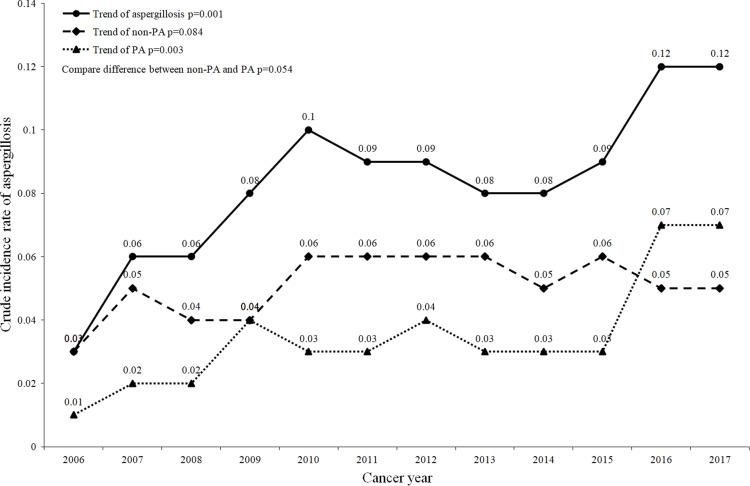
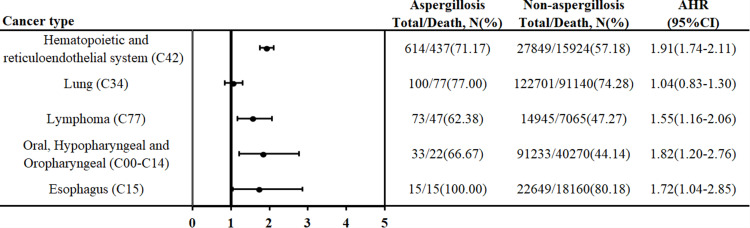
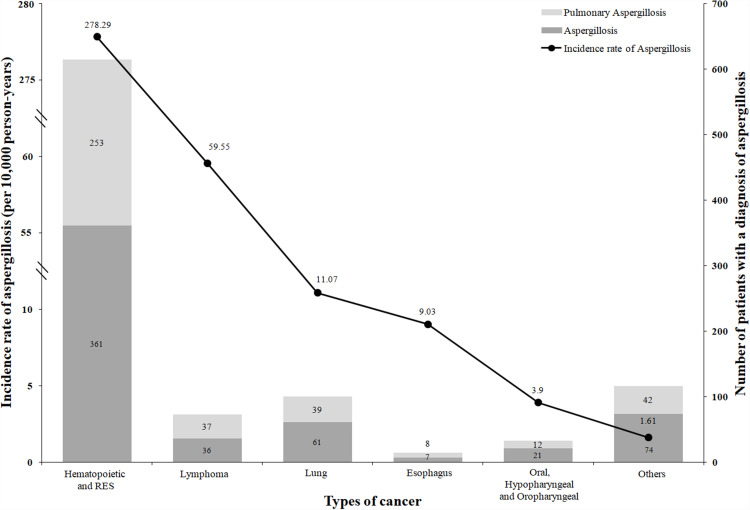
Among 951 cancer patients with a diagnosis of aspergillosis, there were 614 hematopoietic and reticuloendothelial system patients, 100 lung cancer patients, and 73 lymphoma cancer patients. The overall incidence rates of aspergillosis tended to increase significantly from 2006 to 2017 (from 3.50 to 13.37 per 10,000 person-years, p value: <0.0001). Regarding sex, the incidence rates of aspergillosis in males and females were 12.52 and 7.53 per 10,000 person-years, respectively. Patients with a diagnosis of aspergillosis had a 2.30-fold (95% CI: 2.14-2.48, p value: <0.0001) higher risk of mortality than those without aspergillosis.
The incidence of aspergillosis was increased in cancer patients, and cancer patients with aspergillosis had a significantly higher risk of mortality than those without aspergillosis.
曲霉病的发病率正在上升,感染的风险因素包括癌症、入住重症监护病房、慢性肺部疾病、免疫功能低下状态以及服用免疫调节药物。关于不同类型癌症患者中曲霉病发病率的数据有限。我们研究的目的是调查2006年至2017年不同癌症类型中曲霉病的发病率。
数据收集自台湾癌症登记数据库以及国际疾病分类第九版、第十版和临床修订版中用于诊断曲霉病的编码。排除癌症发生前有曲霉病病史的患者,次要结局是有和没有曲霉病的癌症患者1年后的死亡风险。
在951例诊断为曲霉病的癌症患者中,有614例造血和网状内皮系统患者、100例肺癌患者以及73例淋巴瘤患者。从2006年到2017年,曲霉病的总体发病率呈显著上升趋势(从每10000人年3.50例增至13.37例,p值:<0.0001)。按性别划分,男性和女性曲霉病的发病率分别为每10000人年12.52例和7.53例。诊断为曲霉病的患者死亡风险比未患曲霉病的患者高2.30倍(95%可信区间:2.14 - 2.48,p值:<0.0001)。
癌症患者中曲霉病的发病率有所增加,患有曲霉病的癌症患者的死亡风险显著高于未患曲霉病的患者。