Meng Lingkuan, Chan Wai-Sum, Huang Lei, Liu Linjing, Chen Xingjian, Zhang Weitong, Wang Fuzhou, Cheng Ke, Sun Hongyan, Wong Ka-Chun
Department of Computer Science, City University of Hong Kong, Hong Kong Special Administrative Region.
Department of Chemistry, City University of Hong Kong, Hong Kong Special Administrative Region.
Comput Struct Biotechnol J. 2022 Jun 30;20:3522-3532. doi: 10.1016/j.csbj.2022.06.045. eCollection 2022.
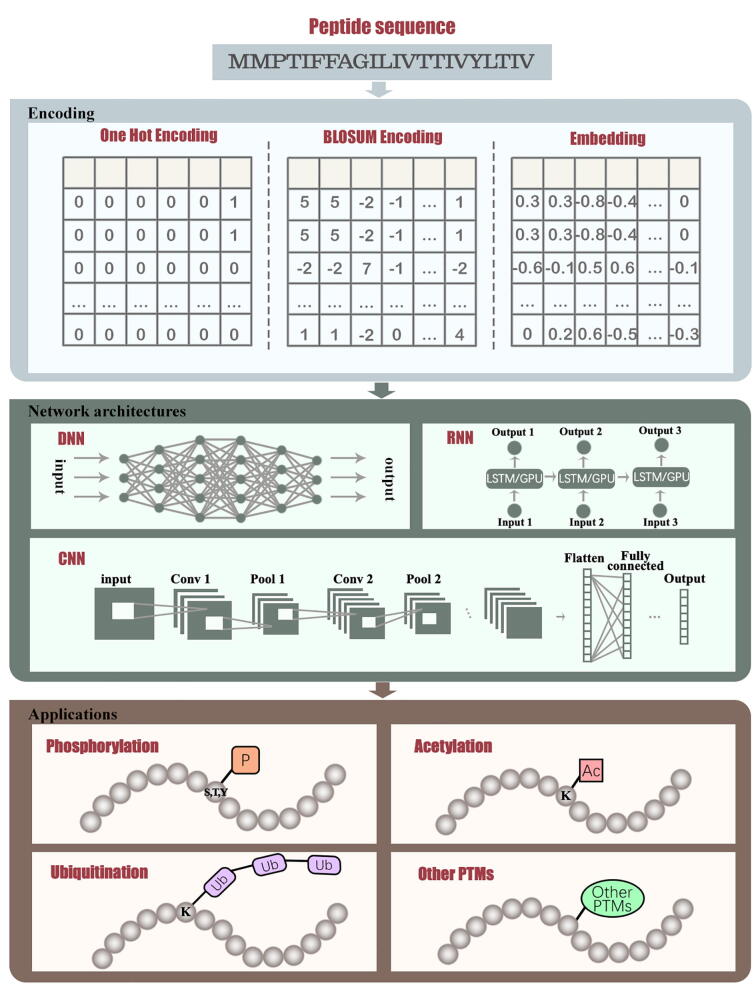
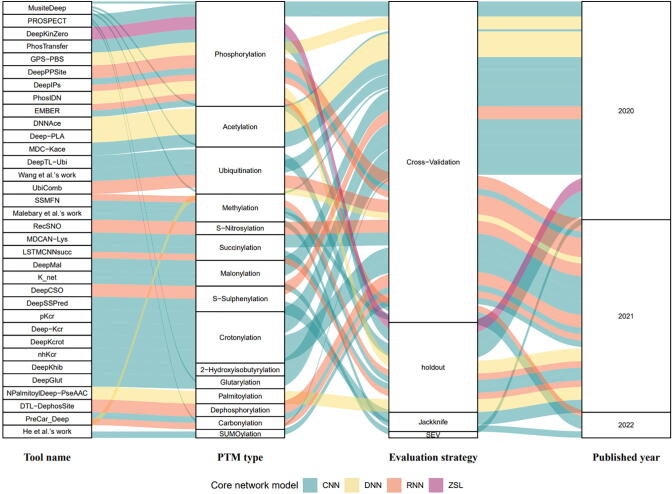
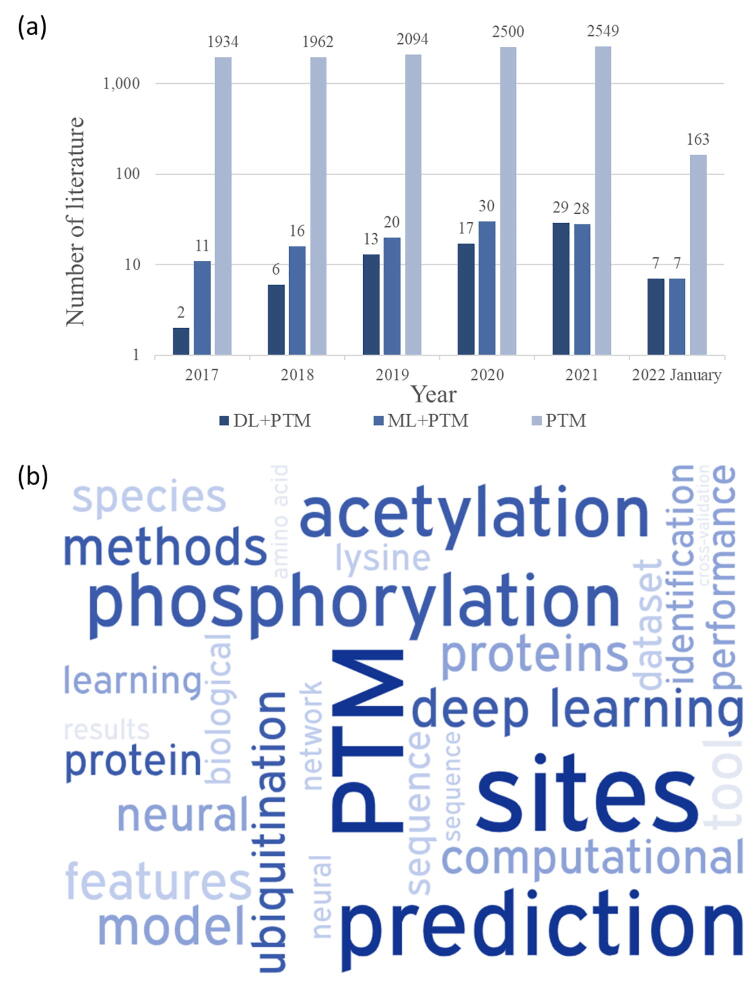
Post-translational modifications (PTMs) are closely linked to numerous diseases, playing a significant role in regulating protein structures, activities, and functions. Therefore, the identification of PTMs is crucial for understanding the mechanisms of cell biology and diseases therapy. Compared to traditional machine learning methods, the deep learning approaches for PTM prediction provide accurate and rapid screening, guiding the downstream wet experiments to leverage the screened information for focused studies. In this paper, we reviewed the recent works in deep learning to identify phosphorylation, acetylation, ubiquitination, and other PTM types. In addition, we summarized PTM databases and discussed future directions with critical insights.
翻译后修饰(PTMs)与多种疾病密切相关,在调节蛋白质结构、活性和功能方面发挥着重要作用。因此,鉴定PTMs对于理解细胞生物学机制和疾病治疗至关重要。与传统机器学习方法相比,用于PTM预测的深度学习方法可提供准确且快速的筛选,指导下游湿实验利用筛选出的信息进行针对性研究。在本文中,我们回顾了深度学习在鉴定磷酸化、乙酰化、泛素化及其他PTM类型方面的最新研究成果。此外,我们总结了PTM数据库,并探讨了具有重要见解的未来发展方向。