Behavioral Disease Research Center, Kermanshah University of Medical Sciences, Kermanshah, Iran.
Department of Health Education and Promotion, Research Center for Environmental Determinants of Health, School of Health, Kermanshah University of Medical Sciences, Kermanshah, Iran.
BMC Public Health. 2022 Jul 22;22(1):1401. doi: 10.1186/s12889-022-13444-x.
Elevated blood pressure is associated with cardiovascular disease, stroke and chronic kidney disease. In this study, we examined the socioeconomic inequality and its related factors in prevalence, Awareness, Treatment and Control (ATC) of hypertension (HTN) in Iran.
The study used data from the recruitment phase of The Prospective Epidemiological Research Studies in IrAN (PERSIAN). A sample of 162,842 adults aged > = 35 years was analyzed. HTN was defined according to the Joint National Committee)JNC-7(. socioeconomic inequality was measured using concentration index (Cn) and curve.
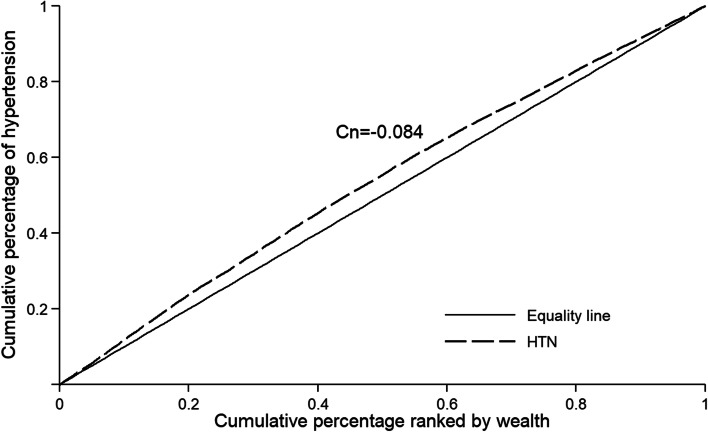
The mean age of participants was 49.38(SD = ± 9.14) years and 44.74% of the them were men. The prevalence of HTN in the total population was 22.3%(95% CI: 20.6%; 24.1%), and 18.8%(95% CI: 16.8%; 20.9%) and 25.2%(95% CI: 24.2%; 27.7%) in men and women, respectively. The percentage of awareness treatment and control among individuals with HTN were 77.5%(95% CI: 73.3%; 81.8%), 82.2%(95% CI: 70.2%; 81.6%) and 75.9%(95% CI: 70.2%; 81.6%), respectively. The Cn for prevalence of HTN was -0.084. Two factors, age (58.46%) and wealth (32.40%), contributed most to the socioeconomic inequality in the prevalence of HTN.
The prevalence of HTN was higher among low-SES individuals, who also showed higher levels of awareness. However, treatment and control of HTN were more concentrated among those who had higher levels of SES, indicating that people at a higher risk of adverse event related to HTN (the low SES individuals) are not benefiting from the advantage of treatment and control of HTN. Such a gap between diagnosis (prevalence) and control (treatment and control) of HTN needs to be addressed by public health policymakers.
高血压与心血管疾病、中风和慢性肾病有关。本研究旨在探讨伊朗高血压(HTN)的流行、知晓、治疗和控制(ATC)的社会经济不平等及其相关因素。
本研究使用了来自伊朗前瞻性流行病学研究(PERSIAN)招募阶段的数据。对 162842 名年龄大于等于 35 岁的成年人进行了分析。HTN 根据联合国家委员会(JNC-7)定义。社会经济不平等用集中指数(Cn)和曲线来衡量。
参与者的平均年龄为 49.38(SD=±9.14)岁,其中 44.74%为男性。总人群中 HTN 的患病率为 22.3%(95%CI:20.6%;24.1%),男性和女性分别为 18.8%(95%CI:16.8%;20.9%)和 25.2%(95%CI:24.2%;27.7%)。HTN 患者的知晓率、治疗率和控制率分别为 77.5%(95%CI:73.3%;81.8%)、82.2%(95%CI:70.2%;81.6%)和 75.9%(95%CI:70.2%;81.6%)。HTN 患病率的 Cn 值为-0.084。年龄(58.46%)和财富(32.40%)是导致 HTN 社会经济不平等的两个主要因素。
社会经济地位较低的人群中 HTN 的患病率较高,而他们的知晓率也较高。然而,HTN 的治疗和控制在社会经济地位较高的人群中更为集中,这表明那些患与 HTN 相关不良事件风险较高的人群(即社会经济地位较低的人群)并没有从 HTN 的治疗和控制中受益。HTN 的诊断(患病率)和控制(治疗和控制)之间的这种差距需要由公共卫生政策制定者来解决。