Banks Christopher J, Colman Ewan, Doherty Thomas, Tearne Oliver, Arnold Mark, Atkins Katherine E, Balaz Daniel, Beaunée Gaël, Bessell Paul R, Enright Jessica, Kleczkowski Adam, Rossi Gianluigi, Ruget Anne-Sophie, Kao Rowland R
Roslin Institute, University of Edinburgh, Edinburgh, EH25 9RG, UK.
Mathematics & Statistics, University of Strathclyde, Glasgow, G1 1XH, UK.
Wellcome Open Res. 2022 May 26;7:161. doi: 10.12688/wellcomeopenres.17716.1. eCollection 2022.
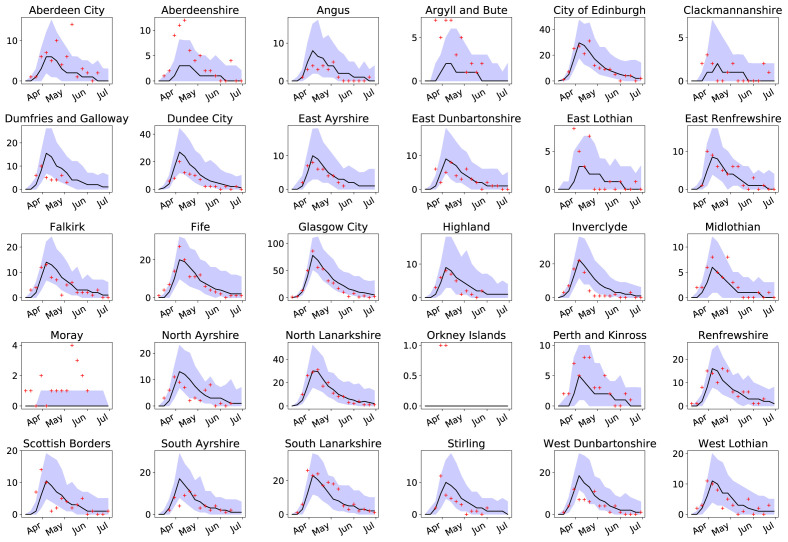
: Mobility restrictions prevent the spread of infections to disease-free areas, and early in the coronavirus disease 2019 (COVID-19) pandemic, most countries imposed severe restrictions on mobility as soon as it was clear that containment of local outbreaks was insufficient to control spread. These restrictions have adverse impacts on the economy and other aspects of human health, and it is important to quantify their impact for evaluating their future value. : Here we develop Scotland Coronavirus transmission Model (SCoVMod), a model for COVID-19 in Scotland, which presents unusual challenges because of its diverse geography and population conditions. Our fitted model captures spatio-temporal patterns of mortality in the first phase of the epidemic to a fine geographical scale. : We find that lockdown restrictions reduced transmission rates down to an estimated 12% of its pre-lockdown rate. We show that, while the timing of COVID-19 restrictions influences the role of the transmission rate on the number of COVID-related deaths, early reduction in long distance movements does not. However, poor health associated with deprivation has a considerable association with mortality; the Council Area (CA) with the greatest health-related deprivation was found to have a mortality rate 2.45 times greater than the CA with the lowest health-related deprivation considering all deaths occurring outside of carehomes. : We find that in even an early epidemic with poor case ascertainment, a useful spatially explicit model can be fit with meaningful parameters based on the spatio-temporal distribution of death counts. Our simple approach is useful to strategically examine trade-offs between travel related restrictions and physical distancing, and the effect of deprivation-related factors on outcomes.
行动限制可防止感染传播至无病地区,在2019冠状病毒病(COVID-19)大流行初期,一旦明确仅靠控制本地疫情不足以控制传播,大多数国家就立即对人员流动实施了严格限制。这些限制对经济和人类健康的其他方面产生了不利影响,量化其影响对于评估其未来价值很重要。在此,我们开发了苏格兰冠状病毒传播模型(SCoVMod),这是一个针对苏格兰COVID-19的模型,由于其地理和人口条件多样,该模型面临着不同寻常的挑战。我们拟合的模型在精细地理尺度上捕捉了疫情第一阶段死亡率的时空模式。我们发现,封锁限制将传播率降低至估计的封锁前水平的12%。我们表明,虽然COVID-19限制措施的实施时间会影响传播率对COVID相关死亡人数的作用,但长途移动的早期减少则不会。然而,与贫困相关的健康状况不佳与死亡率有相当大的关联;考虑到所有发生在养老院之外的死亡情况,发现与健康相关贫困程度最高的议会区(CA)的死亡率是与健康相关贫困程度最低的CA的2.45倍。我们发现,即使在早期疫情中病例确诊情况不佳,也可以根据死亡人数的时空分布,用有意义的参数拟合出一个有用的空间明确模型。我们的简单方法有助于从战略上审视与旅行相关的限制措施和保持社交距离之间的权衡,以及贫困相关因素对结果的影响。