Varughese Lisa A, Bhupathiraju Madhuri, Hoffecker Glenda, Terek Shannon, Harr Margaret, Hakonarson Hakon, Cambareri Christine, Marini Jessica, Landgraf Jeffrey, Chen Jinbo, Kanter Genevieve, Lau-Min Kelsey S, Massa Ryan C, Damjanov Nevena, Reddy Nandi J, Oyer Randall A, Teitelbaum Ursina R, Tuteja Sony
Division of Translational Medicine and Human Genetics, Department of Medicine, Perelman School of Medicine, University of Pennsylvania, Philadelphia, PA, United States.
Center for Applied Genomics, The Children's Hospital of Philadelphia, Philadelphia, PA, United States.
Front Oncol. 2022 Jul 5;12:859846. doi: 10.3389/fonc.2022.859846. eCollection 2022.
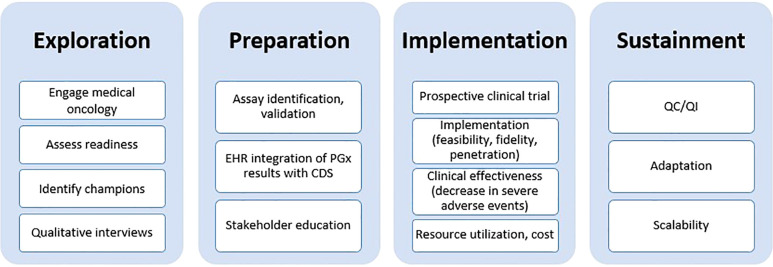
Fluoropyrimidines (fluorouracil [5-FU], capecitabine) and irinotecan are commonly prescribed chemotherapy agents for gastrointestinal (GI) malignancies. Pharmacogenetic (PGx) testing for germline and variants associated with reduced enzyme activity holds the potential to identify patients at high risk for severe chemotherapy-induced toxicity. Slow adoption of PGx testing in routine clinical care is due to implementation barriers, including long test turnaround times, lack of integration in the electronic health record (EHR), and ambiguity in test cost coverage. We sought to establish PGx testing in our health system following the Exploration, Preparation, Implementation, Sustainment (EPIS) framework as a guide. Our implementation study aims to address barriers to PGx testing.
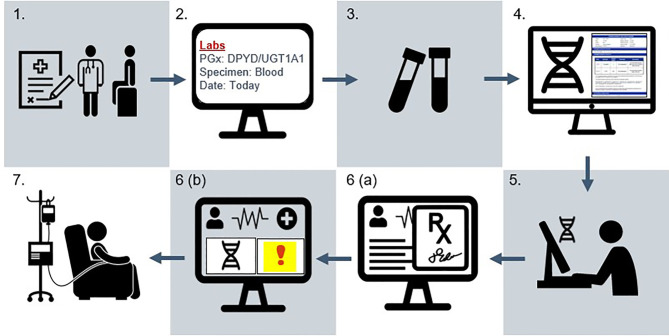
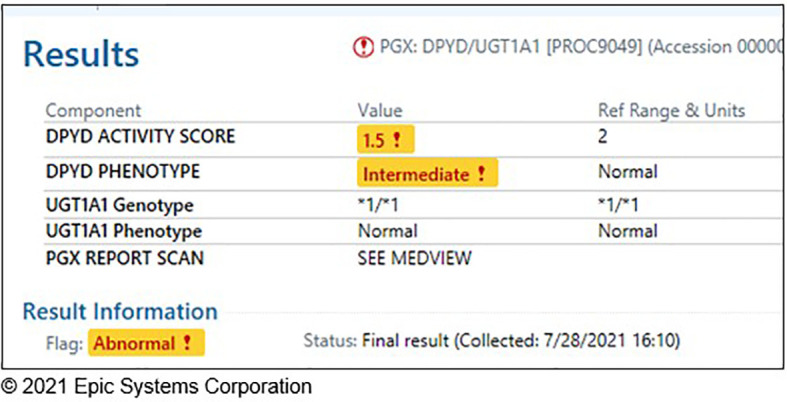
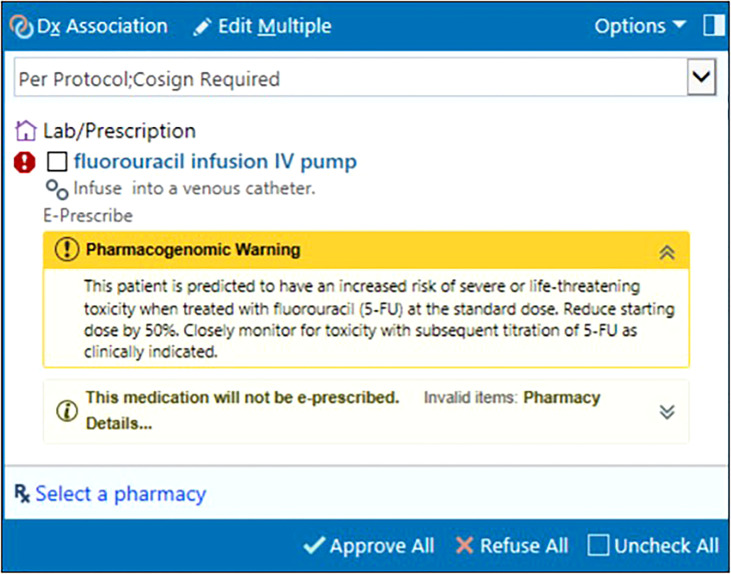
The Implementing Pharmacogenetic Testing in Gastrointestinal Cancers (IMPACT-GI) study is a non-randomized, pragmatic, open-label implementation study at three sites within a major academic health system. Eligible patients with a GI malignancy indicated for treatment with 5-FU, capecitabine, or irinotecan will undergo PGx testing prior to chemotherapy initiation. Specimens will be sent to an academic clinical laboratory followed by return of results in the EHR with appropriate clinical decision support for the care team. We hypothesize that the availability of a rapid turnaround PGx test with specific dosing recommendations will increase PGx test utilization to guide pharmacotherapy decisions and improve patient safety outcomes. Primary implementation endpoints are feasibility, fidelity, and penetrance. Exploratory analyses for clinical effectiveness of genotyping will include assessing grade ≥3 treatment-related toxicity using available clinical data, patient-reported outcomes, and quality of life measures.
We describe the formative work conducted to prepare our health system for and testing. Our prospective implementation study will evaluate the clinical implementation of this testing program and create the infrastructure necessary to ensure sustainability of PGx testing in our health system. The results of this study may help other institutions interested in implementing PGx testing in oncology care.
https://clinicaltrials.gov/ct2/show/NCT04736472, identifier [NCT04736472].
氟嘧啶(氟尿嘧啶[5-FU]、卡培他滨)和伊立替康是常用于治疗胃肠道(GI)恶性肿瘤的化疗药物。对与酶活性降低相关的种系和变体进行药物遗传学(PGx)检测,有可能识别出有严重化疗诱导毒性高风险的患者。PGx检测在常规临床护理中采用缓慢,原因是存在实施障碍,包括检测周转时间长、电子健康记录(EHR)中缺乏整合以及检测费用覆盖不明确。我们试图以探索、准备、实施、维持(EPIS)框架为指导,在我们的医疗系统中建立PGx检测。我们的实施研究旨在解决PGx检测的障碍。
胃肠道癌症药物遗传学检测实施(IMPACT-GI)研究是在一个主要学术医疗系统内的三个地点进行的非随机、务实、开放标签的实施研究。符合条件的、被指示用5-FU、卡培他滨或伊立替康治疗的胃肠道恶性肿瘤患者将在化疗开始前接受PGx检测。样本将被送到一个学术临床实验室,随后在EHR中返回结果,并为护理团队提供适当的临床决策支持。我们假设,提供具有特定给药建议的快速周转PGx检测将提高PGx检测的利用率,以指导药物治疗决策并改善患者安全结果。主要实施终点是可行性、保真度和普及率。基因分型临床有效性的探索性分析将包括使用可用的临床数据、患者报告的结果和生活质量指标评估≥3级治疗相关毒性。
我们描述了为使我们的医疗系统准备好进行PGx检测而开展的形成性工作。我们的前瞻性实施研究将评估该检测项目的临床实施情况,并创建确保PGx检测在我们的医疗系统中可持续性所需的基础设施。这项研究的结果可能有助于其他有兴趣在肿瘤护理中实施PGx检测的机构。
https://clinicaltrials.gov/ct2/show/NCT04736472,标识符[NCT04736472]。